Rattle
Artwork Details
- Title: Rattle
- Date: ca. 1890
- Geography: Made in Alaska, United States
- Culture: Tlingit, Native American
- Medium: Copper, wood, tanned leather, abalone shell, and horn
- Dimensions: 10 × 5 1/2 × 3 1/2 in. (25.4 × 14 × 8.9 cm)
- Credit Line: The Charles and Valerie Diker Collection of Native American Art, Gift of Charles and Valerie Diker, 2021
- Object Number: 2021.434.25
- Curatorial Department: The American Wing
Audio
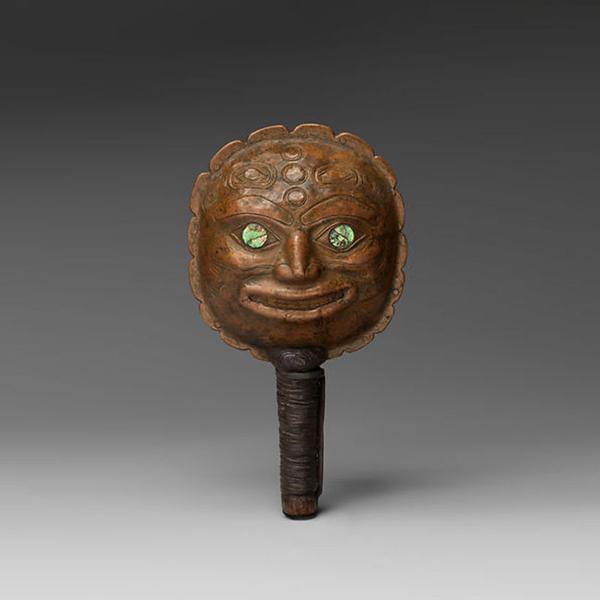
9808: Rattle, Tlingit Artist
TANTOO: Among the Tlingit people of the Pacific Northwest, community healers use dance, song, and sound as medicine to help maintain good health or restore balance for an individual or community. During these practices, a healer might use a rattle similar to this 19th-century example.
Patricia Marroquin Norby, Associate Curator of Native American Art at The Met:
NORBY: This particular rattle is made from copper… In addition to the copper, you can see the abalone shell eyes.
TANTOO: The shell of the abalone—a type of marine mollusk—is also known as mother-of-pearl.
NORBY: Any time you see shells or metal nails or something shiny that are used for eyes, it’s to activate or get a more lively presence to the facial images.
TANTOO: The color-shifting nature of the iridescent abalone shell may help reinforce the transformational power of this healing instrument and medicinal tool.
However, this type of rattle was traditionally made of wood—not copper like this one.
NORBY: And because of that we know that it was made for sale, for market, during a particular period in the nineteenth century.
TANTOO: Gold had been discovered in the Klondike region of the Yukon in the 1890s, and the Tlingit homelands in present-day Southeast Alaska became a gateway to the Klondike Goldrush.
NORBY: There was a large influx of non-indigenous people to this Klondike region. And it then created a market boom for Tlingit items. And that’s when they started creating rattles like this one out of copper, so that they can make them more quickly and more efficiently for sale to help sustain the community.
TANTOO: Creating items specifically for the tourist or collectors’ market is an economic adaptation that has helped many Native communities survive.
[MUSIC]
More Artwork
Related Content
Research Resources
The Met provides unparalleled resources for research and welcomes an international community of students and scholars. The Met's Open Access API is where creators and researchers can connect to the The Met collection. Open Access data and public domain images are available for unrestricted commercial and noncommercial use without permission or fee.
To request images under copyright and other restrictions, please use this Image Request form.
Feedback
We continue to research and examine historical and cultural context for objects in The Met collection. If you have comments or questions about this object record, please contact us using the form below. The Museum looks forward to receiving your comments.
Content Notice
The Metropolitan Museum of Art presents over 5,000 years of art from around the world, and our online collection reflects ongoing work conducted over the course of our more than 150-year history. You may encounter objects or images that may be inappropriate for some viewers or information that may be outdated.