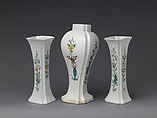
Vase (part of a garniture)
Shortly after the Worcester factory was founded, it purchased another porcelain factory that would profoundly benefit the young enterprise. In 1752, Worcester merged with the Bristol factory, established by Benjamin Lund (British, d. 1768) three years earlier, and it acquired all of Bristol’s equipment, stock, and, most significantly, the lease of Lund’s soapstone mine. The lease made it possible for Worcester to incorporate soapstone in its ceramic body, a practice initiated by Lund at Bristol. The inclusion of soapstone made the soft-paste porcelain more durable, allowing it to tolerate the temperature of boiling water much more readily than the other soft-paste porcelain bodies produced in England at this time. This constituted an enormous advantage, particularly as the custom of tea drinking was rapidly expanding and fueling a demand for porcelain tea wares. In addition, Lund appears to have provided expertise to the Worcester factory for a year after the two concerns merged, and his involvement, in combination with the acquisition of the tangible assets from Lund’s factory, meant that Worcester did not have to endure years of experimentation as was typically the case for new factories.[2] This was particularly important because any porcelain factory founded in England needed to achieve commercial success as quickly as possible. Without the aristocratic patronage that underpinned the porcelain enterprises on the Continent, English factory owners were required to be nimble entrepreneurs, mastering technical challenges, anticipating changes in taste, and supervising a solvent business.
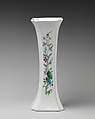
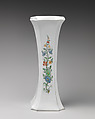
These three vases, which date to the years 1752–53, are among the earliest products of the Worcester factory. Their matched decoration indicates that they almost certainly were made as a garniture, or decorative set of vases, and the larger, middle vase once had a lid, now missing, that would have provided additional visual rhythm to the arrangement.[3] While the painted motifs are different on each panel of the four-sided vases, they are consistently positioned on each of the three vases, indicating the intention that the vases be displayed together. The form of the two beaker vases derives ultimately from archaic Chinese bronzes but through the intermediary of Chinese porcelain, whereas the baluster shape of the central vase was used globally by the mid-eighteenth century, although it, too, had its roots in Chinese porcelain. Both this particular baluster shape and the beaker shape are very rare in Worcester porcelain, and the other known examples of both forms exhibit the same warping in the kiln as do the Museum’s vases (fig. 56).[4] Despite the expertise acquired with the purchase of Lund’s factory, it is clear that Worcester experienced technical challenges at the outset, and it is notable that these vases were decorated even though they had warped in the initial firing.[5]
All four sides of each vase are decorated with floral motifs arranged vertically to skillfully accommodate the format of the panel on which they are painted. Rather than deriving from a specific source, these floral compositions are an amalgam of at least two influences that have been so well integrated that they read as a distinctive type of flower painting. As Simon Spero and John Sandon have pointed out, this manner of floral decoration practiced in the early years of Worcester’s history combines both motifs and palette associated with Chinese famille verte porcelains, in which green enamel is the dominant color, with the Asian-inspired flowers often found on Meissen porcelain from the 1730s that are known as indianische Blumen (Indian flowers).[6] By the later 1750s, this type of flower painting was replaced by a more naturalistic depiction of European flowers, but Asian-inspired motifs and compositions remained popular at Worcester into the 1780s. Several years after this garniture was produced, the factory achieved proficiency in a variety of styles and techniques, which it was able to practice simultaneously, ensuring a success that endured long after most of its competition had gone out of business.
Footnotes
(For key to shortened references see bibliography in Munger, European Porcelain in the Metropolitan Museum of Art. NY: The Metropolitan Museum of Art, 2018)
1 For a history of the Worcester factory during the eighteenth century, see Spero 1984; Spero and Sandon 1996; Spero 2005; Dawson 2007. The author is particularly indebted to Simon Spero for his thorough and insightful research into this factory’s production.
2 Spero 1995, p. 83.
3 Examples of this rare form that retain their lids are in Marshall 1954, p. 129, no. 85, ill. p. 127, pl. 5; Spero 2005, pp. 98–99, no. 20.
4 Dawson 2007, pp. 34–35, no. 4, pp. 38–39, no. 6.
5 Ibid., p. 38.
6 Spero and Sandon 1996, p. 64.
Artwork Details
- Title: Vase (part of a garniture)
- Date: ca. 1752–1753
- Culture: British, Worcester
- Medium: Soft-paste porcelain decorated in polychrome enamels
- Dimensions: confirmed, .32: 10 1/2 × 4 7/8 × 4 1/2 in. (26.7 × 12.4 × 11.4 cm)
- Classification: Ceramics-Porcelain
- Credit Line: Gift of Mrs. Constance D. Stieglitz, in memory of her husband, Marcel H. Stieglitz, 1964
- Object Number: 64.142.32
- Curatorial Department: European Sculpture and Decorative Arts
More Artwork
Research Resources
The Met provides unparalleled resources for research and welcomes an international community of students and scholars. The Met's Open Access API is where creators and researchers can connect to the The Met collection. Open Access data and public domain images are available for unrestricted commercial and noncommercial use without permission or fee.
To request images under copyright and other restrictions, please use this Image Request form.
Feedback
We continue to research and examine historical and cultural context for objects in The Met collection. If you have comments or questions about this object record, please contact us using the form below. The Museum looks forward to receiving your comments.
Content Notice
The Metropolitan Museum of Art presents over 5,000 years of art from around the world, and our online collection reflects ongoing work conducted over the course of our more than 150-year history. You may encounter objects or images that may be inappropriate for some viewers or information that may be outdated.