English
DonateMembershipTickets

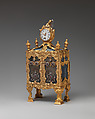
Strongbox with clockwork

This sumptuous-looking strongbox is an extraordinary example of Berlin Rococo style, an interpretation of the rococo that was tailored to the taste of Frederick the Great, King of Prussia (r. 1740–1786). Frederick's name became synonymous with Rococo décor; in his honor, it was later called “Friderizianisches Rococo.” It may have been used to store the King’s seal, which represented the head of state in his absence to validate important contracts. The intricate lock, which has twenty-two sliding bolts requires two keys and secret knowledge to open; the keyhole to initiate the ceremony is hidden underneath the base of one of the soldiers stationed around the top. A collaboration between clockmaker Alexander Fromery and court gunsmith Christian Ludwig von der Fecht, the strongbox is an unparalleled showpiece of both the King’s taste and his artisan’s talent.

Artwork Details

Object Information
  • Title: Strongbox with clockwork
  • Maker: Alexander Fromery (German, 1695–1775)
  • Maker: Christian Ludwig von der Fecht (German, 1710–1753)
  • Date: 1750
  • Culture: German, Berlin
  • Medium: Iron, steel, copper, brass, partially silvered and gilded; glass, red silk velvet
  • Dimensions: confirmed: 21 1/2 × 22 5/8 × 13 7/8 in., 110 lb. (54.6 × 57.5 × 35.2 cm, 49.9 kg)
  • Classifications: Metalwork-Brass, Metalwork-Iron
  • Credit Line: Purchase, Anna-Maria and Stephen Kellen Acquisitions Fund, 2022.
  • Object Number: 2022.366a–d
  • Curatorial Department: European Sculpture and Decorative Arts
More Artwork
St. Maurice (?), Pierre François Basan  French, Engraving
Possibly Pierre François Basan
1743–97
Nécessaire (one of a pair), John Barbot  British, Gold, agate, rubies, diamonds, silver, wood carcass, silk velvet, miror glass; enamel miniature; glass, enamel, topaz; movement: gilded brass, steel, enamel face; shagreen on wood with gold piqué ornament and gilt-brass mounts, British, London
Entrepreneur John Barbot
Enamel miniature of King George IV painted by Charles Muss
After a portrait by Sir Thomas Lawrence
ca. 1760
Old Woman with a Brazier, after Rubens, Pierre François Basan  French, Engraving
Pierre François Basan
After Peter Paul Rubens
18th century
Nécessaire incorporating a watch (one of a pair), John Barbot  British, Gold, agate, rubies, diamonds, silver, wood carcass, silk velvet, mirror glass; glass, enamel, ivory, steel; movement: gilded brass, steel; enamel face, British, London
Entrepreneur John Barbot
ca. 1760
Mary, Queen of Scots, Wilhelm Hermes  German, Lithograph
Publisher Published by Wilhelm Hermes
Sitter Mary, Queen of Scots
19th century

Research Resources

The Met provides unparalleled resources for research and welcomes an international community of students and scholars. The Met's Open Access API is where creators and researchers can connect to the The Met collection. Open Access data and public domain images are available for unrestricted commercial and noncommercial use without permission or fee.

To request images under copyright and other restrictions, please use this Image Request form.

Feedback

We continue to research and examine historical and cultural context for objects in The Met collection. If you have comments or questions about this object record, please contact us using the form below. The Museum looks forward to receiving your comments.

Send feedback

Content Notice

The Metropolitan Museum of Art presents over 5,000 years of art from around the world, and our online collection reflects ongoing work conducted over the course of our more than 150-year history. You may encounter objects or images that may be inappropriate for some viewers or information that may be outdated.