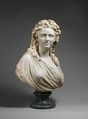
玛尔绪阿斯半身像
Artwork Details
- 标题: 玛尔绪阿斯半身像
- 艺术家: 巴尔塔扎·佩尔莫瑟,德国,1651–1732年
- 创作日期: 约1680–85年
- 材料: 大理石雕像,黑色大理石座,大理石嵌板
- 尺寸: 带座高27英寸(68.6厘米)
- 来源信息: 购买,罗杰斯基金和哈里斯·布里斯班·迪克 基金,2002年
- 藏品编号: 2002.468
- Curatorial Department: European Sculpture and Decorative Arts
Audio
89. Marsyas
Body Language
Edward Vessel: One thing that this piece really illustrates is just how rich our ability to interpret a face is.
Narrator: Edward Vessel is a cognitive neuroscientist. He studies how the brain processes aesthetic responses.
Edward Vessel: The pathways that are involved in recognizing and understanding what it is we're looking at have specialized regions that seem to respond primarily or solely to faces. On the other hand, there are brain regions that seem to be more involved in extracting that emotional meaning from a face. In the case of Marsyas, the emotion that is being conveyed and the facial expressions that are being depicted are so extreme that, even without an explicit act of mimicry, most likely our brains are making an analogy to what it would be like to be making these types of facial expressions ourselves. Marsyas's mouth is formed in this shape that clearly should be accompanied by an intense scream or bellow, and I can't help but almost hear that bellow myself when I look at it.
Yet, on the other hand, you're also responding to this particular sculpture as an art object. It is not a real face. We are only beginning to understand what it is that allows us to appreciate an object in an aesthetic context. If you were to take this object and make it more realistic, at a certain point you might cross a line where people would, in fact, have a reaction that would be true terror.
More Artwork
Related Content
Research Resources
The Met provides unparalleled resources for research and welcomes an international community of students and scholars. The Met's Open Access API is where creators and researchers can connect to the The Met collection. Open Access data and public domain images are available for unrestricted commercial and noncommercial use without permission or fee.
To request images under copyright and other restrictions, please use this Image Request form.
Feedback
We continue to research and examine historical and cultural context for objects in The Met collection. If you have comments or questions about this object record, please contact us using the form below. The Museum looks forward to receiving your comments.
Content Notice
The Metropolitan Museum of Art presents over 5,000 years of art from around the world, and our online collection reflects ongoing work conducted over the course of our more than 150-year history. You may encounter objects or images that may be inappropriate for some viewers or information that may be outdated.