Der Befreite
Artwork Details
- Titel: Der Befreite
- Künstler: John Quincy Adams Ward, Amerikaner, 1830–1910
- Datum: 1863, gegossen 1891
- Medium: Bronze
- Dimensionen: 49,5 x 37,5 x 24,8 cm
- Anerkennung: Schenkung von Charles Anthony Lamb und Barea Lamb Seeley, in Gedenken an ihren Großvater, Charles Rollinson Lamb, 1979
- Akzession Nr.: 1979.394
- Curatorial Department: The American Wing
Audio
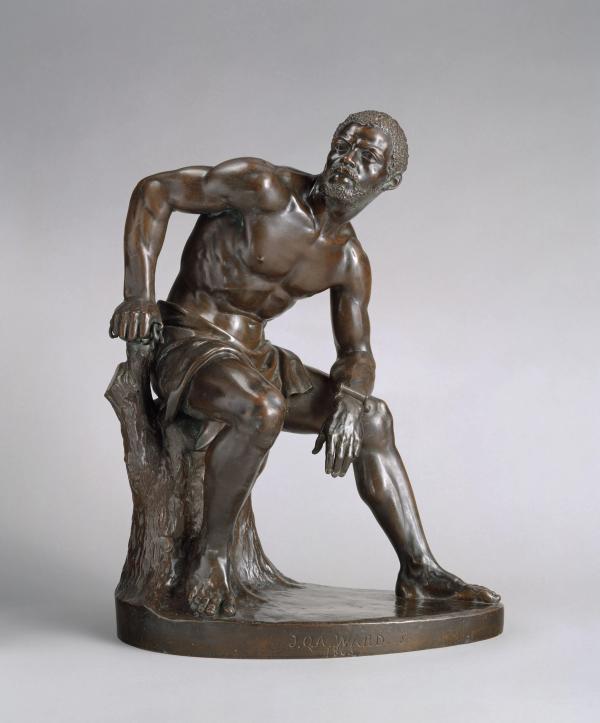
4032. John Quincy Adams Ward, The Freedman, 1863
NARRATOR: When Abraham Lincoln issued the Emancipation Proclamation, it inspired this sculpture of a formerly enslaved Black man holding broken manacles and looking up, toward a new future.
HUGH HAYDEN: I’m struck by his sense of agency, and that he’s somewhat in motion. Is he sitting down, or is he getting up? I think often the museum text will say he's getting up, but I also like the idea that he's sitting down to rest.
NARRATOR: This sculpture inspired artist Hugh Hayden to respond–this time exploring the ongoing resonance of issues concerning enslavement and its legacy.
HUGH HAYDEN: Within my greater body of work, I explore forms and ideas related to inhabiting the American dream, often using wood furniture, whether it’s an Adirondack chair which might denote leisure and rest, or school desks that might suggest education, and upward mobility.
I’ve made another sculpture based off of a 3D scan of this work where it’s the same man except we’ve given him contemporary clothing like cargo shorts and a button up fishing shirt and flip flops, and the stump has been remade as a wooden Adirondack chair. Again is he relaxing, or is he getting up to do something because he has agency?
NARRATOR: For Hayden, to be an artist—whether in the 19th or 21st century—is to explore ideas beyond the depicted moment, with a personal and visceral response.
HUGH HAYDEN: You're not a scientist. You're not a historian. You’re conveying this mixture of history and emotion in a skillful and creative way to represent an idea. Ward is doing that at that time using those ingredients and how they made sense to him, and now I’m remixing that again, making my own recipe to further conversation and dialogue.
Listen to more about this artwork
More Artwork
Related Content

Research Resources
The Met provides unparalleled resources for research and welcomes an international community of students and scholars. The Met's Open Access API is where creators and researchers can connect to the The Met collection. Open Access data and public domain images are available for unrestricted commercial and noncommercial use without permission or fee.
To request images under copyright and other restrictions, please use this Image Request form.
Feedback
We continue to research and examine historical and cultural context for objects in The Met collection. If you have comments or questions about this object record, please contact us using the form below. The Museum looks forward to receiving your comments.
Content Notice
The Metropolitan Museum of Art presents over 5,000 years of art from around the world, and our online collection reflects ongoing work conducted over the course of our more than 150-year history. You may encounter objects or images that may be inappropriate for some viewers or information that may be outdated.