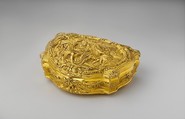
Box
The containers were usually of such luxurious nature that they were the ultimate fashion accessories in eighteenth-century Europe and were frequently given as presents. Beginning in the 1720s and continuing up to the French Revolution, snuff boxes were produced in significant quantities.
According to Denis Diderot and Jean le Rond d’Alembert’s Encycloplédie, published between 1751 and 1772, boxes like this one, made entirely of gold, were referred to as tabatières pleines. The small size of this box suggests that it was a journée or a demi-journée. Holding just sufficient snuff for a day or half a day, the chased decoration of a hound and deer on the lid likely indicates its use whilst hunting.
The making of gold boxes was highly restricted in Paris in the eighteenth century: it is likely that only 20-30 craftsmen would have been engaged in this craft at any one time. The workshops were all in the same neighborhood and work was permitted only in daylight hours in workshops which were in full view of the street.
The production and decoration of the box could involve multiple artists and craftsmen: A goldsmith, an engine turner, a chaser, an enameller, a varnisher, and miniature painter could have contributed to the manufacture of a single box. Their form and decoration evolved, reflecting changes in fashion and the development of new techniques.
Snuff was used by women as well as by men. Whereas men carried snuff boxes in a coat or waistcoat pocket, women carried their necessities in a reticule or pochette, a small drawstring bag. The ritual of taking snuff involved balancing the box in one hand, opening its lid, while taking a pinch with the other, thereby establishing the size, shape and weight of the box. The integral hinged lid minimized any spillage and had to fit snugly to keep the contents dry. The absence of apparent solder and the beautifully engineered hinges are evidence of the extraordinary skill of their makers.
The French writer Louis-Sébastien Mercier observed in 1781 that “there are boxes for each season. The one for winter is heavy; that for summer light. There are those who carry this refinement to the extent of changing boxes every day: it is by this distinctive touch that one may recognize the man of taste.”
Daughter of one of the founders of the Weyerhaeuser Timber Company, Catherine D. Wentworth (1865–1948) was an art student and painter who lived in France for over thirty years. She became one of the most important American collectors of eighteenth-century French silver and on her death in 1948 bequeathed part of her significant collection of silver, gold boxes, French furniture and textiles to the Metropolitan Museum.
Artwork Details
- Title: Box
- Date: 1736–38
- Culture: French, Paris
- Medium: Gold
- Dimensions: Overall: 7/8 × 2 1/2 × 1 7/8 in. (2.2 × 6.4 × 4.8 cm)
- Classification: Metalwork-Gold and Platinum
- Credit Line: Bequest of Catherine D. Wentworth, 1948
- Object Number: 48.187.438
- Curatorial Department: European Sculpture and Decorative Arts
More Artwork
Research Resources
The Met provides unparalleled resources for research and welcomes an international community of students and scholars. The Met's Open Access API is where creators and researchers can connect to the The Met collection. Open Access data and public domain images are available for unrestricted commercial and noncommercial use without permission or fee.
To request images under copyright and other restrictions, please use this Image Request form.
Feedback
We continue to research and examine historical and cultural context for objects in The Met collection. If you have comments or questions about this object record, please contact us using the form below. The Museum looks forward to receiving your comments.
Content Notice
The Metropolitan Museum of Art presents over 5,000 years of art from around the world, and our online collection reflects ongoing work conducted over the course of our more than 150-year history. You may encounter objects or images that may be inappropriate for some viewers or information that may be outdated.