Vishnu auf Thron
Artwork Details
- Titel: Vishnu auf Thron
- Zeitraum: Pandya-Dynastie
- Datum: Zweite Hälfte d. 8. Jhds.–frühes 9. Jhd.
- Geografie: Indien, Tamil Nadu
- Medium: Granit
- Dimensionen: H: 2,97 m
- Anerkennung: Neuerwerb, Schenkung der Charles Engelhard Foundation in Gedenken an Charles Engelhard, 1984
- Akzession Nr.: 1984.296
- Curatorial Department: Asian Art
Audio
7950. Seated Four-Armed Vishnu, Part 1
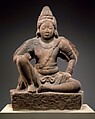
This colossal seated figure of the god Vishnu towers more than nine feet tall. It is surely one of the largest Indian sculptures outside of India. Vishnu wears a cylindrical crown, or miter. Royal lions support the base of his throne. His left foot rests on a double lotus blossom. His missing arms and hands would have held the traditional martial attributes of Vishnu: a mace, conch shell, and war discus, or chakra.
The sculptures in earlier galleries all came from north India. This image is from the southern tip of India: an area never influenced by Gupta-period traditions. The relaxed pose and broad, plain surfaces are typical of the monumental Hindu sculptures carved from the sixth to the tenth centuries, under the Pandya dynasty. Many Pandya figures were carved directly into cliffs and other natural rock formations. Nearby you’ll see another Pandya-dynasty sculpture from the same period. Most Hindu gods rode upon animal vehicles. This seated figure had the wings of a bird—the tips have been broken off. This is Garuda: a mythological creature, half-man, half-bird, who transported Vishnu through the air.
If you haven't already, and you'd like to learn more about Hinduism, press play.
Listen to more about this artwork
More Artwork
Related Content

Research Resources
The Met provides unparalleled resources for research and welcomes an international community of students and scholars. The Met's Open Access API is where creators and researchers can connect to the The Met collection. Open Access data and public domain images are available for unrestricted commercial and noncommercial use without permission or fee.
To request images under copyright and other restrictions, please use this Image Request form.
Feedback
We continue to research and examine historical and cultural context for objects in The Met collection. If you have comments or questions about this object record, please contact us using the form below. The Museum looks forward to receiving your comments.
Content Notice
The Metropolitan Museum of Art presents over 5,000 years of art from around the world, and our online collection reflects ongoing work conducted over the course of our more than 150-year history. You may encounter objects or images that may be inappropriate for some viewers or information that may be outdated.