Guan Yu
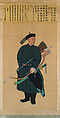
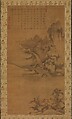
The painting, which comes from a set of religious images used in “water and land” (shuilu) rituals, is distinguished by its high level of craftsmanship, intricate detail, and lavish use of mineral pigments. An inscription in the lower right, “Respectfully commissioned by the imperial prince Zhuang,” shows that the painting was the product of the imperial workshop. Judging from its style, it was probably commissioned by the first holder of that title, the powerful Manchu prince Boggodo (1650–1723), whose grandfather Abahai (1592–1643), was the Qing dynasty founder.
Artwork Details
- 清 佚名 監門關聖帝君圖 軸
- Title: Guan Yu
- Artist: Unidentified artist , ca. 1700
- Period: Qing dynasty (1644–1911)
- Date: ca. 1700
- Culture: China
- Medium: Hanging scroll; ink, color, and gold on silk
- Dimensions: Image: 68 1/8 x 36 7/16 in. (173 x 92.6 cm)
Overall with mounting: 105 1/8 x 48 11/16 in. (267 x 123.7 cm)
Overall with knobs: 105 1/8 x 52 1/2 in. (267 x 133.4 cm) - Classification: Paintings
- Credit Line: Purchase, The B. Y. Lam Fund and Friends of Asian Art Gifts, in honor of Douglas Dillon, 2001
- Object Number: 2001.442
- Curatorial Department: Asian Art
Audio
7585. Emperor Guan
More Artwork
Related Content
 Free to download
Research Resources
The Met provides unparalleled resources for research and welcomes an international community of students and scholars. The Met's Open Access API is where creators and researchers can connect to the The Met collection. Open Access data and public domain images are available for unrestricted commercial and noncommercial use without permission or fee.
To request images under copyright and other restrictions, please use this Image Request form.
Feedback
We continue to research and examine historical and cultural context for objects in The Met collection. If you have comments or questions about this object record, please contact us using the form below. The Museum looks forward to receiving your comments.
Content Notice
The Metropolitan Museum of Art presents over 5,000 years of art from around the world, and our online collection reflects ongoing work conducted over the course of our more than 150-year history. You may encounter objects or images that may be inappropriate for some viewers or information that may be outdated.