Adam
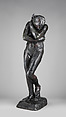
Adam is one of a series of powerful male nudes that established Rodin as a major sculptor in the 1870s and early 1880s. They include The Age of Bronze (Metropolitan Museum of Art) [4] and Saint John the Baptist Preaching (Museum of Modern Art, New York). Of these, Adam offers the clearest homage to Michelangelo, whose marbles, such as the Dying Slave and Rebellious Slave (Accademia, Florence, and Musée du Louvre, Paris), and fresco The Creation of Adam on the Sistine Ceiling in the Vatican, Rodin had passionately admired and studied in Italy before he returned home in 1876. [5] Adam’s extended right forefinger alludes to the awakening gesture in Michelangelo’s painted Creation scene.
This particular sculpture helped to establish Rodin’s reputation in America. The New York investor Thomas Fortune Ryan, who collected works by Rodin as well as Italian Renaissance art, gave several of the French artist’s marbles to the Museum; he also contributed funds to purchase other works by the man generally recognized as the greatest living sculptor. In 1910 one of the foremost American sculptors, Daniel Chester French, who was chairman of the Museum’s Sculpture Committee, visited Rodin’s studio in Meudon with Vice Director Edward Robinson; at that time they commissioned the present work, which is evidently the first bronze cast from a plaster model that Rodin had created several decades before.[6] Two years later, the Museum dedicated a gallery to Rodin’s work, a tribute it has rarely accorded to a living artist; this was an especially noteworthy event since the display preceded the establishment of the Musée Rodin in Paris by four years and the founding of the Museum of Modern Art in New York by seventeen years. In the new gallery, the bronze Adam and Eve were joined by some forty other sculptures and drawings, many of them gifts from the artist himself. Based on this core collection, the Museum has assembled a comprehensive representation of Rodin’s work in all media executed throughout his career. [7]
Footnotes
1. See Elsen 1960, among many other treatments of the subject.
2. Letter in the Archives Nationales, Paris; quoted in ibid., p. 67.
3. The sketch is in the Musée Rodin, Paris (ibid., pl. 42).
4. Acc. no. 07.127.
5. See Rodin and Michelangelo 1997, especially on the cast of Adam in the Rodin Museum, Philadelphia, pp. 124 – 25, no. 20 (entry by Christopher Riopelle).
6. Rodin’s list of works to be supplied to the Metropolitan Museum includes the entry "Adam: Jamais de bronze ou de marbre, à faire, 20,000" (Adam: Never in bronze or marble, to make, 20,000); list dated July 22, 1910, Thomas F. Ryan Correspondence, Office of the Secretary Records, The Metropolitan Museum of Art Archives. The original plaster is now in the Musée Rodin, Paris (Grappe 1927, p. 32, no. 28); another plaster is in the Ny Carlsberg Glyptotek, Copenhagen (Rostrup 1964, p. 138, no. 734a). Other bronze casts are in the Musée Rodin, Paris (Grappe 1927, p. 32, no. 27), in the Rodin Museum, Philadelphia (see note 5 above), and in the Öffentliche Kunstsammlung, Basel (Gantner 1953, p. 26, fig. 11).
7. See Vincent 1981.
Artwork Details
- Title: Adam
- Artist: Auguste Rodin (French, Paris 1840–1917 Meudon)
- Date: modeled 1880 or 1881, cast 1910
- Culture: French, Paris
- Medium: Bronze
- Dimensions: Overall (confirmed): 76 3/8 × 30 3/8 × 32 1/2 in., 831 lb. (194 × 77.2 × 82.6 cm, 376.9 kg)
- Classification: Sculpture-Bronze
- Credit Line: Gift of Thomas F. Ryan, 1910
- Object Number: 11.173.1
- Curatorial Department: European Sculpture and Decorative Arts
Audio
2191. Adam
More Artwork
Related Content
Research Resources
The Met provides unparalleled resources for research and welcomes an international community of students and scholars. The Met's Open Access API is where creators and researchers can connect to the The Met collection. Open Access data and public domain images are available for unrestricted commercial and noncommercial use without permission or fee.
To request images under copyright and other restrictions, please use this Image Request form.
Feedback
We continue to research and examine historical and cultural context for objects in The Met collection. If you have comments or questions about this object record, please contact us using the form below. The Museum looks forward to receiving your comments.
Content Notice
The Metropolitan Museum of Art presents over 5,000 years of art from around the world, and our online collection reflects ongoing work conducted over the course of our more than 150-year history. You may encounter objects or images that may be inappropriate for some viewers or information that may be outdated.