Furniture support: female sphinx with Hathor-style curls
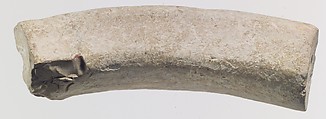
A group of ivories given to the Museum in the 1930s is thought to have come from Acemhöyük because of close similarities in style and subject to those known to have been found there. Ranging in color from white to gray-blue and a pinkish orange, they have been warped and discolored by fire and soil conditions. They were carved to represent the fantastic composite creatures important in the mythology of the ancient Near East. This small female sphinx is a form borrowed from the Egyptians. Her large almond-shaped eyes and spiral locks ultimately derive from the Egyptian goddess Hathor. As with the later ivories from Nimrud, this sphinx, one of four in the Museum, was carved as furniture decoration.
Artwork Details
- Title: Furniture support: female sphinx with Hathor-style curls
- Period: Middle Bronze Age–Old Assyrian Trading Colony
- Date: ca. 18th century BCE
- Geography: Anatolia, probably from Acemhöyük
- Culture: Old Assyrian Trading Colony
- Medium: Ivory (Hippopotamus), gold foil
- Dimensions: 5 3/16 × 1 5/8 × 1 7/8 in. (13.2 × 4.2 × 4.8 cm)
- Credit Line: Gift of George D. Pratt, 1932
- Object Number: 32.161.46
- Curatorial Department: Ancient West Asian Art
Audio
7021. Furniture support: female sphinx with Hathor-style curls, Part 1
Listen to more about this artwork
More Artwork
Related Content

Research Resources
The Met provides unparalleled resources for research and welcomes an international community of students and scholars. The Met's Open Access API is where creators and researchers can connect to the The Met collection. Open Access data and public domain images are available for unrestricted commercial and noncommercial use without permission or fee.
To request images under copyright and other restrictions, please use this Image Request form.
Feedback
We continue to research and examine historical and cultural context for objects in The Met collection. If you have comments or questions about this object record, please contact us using the form below. The Museum looks forward to receiving your comments.
Content Notice
The Metropolitan Museum of Art presents over 5,000 years of art from around the world, and our online collection reflects ongoing work conducted over the course of our more than 150-year history. You may encounter objects or images that may be inappropriate for some viewers or information that may be outdated.