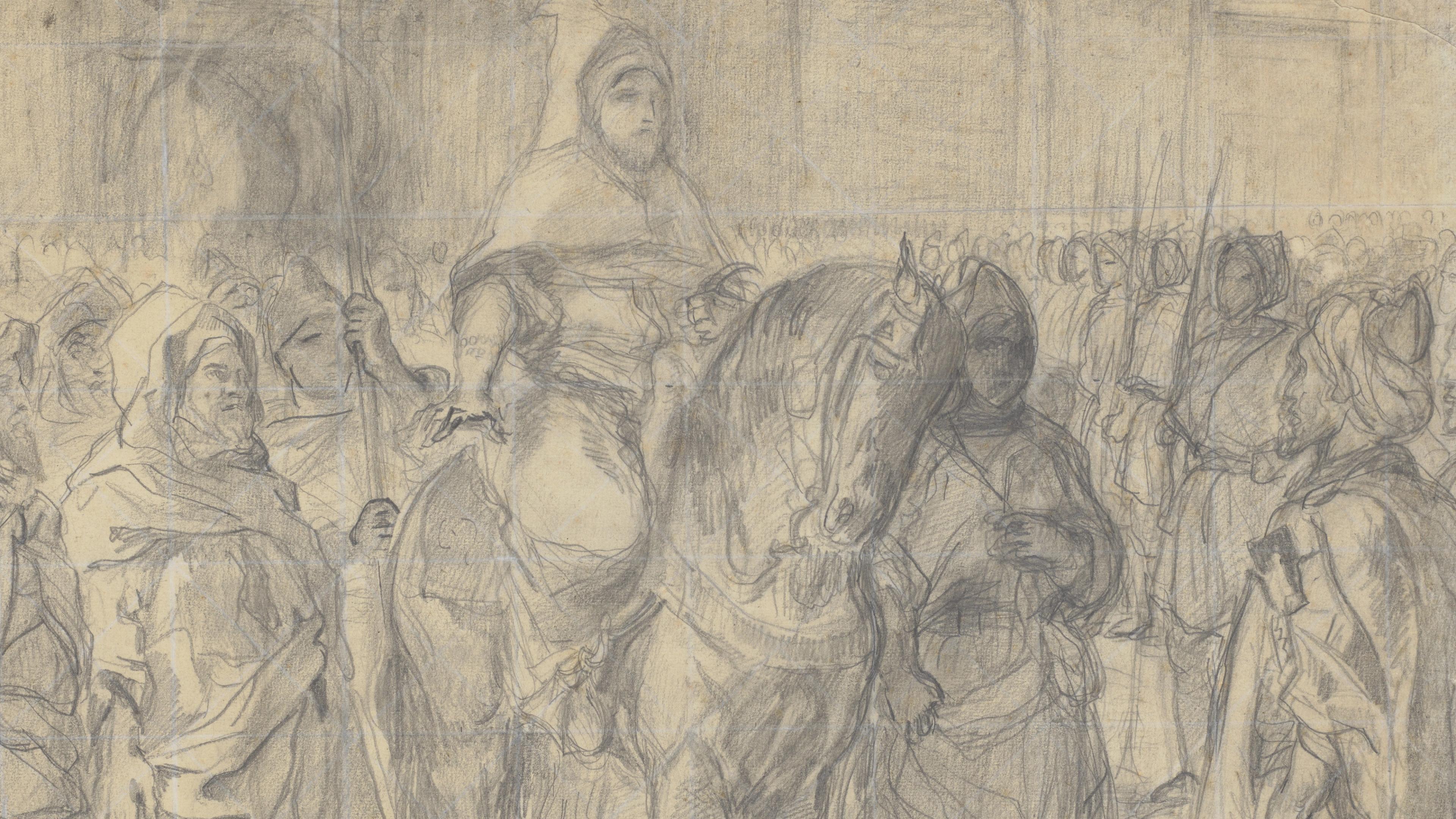
Eugène Delacroix (French, 1798–1863). Study for "The Sultan of Morocco and His Entourage" (detail), 1845. Graphite; squared in white chalk, 23 1/2 x 19 9/16 in. (59.7 x 49.7 cm). The Metropolitan Museum of Art, New York, Rogers Fund, 1961 (61.202)
I'm Nicola López.
For me, learning about artwork and seeing artwork has become less and less about the single piece of work, and maybe more interesting to me is how an artist moves through their practice, how they've grown and changed. That's something that you see when you're looking at works in the drawings gallery, because you often see a real breadth of mediums.
Even if you don't have artistic training, we've all made a mark with a pencil. In some of these sketches you see, you know, a little smudge or something's been kind of moved over, it's been erased and redrawn. And so you're almost responding to these works in a physical way, on a physical level. And so you get that sense of kind of an intimate view into their process and practice and thinking—almost like getting a little glimpse into their studio.
I doubt that Delacroix actually intended to exhibit these sketches as finished works of art, but we get to see what he’s thinking about. The sense of fluidity in that ink, and then you get the weights in those lines: so you get the trial and error, you get the process. And you don't get that same sense out of a painting. It's a different language, and it might allow you a different way into their work.
And I was looking at the Callot print and drawing. And it's the same image, except that in the print it’s flipped, but the ink has this dreamy, kind of fluid quality. You really get the sense of that kind of light dissolving over the landscape. And then that same image, created in etching, is just so hyper-precise.
Every medium has its own personality, and I think that paper is a really sensitive surface. You know, the paper dictates part of what that image is going to look like in the end: the variation in lines, the way that you can really feel depth, or even speed. The speed of the artist's hand is recorded in the paper in a way that not all materials indicate.
And you see how medium contradicts or pushes or questions the subject matter. And part of its content is about how these different layers interact. Through the medium there is definitely something that just cuts across time.
As an artist, to feel as though I can have a conversation with these artists that I really admire, who might have lived hundreds of years ago… But there's still something that makes our work equate.