Dance crest with opposing faces
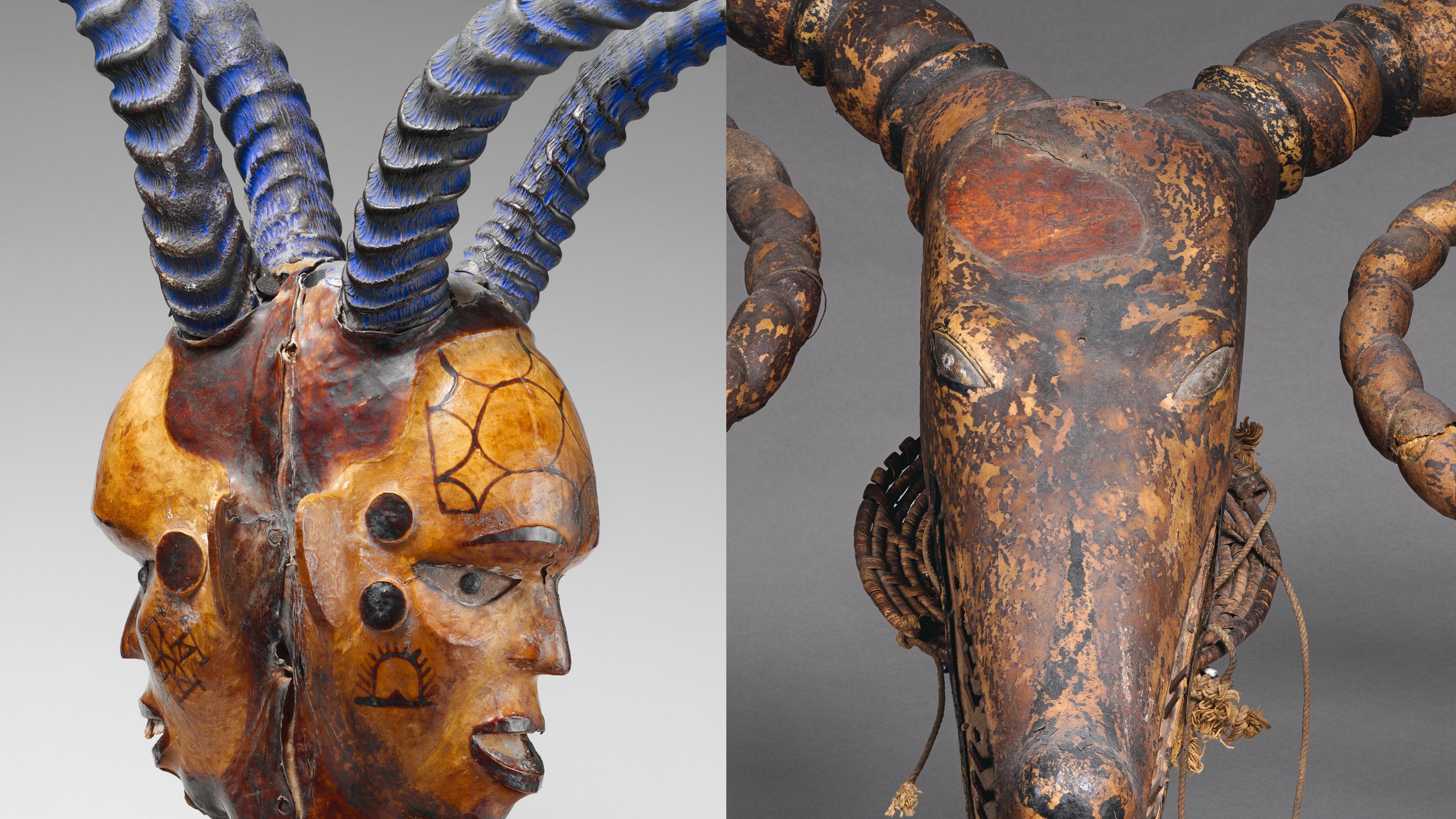
The headdresses, which bear the same name as the society that owns them, are worn during funerals and initiations. Some are startlingly naturalistic and may be portraits of known individuals; others are highly stylized. There are three overall types: helmet masks that cover the wearer's head entirely, masks that cover only the face, and headdresses that, like this one, are attached to basketry caps worn on top of the head.
To make a headdress, the artist carves the form from a single piece of wood and covers it with soft, untanned antelope skin that has been soaked in water for several days. He stretches, binds, and pegs the skin into place until it dries and stiffens. Eyes, scarifications, and hair are often carved separately and pegged into the finished piece. Before it is worn, the headdress is painted or colored, then adorned with porcupine quills, feathers, or feathered rods stuck into holes at the top.
Artwork Details
- Title: Dance crest with opposing faces
- Artist: Ejagham or Bale artist
- Date: 19th–mid-20th century
- Geography: Nigeria, Lower Cross River region
- Culture: Ejagham or Bale peoples
- Medium: Wood, animal hide, pigment, cane, Kobus kob horns, iron, bone or ivory
- Dimensions: H. 20 1/2 × W. 18 5/8 × D. 13 1/4 in. (52.1 × 47.3 × 33.7 cm)
- Classification: Wood-Sculpture
- Credit Line: The Michael C. Rockefeller Memorial Collection, Bequest of Nelson A. Rockefeller, 1979
- Object Number: 1979.206.299
- Curatorial Department: The Michael C. Rockefeller Wing
Audio
988. Kids: Headdress: Janus, Part 1
Listen to more about this artwork
More Artwork
Related Content
 Free to download
Research Resources
The Met provides unparalleled resources for research and welcomes an international community of students and scholars. The Met's Open Access API is where creators and researchers can connect to the The Met collection. Open Access data and public domain images are available for unrestricted commercial and noncommercial use without permission or fee.
To request images under copyright and other restrictions, please use this Image Request form.
Feedback
We continue to research and examine historical and cultural context for objects in The Met collection. If you have comments or questions about this object record, please contact us using the form below. The Museum looks forward to receiving your comments.
Content Notice
The Metropolitan Museum of Art presents over 5,000 years of art from around the world, and our online collection reflects ongoing work conducted over the course of our more than 150-year history. You may encounter objects or images that may be inappropriate for some viewers or information that may be outdated.