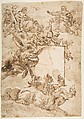
God the Father with Angels Holding Symbols of the Passion
The artist must have produced numerous drawings such as this one in order to think through the illusionism of the enormous dome fresco with its magical effects of light and sharply foreshortened figures (which exhibit a remarkable articulation of detail for such a large painting). There are many differences of design between the finished fresco and this preparatory drawing in which angels hold palm branches, Veronica's veil, and the column of the Flagellation. The subject of the fresco - the Trinity in Glory and the Glorification of Christ's Instruments of the Passion - held special significance in the devotional practices of the Counter-Reformation Saint Philip Neri and the Filippine order, patrons of the Chiesa Nuova. Walter Vitzthum identified pen and chalk drawings by Cortona for the dome in Edinburgh, Vienna, and Paris, while Eckhard Schaar published a study for the figure of God the Father at Düsseldorf (se here 'references'). Nicholas Turner suggested that a pen and ink sketch (private collection, London) is a study for the figures of Abraham, Isaac, and Adam in the dome fresco.
Artwork Details
- Title: God the Father with Angels Holding Symbols of the Passion
- Artist: Pietro da Cortona (Pietro Berrettini) (Italian, Cortona 1596–1669 Rome)
- Date: 1647–51
- Medium: Black chalk
- Dimensions: 18-1/4 x 14-1/4 in. (46.4 x 36.2 cm)
- Classification: Drawings
- Credit Line: Rogers Fund, 1971
- Object Number: 1971.146
- Curatorial Department: Drawings and Prints
More Artwork
Related Content
 Free to download
Research Resources
The Met provides unparalleled resources for research and welcomes an international community of students and scholars. The Met's Open Access API is where creators and researchers can connect to the The Met collection. Open Access data and public domain images are available for unrestricted commercial and noncommercial use without permission or fee.
To request images under copyright and other restrictions, please use this Image Request form.
Feedback
We continue to research and examine historical and cultural context for objects in The Met collection. If you have comments or questions about this object record, please contact us using the form below. The Museum looks forward to receiving your comments.
Content Notice
The Metropolitan Museum of Art presents over 5,000 years of art from around the world, and our online collection reflects ongoing work conducted over the course of our more than 150-year history. You may encounter objects or images that may be inappropriate for some viewers or information that may be outdated.