As with all hybrid creatures, dragons are drawn from natural elements yet compounded in ways that are impossible in nature. Artists across the globe have given form to dragons by combining characteristics and attributes of multiple creatures—principally snakes, crocodiles, and other reptiles—in imaginative ways. Just as they cross species-specific boundaries, they themselves often appear capable of traversing social and conceptual limitations, enacting dramatic interventions in the lives of mortals. Dragons can be fearsome adversaries or steadfast friends, symbols of power and prosperity but also of aggression and destruction. They can also be protective: as snakes never close their eyes, dragons often function as guardians.
In their 1957 Book of Imaginary Beings, a modern riff on the bestiary, a type of text filled with animal, plant, and mineral lore that rose to popularity in twelfth-century Europe, the Argentinian writer Jorge Luis Borges and his coauthor Margarita Guerrero address the appeal of the hybrid, as well as its conceptual uncertainties, through the dragon: “We do not know what the dragon means, just as we do not know the meaning of the universe, but there is something in the image of the dragon that is congenial to man’s imagination, and thus the dragon arises in many latitudes and ages. It is, one might say, a necessary monster.” Here, in conjunction with the exhibition Creatures of Myth and Imagination: Europe and the Americas, we introduce seven necessary dragons currently slithering, crawling, or flying around The Met Cloisters.
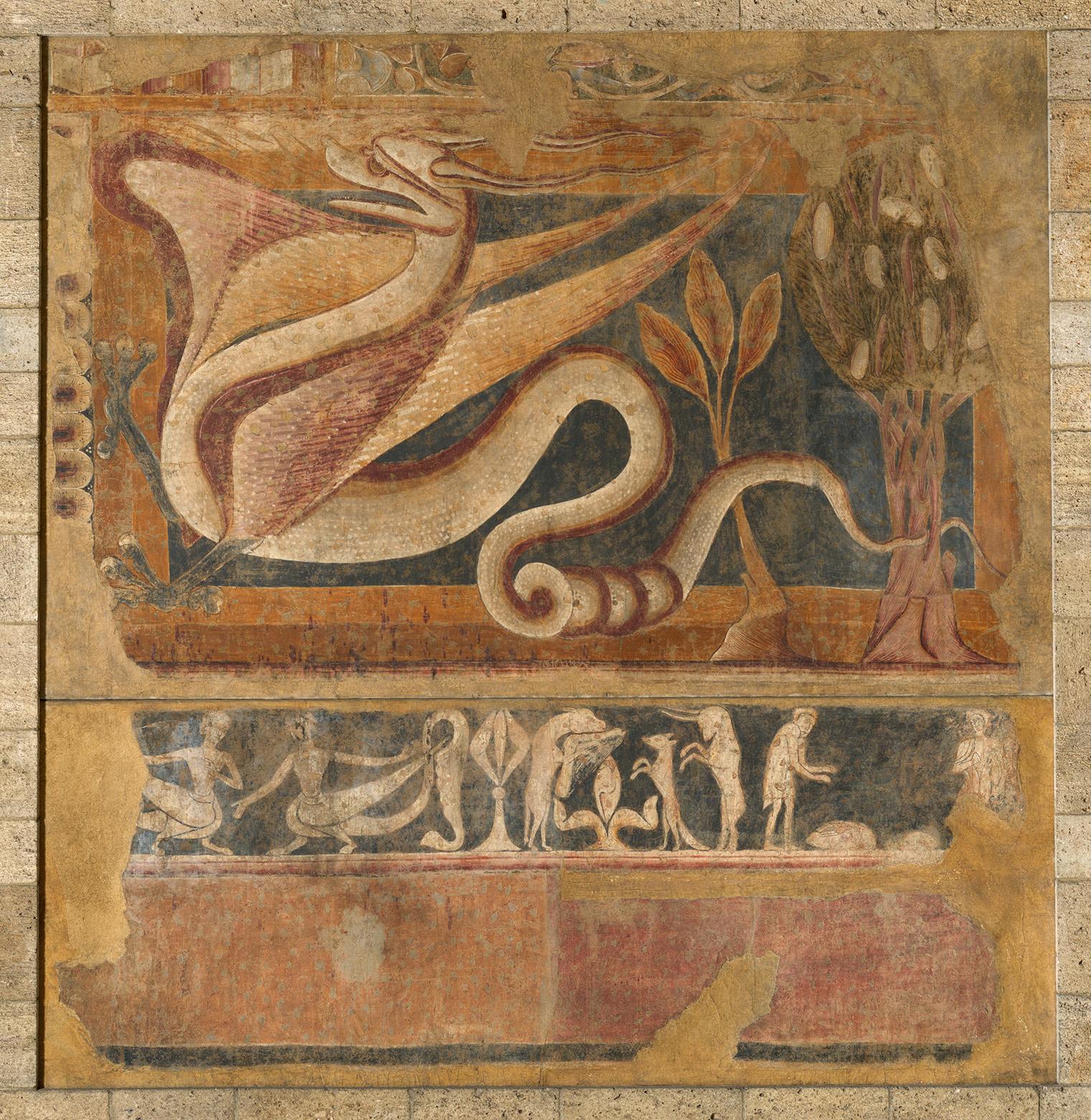
Dragon, after 1200. Spanish. Fresco, mounted on canvas, 10 ft. 11 in. × 11 ft. (332.7 × 335.3 cm). The Metropolitan Museum of Art, New York, The Cloisters Collection, 1931 (31.38.2a, b)
In the bestiary, the dragon is a snake—the largest of all serpents—capable, remarkably, of becoming airborne. A fresco from the Monastery of San Pedro de Arlanza seems to respond to this description in its portrayal of a long, sinuous reptile with wings and avian claws. The dragon’s surprisingly toothless mouth and spiraling tail may underscore the bestiary’s assertion that this beast’s teeth are less harmful than its tail, which strikes and squeezes prey with deadly force. The description is reminiscent of a boa constrictor, but while bestiaries resemble natural histories in some ways, their goal was to provide spiritual edification, with Christian moral teachings infusing descriptions of creatures. As the texts identify the dragon with the Devil, who often takes the guise of a serpent in the Bible, the fresco may present similar symbolism. Alternatively, or in addition, this large-scale image was perhaps meant to dazzle and impress its original viewers, visitors of a large and powerful monastery in northern Spain.
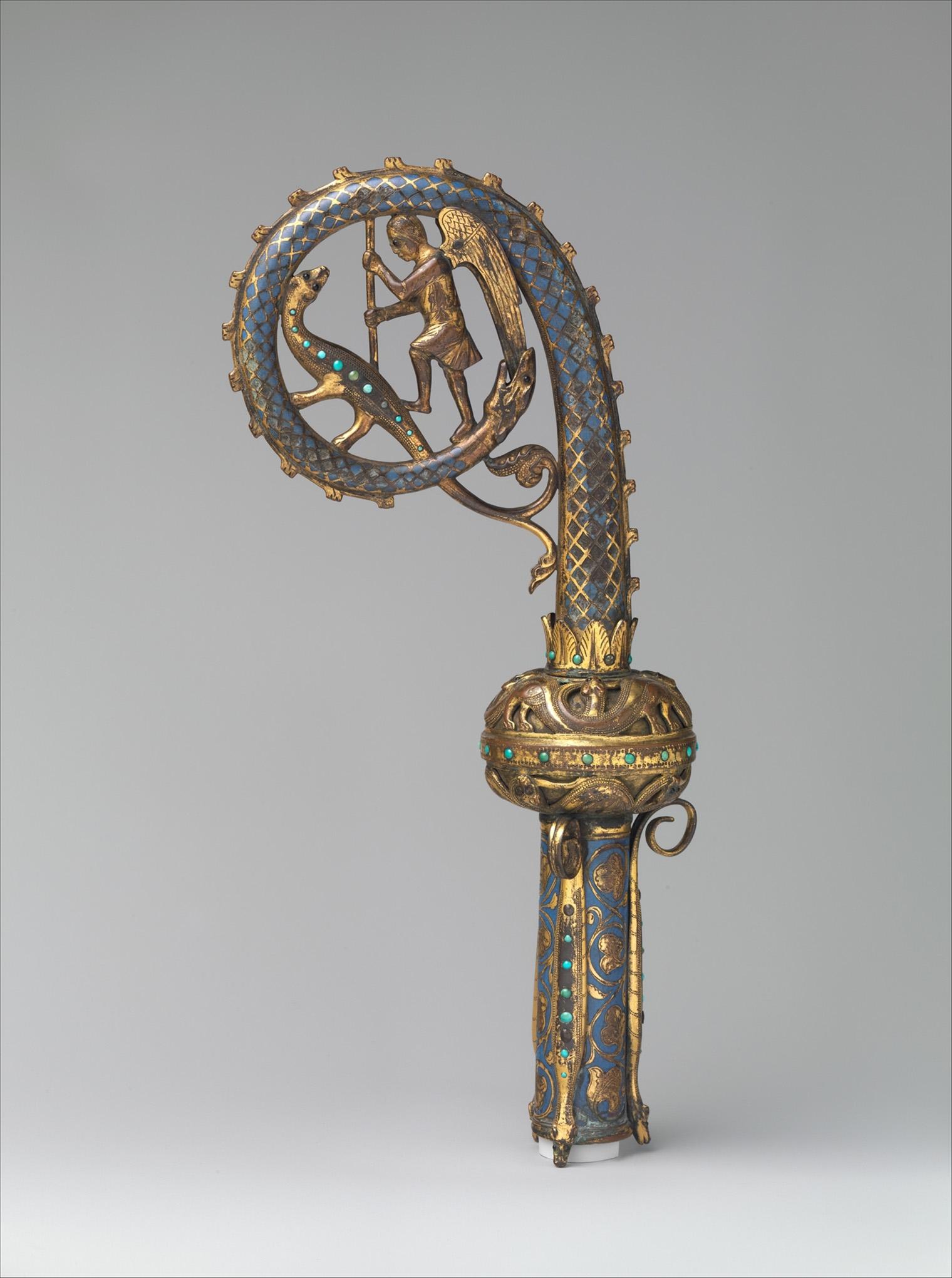
Head of a Crozier with Saint Michael Slaying the Dragon, 1220–30. French. Made in Limoges, France. Champlevé enamel, gilded copper, and glass paste, 12 13/16 × 4 15/16 × 2 3/4 in. (32.5 × 12.5 × 7 cm). The Metropolitan Museum of Art, New York, Gift of J. Pierpont Morgan, 1917 (17.190.834a, b)
The dragon’s association with the Devil, sin, and evil, spelled out in the texts of the bestiary, had fruitful implications for medieval art in all areas. These beasts frequently decorate objects of Christian religious ritual, in which they confront God’s chosen warriors and inevitably meet defeat. This crozier, which originally topped a ceremonial staff made for a church leader, depicts God’s representative, the Archangel Michael, spearing a wingless dragon with a foliate tail. In the Bible’s book of Revelation, Michael triumphs over a fearsome dragon representing the Antichrist, their battle evoking the struggle and eventual triumph of good over evil.
The entire object is teeming with reptilian creatures: the crook is a serpentine dragon trying to devour the archangel, wings first, while two registers of dragons decorate the knop, and snakes with curly tails stretch out along the handle. The decorations underscore the symbolic function of the crozier. Whether wielded by a bishop, abbot, or abbess, the crozier’s depiction of the vanquishing of evil, visualized as a confrontation between otherworldly creatures, alluded to the user’s role as a spiritual and moral guide.
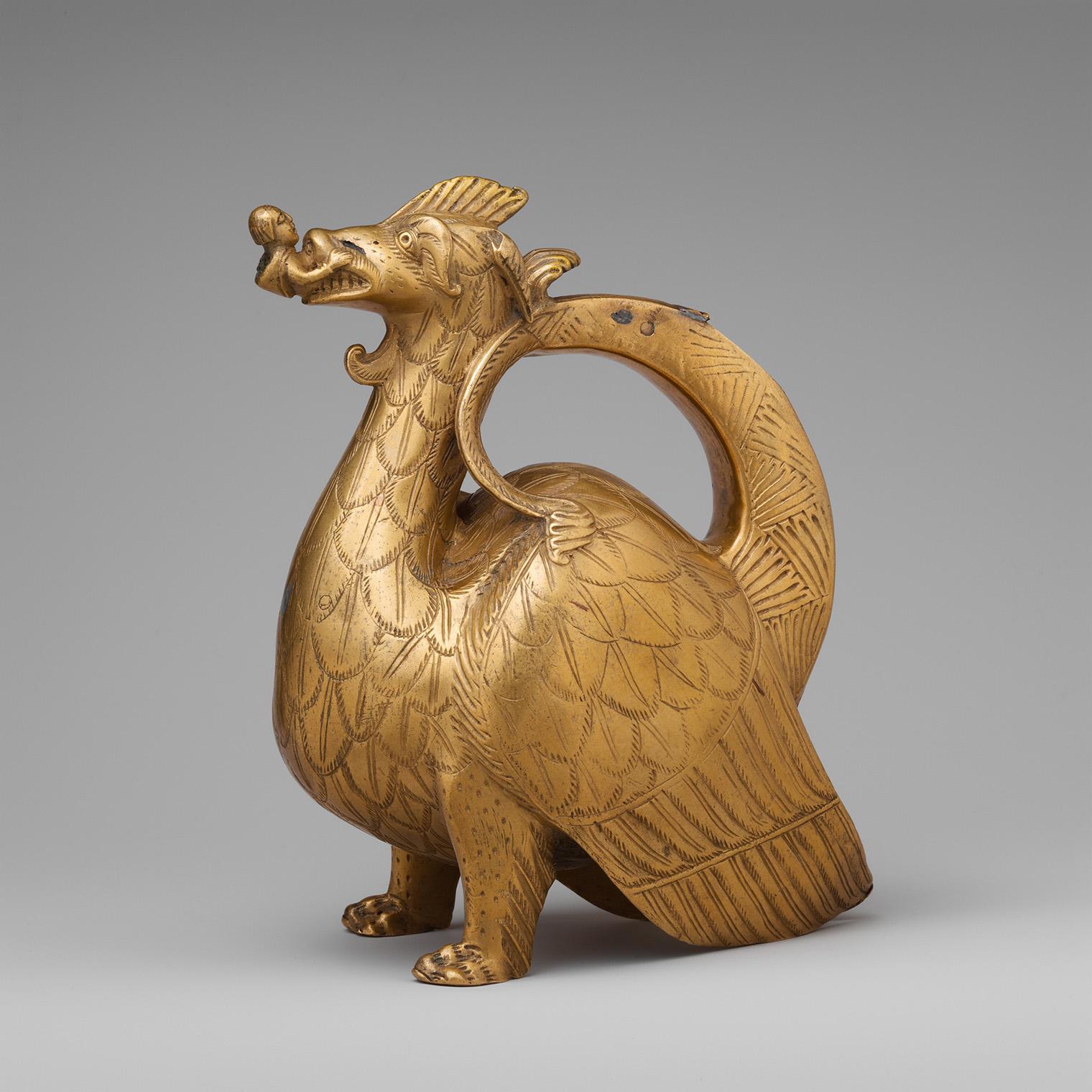
Aquamanile in the Form of a Dragon, ca. 1200. North German. Made in Limoges, France. Copper alloy, 8 3/8 × 7 3/16 × 4 3/8 in., 4.4 lb. (21.3 × 18.3 × 11.1 cm, 2 kg) wall thickness: 1/8 in. (0.3 cm). The Metropolitan Museum of Art, New York, The Cloisters Collection, 1947, (47.101.51)
That dragons were embodiments of deep spiritual concerns in medieval Europe is undeniable, but sometimes this association was interpreted more lightheartedly. This aquamanile is an example of a vessel used for handwashing in various settings, from the altar table to the dinner table. In an ecclesiastic setting, ritual handwashing was an important form of symbolic purification for a celebrant before consecrating the Eucharist. In a domestic setting, handwashing at the table before meals was a practice of refined diners. It is unclear in which context this example, taking the form of a feathered dragon with furry paws, was originally used.
Clamped and half devoured within the beast’s jaws is a diminutive figure, sometimes identified as a monk, whose hood forms the vessel’s spout. If intended to represent a holy or at least ecclesiastic figure, this composition contrasts with the imagery seen on the crozier, as the dragon has the upper hand. The reversal suggests a humorous take on the familiar binary of good versus evil. Alternatively, it may have told a story that did not have a primarily religious basis but was rather of an adventurous nature.
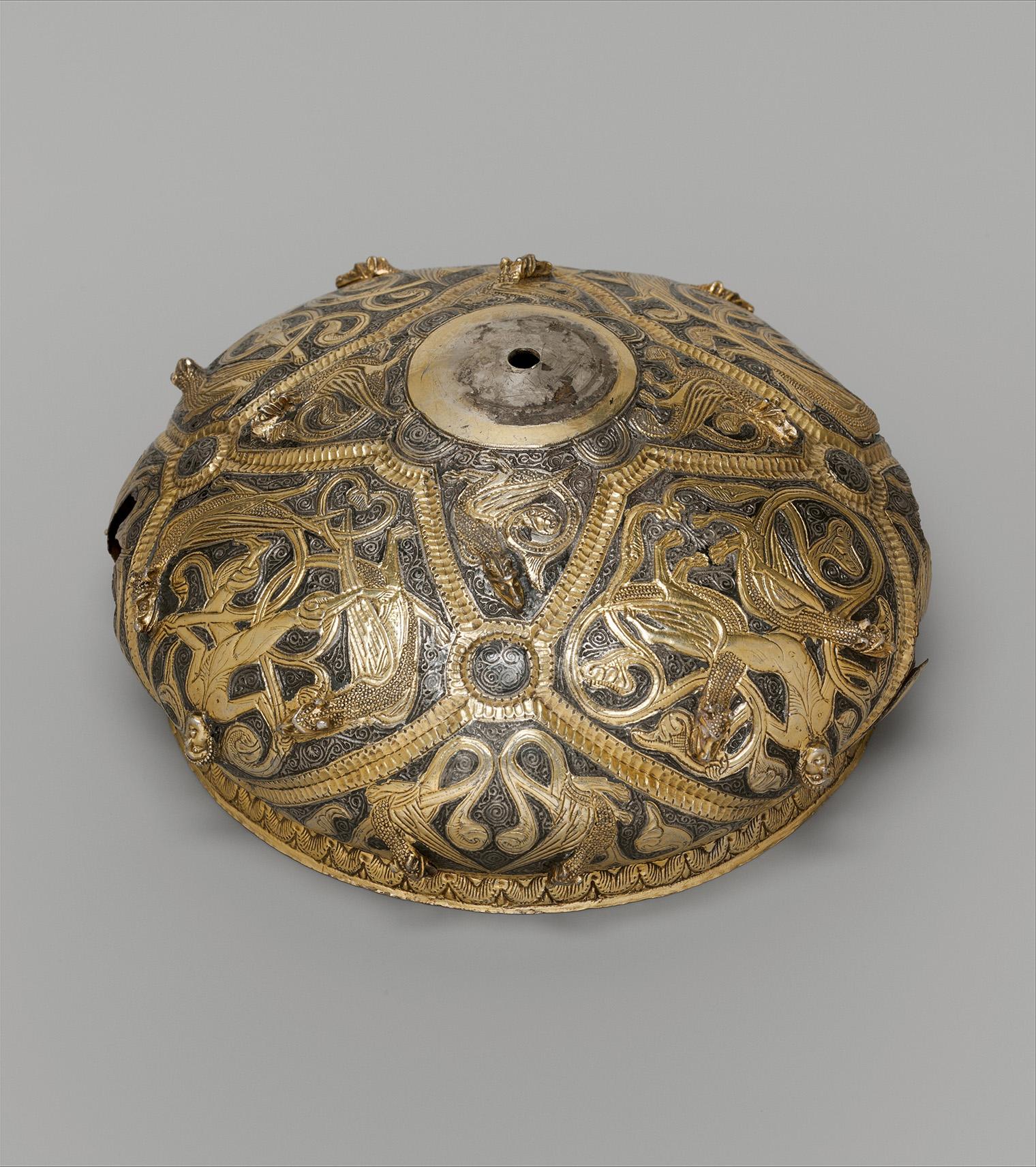
Bowl of a Drinking Cup, late 12th century. British or Scandinavian. Made in England or Scandinavia. Silver, silver gilt, and niello, 6 7/8 × 3 1/8 in. (17.5 × 7.9 cm). The Metropolitan Museum of Art, New York, The Cloisters Collection, 1947, (47.101.31)
Of course, dragons also play prominent roles in medieval tales of saints, travelers, magicians, and warriors, where they are often foils to heroic protagonists. The dragons of adventure stories materialize explicitly or implicitly in objects of status and power, as on this dazzling cup. Covered with dragons large and small, the composition highlights four nude men posed heroically between the intertwined, vine-like tails of two such beasts. To those who drank from it, the cup’s highly textured surface—further enlivened by separately cast and raised heads of dragons and men—must have felt like holding a tangle of writhing creatures. It is possible that this object’s elite original owner wished to assimilate the power of the brave dragon-wranglers, which draws on the ancient motif of the “master of the beasts,” or perhaps of the dragons themselves. Either way, lifting the cup would have displayed its decoration to others, conveying the drinker’s own strength and courage.
An early sixteenth-century French globe indicates unexplored territories with the phrase “here be dragons,” and when we look across the Atlantic Ocean to the Americas, we see that there were, indeed, dragons on this side of the world as well. The most well-known ancient American hybrid creature is Quetzalcoatl, a feathered serpent. Although representations of feathered snakes are known from the many cultures that preceded the rise of the Mexica (also known as Aztecs) in the fourteenth century, we have the benefit of their finely detailed manuscripts to deepen our understanding of this deity associated with the sun, the planet Venus, priesthood, and the arts.
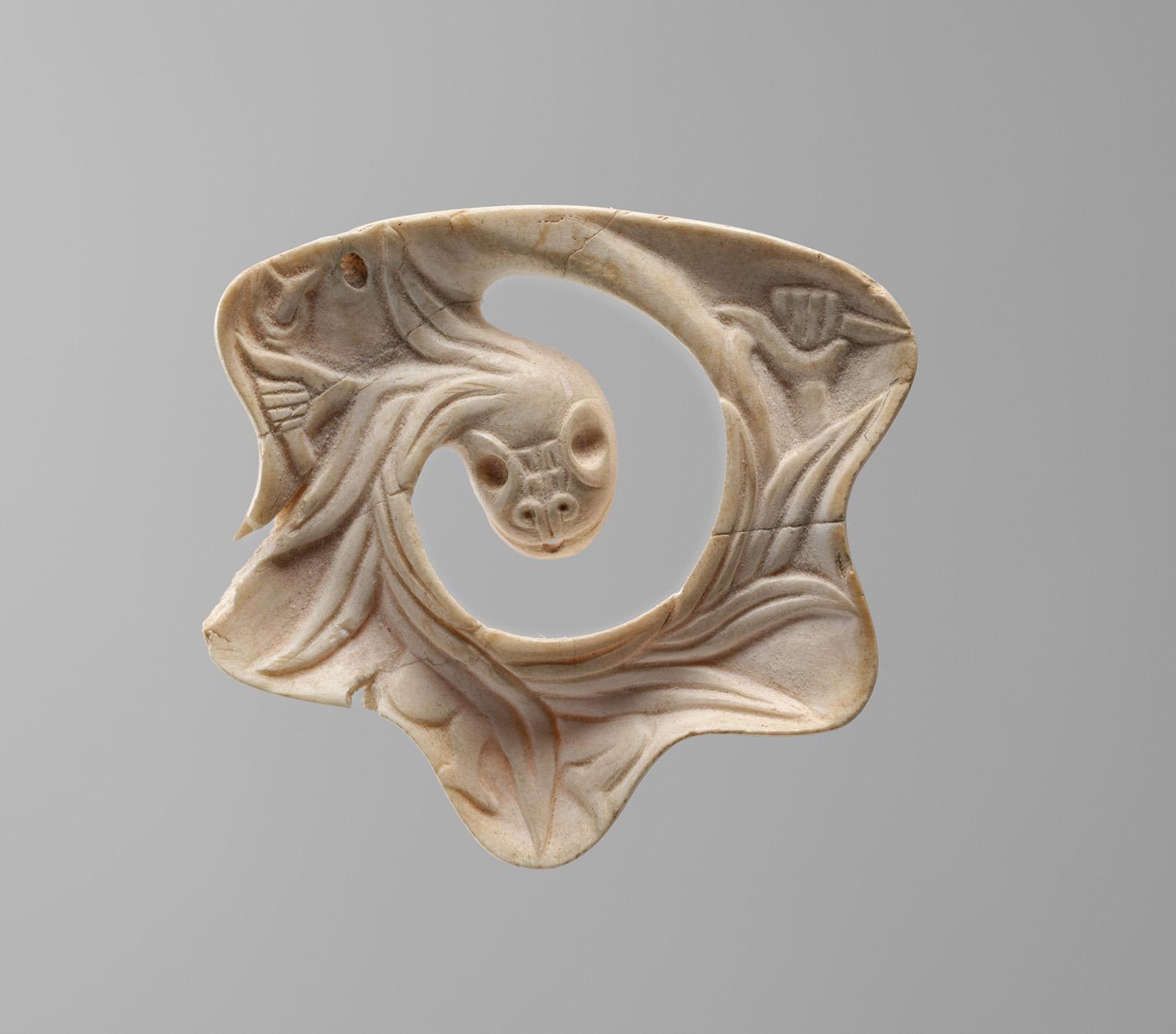
Feathered serpent pendant, 1325–1521 CE. Mexico. Mexica (Aztec). Shell, 6 7/8 × 3 1/8 in. H. 1 5/8 × W. 1 7/8 × D. 1/4 in. (4.1 × 4.8 × 0.6 cm). The Metropolitan Museum of Art, New York, Gift of the Mol Collection, 2020, (2020.386.1)
The deity’s Nahuatl name combines quetzal, a bird known for its luxuriant green plumage, and coatl, the term for a snake. A fine depiction of this plumed deity is incised on the cross-section of a conch shell. Its body is coiled around the central void, while its head, seen in dorsal view with eyes drilled on either side of its feathered snout, extends into the empty space. Quetzalcoatl represents the fusion of the body of a snake—an earthly element—and the long, iridescent green feathers of the quetzal, whose nature is primarily celestial. This duality grants him the ability to move between different levels of the cosmos and to recirculate divine substances from the world of the gods to the realm of humankind.
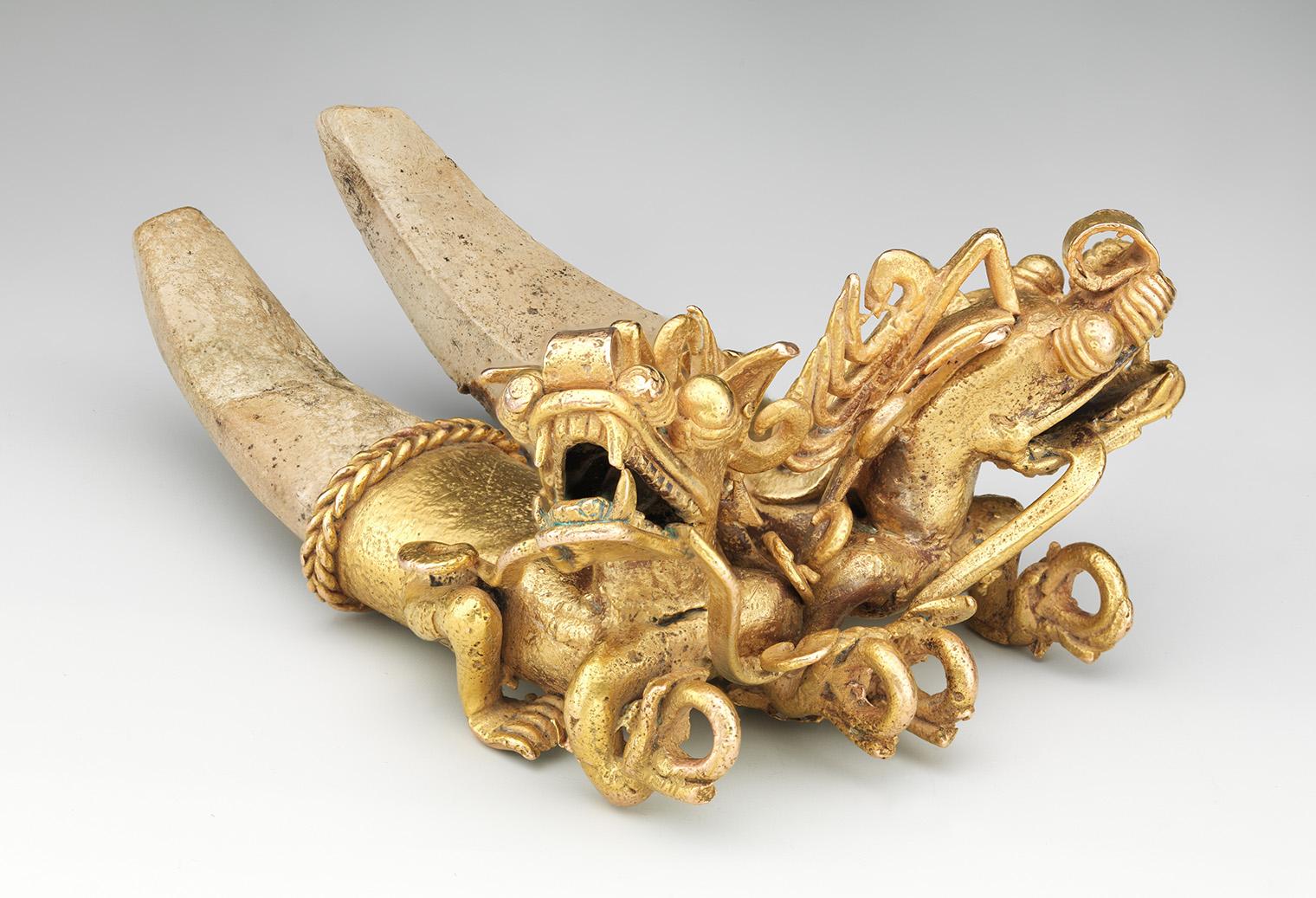
Double crocodile pendant, 950–1100 CE. Panama, Cocle Province, Rio Parita region. Coclé (Macaracas). Gold, shell, H. 3 3/4 × W. 3 × D. 1 1/2 in. (9.5 × 7.6 × 3.8 cm). The Metropolitan Museum of Art, New York, Jan Mitchell and Sons Collection, Gift of Jan Mitchell, 1991, (1991.419.17)
Regions south of Mexico are also rich in composite creatures. We may lack specific names for these beings—there was no written practice in most of Central and South America before the sixteenth century—yet their enigmatic forms display immensely creative amalgamations of reptilian, avian, and other animal forms. The prize for the most ferocious ingredients per square inch surely would go to a pendant made in the region that is now Panama. The ornament’s twined beings display features from an impressive number of animals: the overall body shape is lizard-like or crocodilian; the eyes, nose, and ears evoke a bat; the head crest is reminiscent of an iguana crest or deer antlers; and the tails are made of shell. Ambitious in conception, the beasts’ heads are oriented away from each other, a ribbon-like lead in their jaws hardly containing their aggressive power.
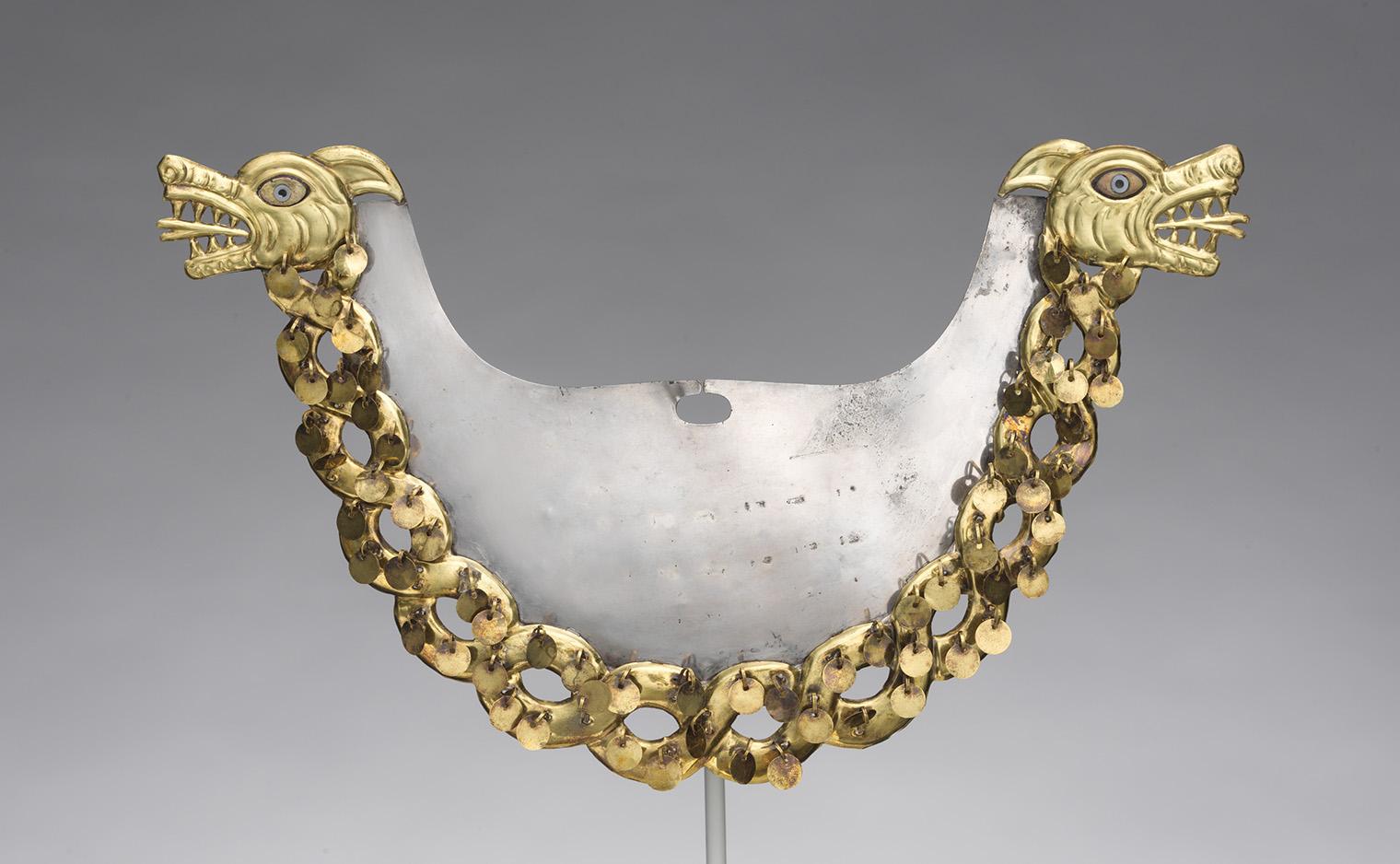
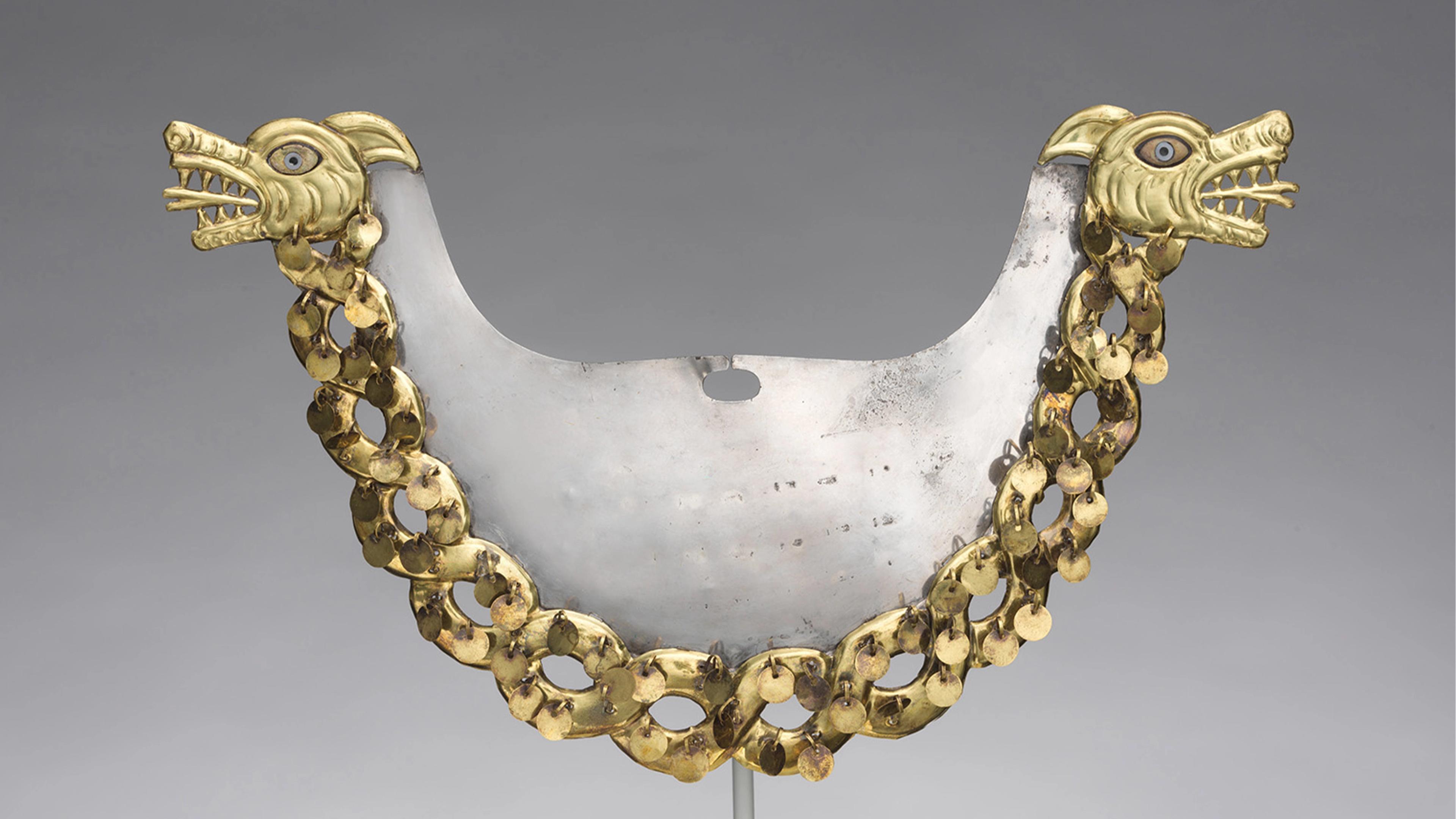
Nose ornament with intertwined creatures, 500–800 CE. Peru. Moche. Gold, silver, H. 4 15/16 x W. 8 5/16 x D. 7/16 in. (12.5 x 21.1 x 1.1 cm). The Metropolitan Museum of Art, New York, The Michael C. Rockefeller Memorial Collection, Bequest of Nelson A. Rockefeller, 1979, (1979.206.1225)
Where do dragons roam? In ancient American art, they are often captured as ornaments, worn on the body, and animated through movement. On the Panamanian pendant, the loops at the creatures’ claws allowed the ornament to be suspended from a cord; when worn, the creatures’ heads would have been oriented toward the wearer’s head. Elsewhere, they dwell front and center on the wearer’s face. A silver-and-gold nose ornament from the ancient Andes would obscure much of the lower half of a face when suspended from the nasal septum. Two distinct animals are combined to create a mythical, bicephalic beast that seems to quiver with threatening energy. The ornament’s silver crescent is embraced by bodies of intertwined serpents with snarling canine heads, fangs bared and ears back in aggression. The bodies are adorned with dozens of small, circular dangles suspended from little wires. In motion, the ornament transformed the wearer’s appearance in a dazzling display as the dangles caught the light, animating the creatures’ bodies and projecting their power to beholders.
In the modern age, we readily dismiss dragons as figments of the imagination, scoffing at a premodern willingness to believe in them. And yet, it is clear that in some ways we still believe they exist—or at least want them to. They thrive in contemporary popular culture, from Tolkien's Smaug to How to Train Your Dragon. They remain in our minds as beings of terror and delight, revulsion and fascination, menace and benevolence: they are abiding, necessary dragons that fuel our imaginations and provide us with ways of thinking about our world—and the undiscovered worlds that may still be out there.
This essay is published in conjunction with the exhibition Creatures of Myth and Imagination: Europe and the Americas, on view through October 18, 2026.


