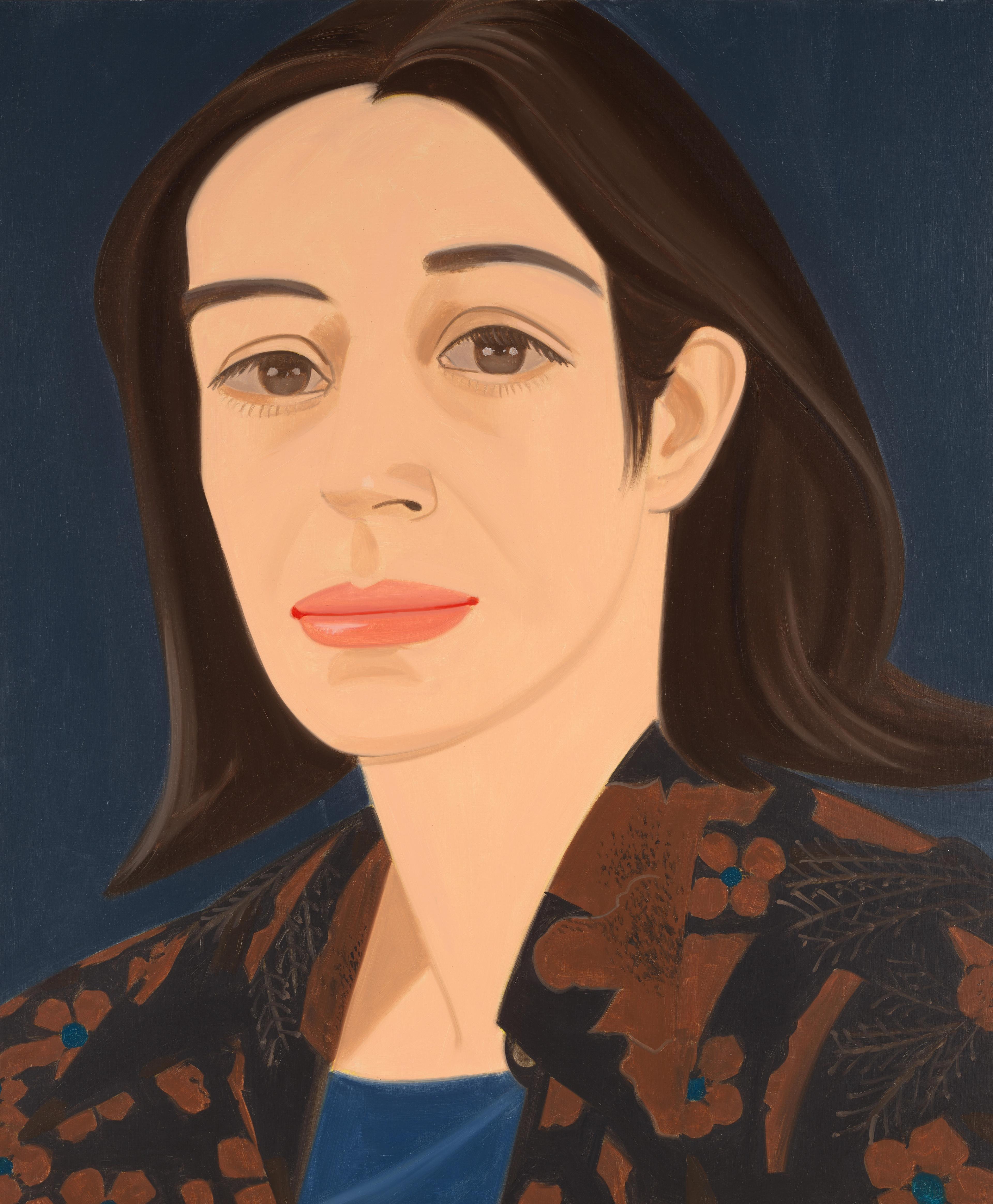
Alex Katz (American, born Brooklyn, New York, 1927). Black and Brown Blouse, 1976. Oil on canvas, 72 1/8 × 60 in. (183.2 × 152.4 cm). The Metropolitan Museum of Art, New York, George A. Hearn Fund, 1978 (1978.9). © Alex Katz
I’m Lin Tianmiao. I do installation art.
I’m from China. I first saw the work of Alex Katz in the 80s. I find his touch, the flatness of his work, very similar to Chinese ink painting or Japanese woodblock prints. Like Chinese brush painting the process itself seems very fast. His brushwork is very simple. You can see, through the maneuvering of his brush, his passion. But this is a controlled passion.
Being an artist there’s a lot of considerations in the background. He expressed himself only after he has carefully thought it through, only then does his brush follow his thoughts. With so much thinking behind it, he exudes confidence.
It’s like reading a poem that overwhelms you instantly and makes you feel stunned. It’s rare to find, in Western art, a sense of poetry. Western art gives you a story. But Alex Katz catches one split moment: a precious, precise moment.
Many of his portraits are of people dear to him, so it is easy to capture the multidimensionality of a person. Katz’s works appear traditional, but I don’t think they are. I find behind his works a kind of spiritual communication between human beings.
I’m attracted to the precision with which he portrays psychology. His subjects appear very realistic, but the emotion is not realistic. His portrayal of materialistic middle class life is more spiritual, more sensitive. What he portrays makes you feel peaceful. This, to me, is particularly precious. Even the complicated colors—like the color of the lips—he transforms to something otherworldly. He purifies the real world to such a degree it becomes ethereal.
I feel that he captures today’s living condition, with the commercial society of the US, for example, advertisement. I’m also convinced that he’s influenced by film. I feel that viewers all are somewhat voyeuristic, and he enlarges this voyeurism. He enlarges private life and makes it public, catching the most touching, the most revealing, the most hidden moment that you really don’t want other people to see. He’s magnifying this face of the portrait to expose the spiritual elements. Only art can attain that degree of experience.