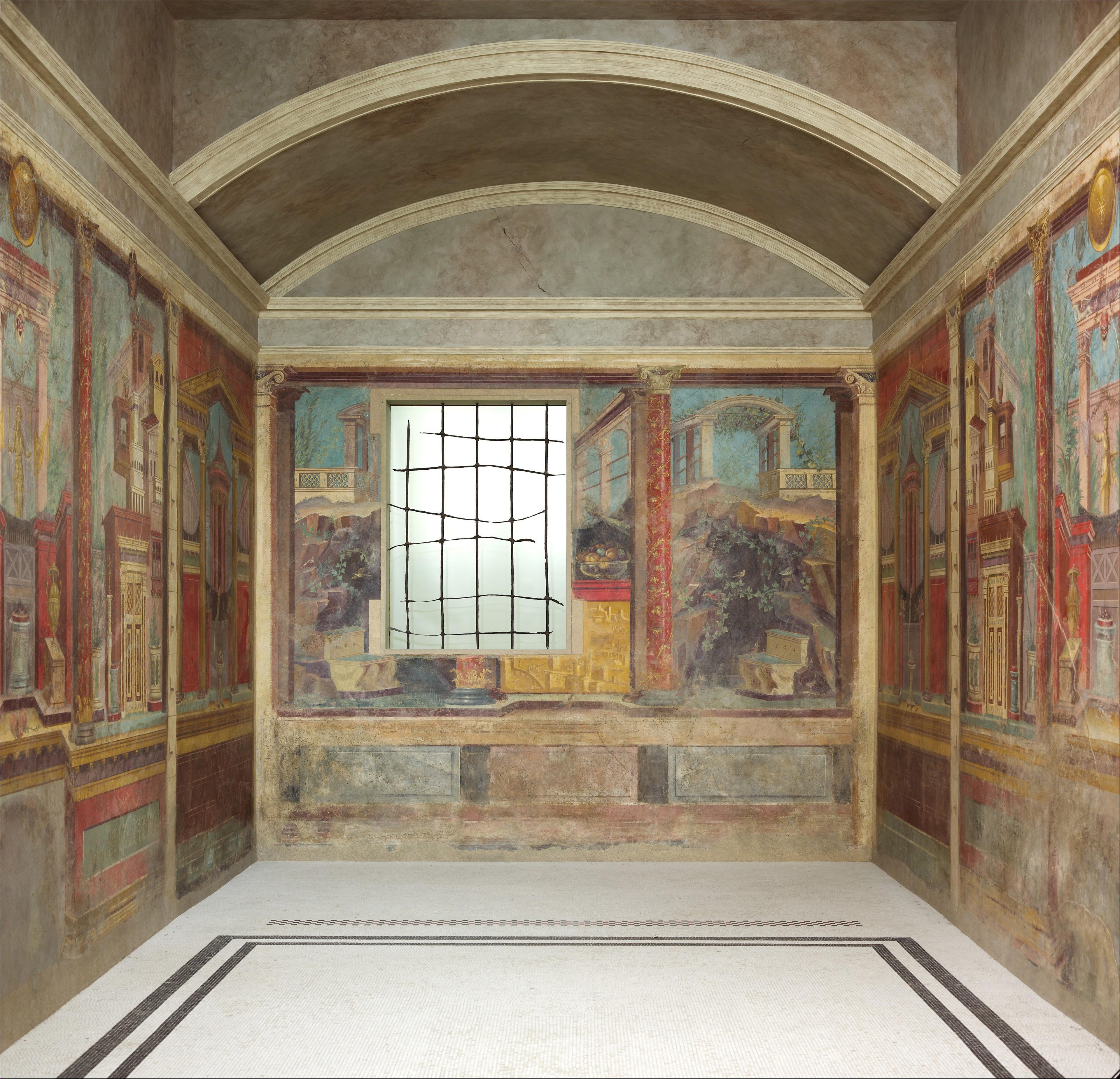
Cubiculum (bedroom) from the Villa of P. Fannius Synistor at Boscoreale, ca. 50–40 BCE. Roman, Late Republic. Fresco, 8 ft. 8 1/2 in. × 10 ft. 11 1/2 in. × 19 ft. 1 7/8 in. (265.4 × 334 × 583.9 cm). The Metropolitan Museum of Art, New York, Rogers Fund, 1903 (03.14.13a–g)
My name is Diana Al-Hadid and I am an artist.
I started making sculptures that were large enough that they stopped being objects and started being environments. I see these spaces as installations. They’re actual rooms that were lived in. These villas were on the outskirts of Naples. They’re kind of like the Hamptons—ancient Hamptons, I guess. You really see the opulence. This was a show-offy guy. That was a bedroom. All of this was meant for a single visitor. It’s indulgent. And this was the first century BC—it’s astounding.
Even though it’s a flat wall, the perspective is exaggerated. You can sink deep into the space and go infinitely past these impressive, proud buildings into gardens. It’s got narrative muscle, it’s telling you exactly where you are and where you might go in this land beyond.
But then you can also pull yourself up to the surface and examine the trompe-l'oeil details. Sometimes it looks like it’s metal, and sometimes it looks like it’s marble. And you can see shadows cast from one particular angle, related to the window that’s actually in the room, so it’s very smart.
At first glance it feels wide and expansive, but then you snap back to symmetry. The west and the east walls are mirrors of each other. There’s a real sense of depth, but it also feels a little fictitious to me—like those stacked buildings don’t look possible.
You’re confronted with the fact that this is still on a wall. I’m interested in that line between something that’s illusionistic and something that’s literal. There’s reliance on and denial of the wall.
I can’t look at these and divorce myself of the event that brought them to us: the eruption of Mount Vesuvius in 79 A.D. I mean, who doesn’t love the story of Pompeii? It’s one of the most unfortunate—but for history’s sake, fortunate—events. It's kind of horrible to say, but it’s a strange paradox: this complete destruction annihilated an entire region but at the same time preserved it.
You’re reminded of this at every moment because there are these long cracks, these fissures in the surface, so the event is laminated into the image. You realize that this is thousands of years ago, and history feels impossibly long and hard to conceptualize, but there was this one event. And you see that history is a sudden, instant thing. This room connects that fuzzy boundary between something real and something imagined. It’s this rare glimpse into a charged moment with clarity.