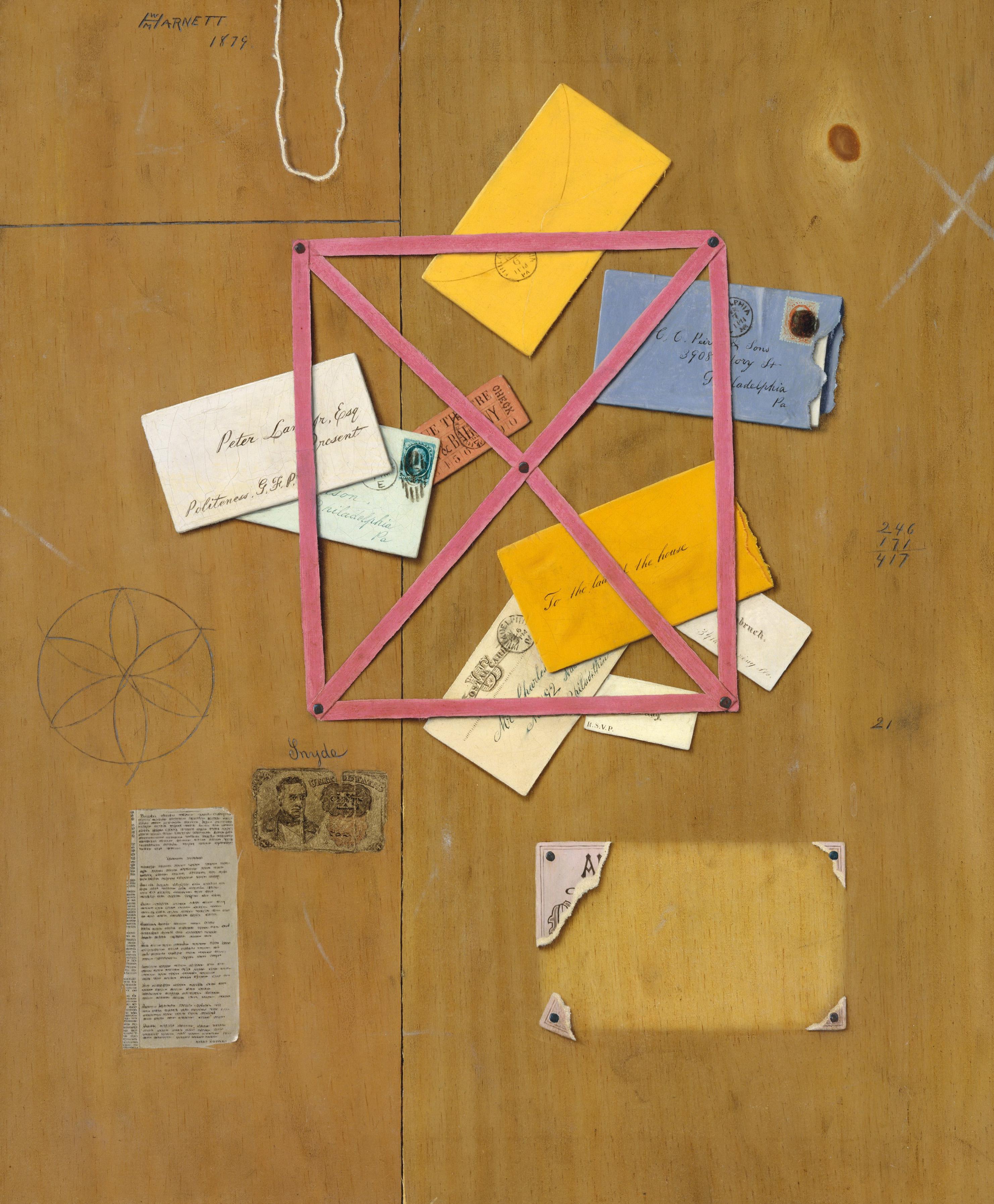
William Michael Harnett (American, 1848–1892). The Artist's Letter Rack, 1879. Oil on canvas, 30 x 25 in. (76.2 x 63.5 cm). The Metropolitan Museum of Art, New York, Morris K. Jesup Fund, 1966 (66.13)
My name is Spencer Finch and I'm an artist who lives in Brooklyn.
I'm really interested in unconventional representations of conventional ideas in art. Trompe l'oeil—it's like so gimmicky, it seems—but then, with Harnett, you look at this artist's rack, you know, a nineteenth-century painting, and it's an abstraction. Like, if you squint and you can't really see the details it becomes an abstraction, and quite a beautiful abstraction, if you look at the choice of color and the position of those orange envelopes and the blue, and then there's this weird little piece of string.
The whole idea of trompe l'oeil painting—it gets to the very basis of what painting is: this idea of representing things and recreating reality, and how closely you're trying to reproduce something when you're making something else.
And then it's not only just an abstraction; it's also like a portrait. It's almost like a diary. To think about a portrait being done as a collection of papers—it's really sort of unconventional, but it's also a way of organizing information and images in a very analog way. That's what is happening here. If you look at the tape that's over one envelope, then that envelope's over another envelope, and then that is over another ticket, and that is under then another piece of tape. I mean, also, this weird spirographic flower—it's like graffiti. It's a little bit of a joke, of a drawing within a painting. This faded wood, where this piece was pulled off—it makes you think about, what is the sunlight like in this room?
In some ways it's frighteningly similar to contemporary imagery. The background, it's almost like the wallpaper of a computer screen. It doesn't have the richness that other works of art have. There's this transparency to this because it is photorealistic; there's not that tension between, sort of, what it is and what it says. It would seem that there's not a lot of inflection, that he's not adding a lot: he's just a copyist. I think there's more than that going on.
As an artist, one looks at work, you know, with certain goals in mind: things you can learn and things you can use in your own work. And I think the Harnett is something where I was really thinking about it in those terms. I like that it's so minor. There's something poor about it, you know, these sort of things that wouldn't normally be the subject of art, you know? It's so modest: an artwork that accepts its own limitations. At the same time, this sort of obligation to make art, in spite of all these incredible odds against it.
He was really thinking about what the ontology of the painting was, what the ontology of the object was. What does it mean to make a work of art? And I think there's kernels of that philosophical exploration in this.