This essay is part of La Fin du monde: A Modernist Book, a research project from the Leonard A. Lauder Research Center for Modern Art.
Before reading Cendrars’s text in relation to Léger’s image-making, it is helpful to realize that their collaboration had its limitations. Both of them were totally committed to the project, but they were able to work alongside one another only in short bursts. This was the moment when Cendrars was able to become actively engaged in film making—a major distraction. In 1919, when he worked as assistant réalisateur on Abel Gance’s film J’accuse, a dramatic exposé of the suffering unleashed by the war, he was only in Paris for brief stays of a week or two at a time. What follows is just one possible reading of the book they produced.
La Fin du monde filmée par l’Ange N.-D. begins with a sardonic, farcical satire aimed at the powers in command. The year 1917, when Cendrars wrote it, had been for many in France a demoralizing low point in the war, the year of the failed Chemin des Dames offensive and of mutinies by French frontline troops. Chapter 1 brings together business, modernity, religion, and the war. God the Father is a cigar-chomping war-profiteer, delighted by the success that the killing has brought him: “It’s been a good year. The Great War has been profitable. So many services for the souls’ eternal rest. A billion dead at 1.25 francs per.”
The opening image by Léger, the only one in the book that combines typeset text with image, centers on “Dieu le père” (God the Father), at his American-style desk, smoke rising from his cigar in graceful elliptical curves. Beneath his eyeshade, his fingers can be seen clutching the cigar. He is taken over by the paraphernalia of his office and by stenciled letters, a few, roughly cut—just letters without words—others, crisply cut, that spell “ENGLISH SPOKEN” (in red) and “CAISSE” (cash machine, in yellow). Typeset in black, in an enlarged font, at bottom left, is: “C’est le… ” (it is the…). Above right, enlarged further to dominate both pages, is “31 DECEMBRE.” These are the opening words of the book: “It’s December 31st.” The sentence is split apart. Indeed, the disintegration of the legible and the recognizable is a key to the force given letters, words, and image together. One figure emerges more recognizably than God the Father himself. It is the postman who, toward the end of the chapter, delivers a telegram from God the Father’s faithful servant Ménélik in Mars City. Léger depicts him wearing a French military kepi. Erect and buttoned up, he contrasts with the mood of dissipation and relaxation created by the divine Big Businessman.
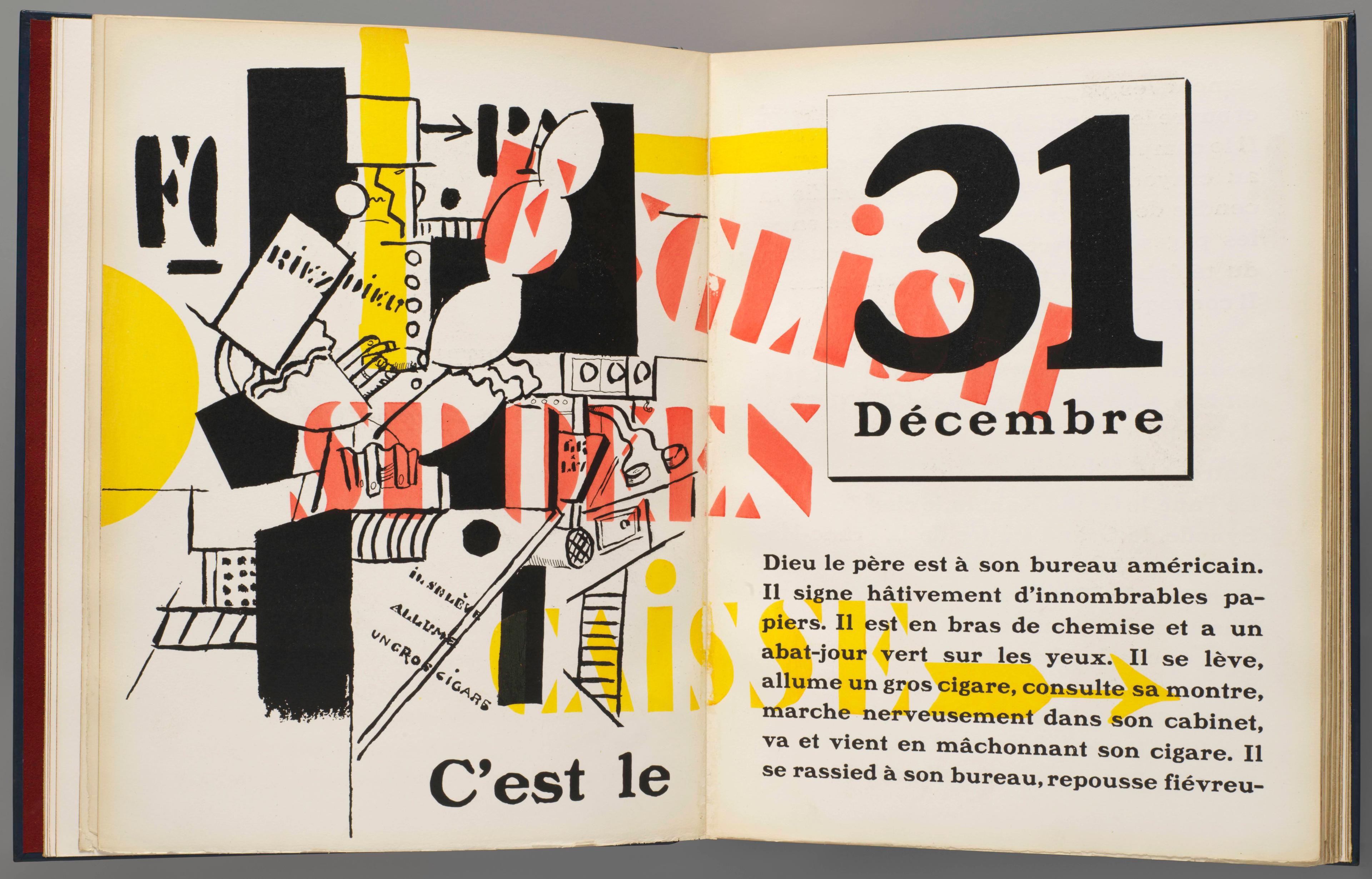
Blaise Cendrars (author) and Fernand Léger (artist). La Fin du monde filmée par l’Ange N.-D., 1919. Illustrated book with twenty-two pochoirs published by Éditions de la Sirène, Paris, and eleven compositions in gouache and pencil, in embossed leather binding, 13 3/8 × 11 1/8 × 1 5/8 in. (34 × 28.3 × 4.1 cm). Collection of the Leonard A. Lauder Cubist Library, Leonard A. Lauder Research Center for Modern Art (PN1997 .F465 1919 LALRC Quarto)
In Cendrars’s text, rubbing his hands together, God the Father responds to the telegram from Ménélik and then is driven in his “automobile de luxe” to send a propaganda procession off to Mars City by “le train interplanétaire.” The train arrives with a great din, and leaves in a flash of “ultra-violet,” while: “The lit signals redouble in brightness.” In response to the text, Léger supplies color and light to end the chapter: white discs set off tapering color bands in yellow, blue, and orange.
Léger’s opening spread for chapter 2 refigures God the Father as the celebrated circus impresario P. T. Barnum in a bow tie. In bright orange and black, a stenciled “2” and “CHAPITRE” tell us where we are in the book. On the next page, the chapter begins: “God the Father, the P. T. Barnum of religions, has relocated to Mars.” The chapter tells the story of the disastrous failure of the Barnum of religions’s propaganda procession to convert the Martians. The procession becomes a cavalcade of circus performers, led by Krishna and Jesus, with a spectacularly transcultural crowd following in great motor vehicles decked out as Gothic cathedrals, pagan temples, pagodas, and synagogues, with room found for Mormons and Anabaptists; African, Oceanic and Mexican “fétiches”; and even for a few “charlatans,” including a circus freak and a “Zulu” fire-eater, a recollection of colonialism’s contribution to exotic fairground spectacle. The procession ends with Charlie Chaplin on stilts.
Léger opens the chapter by giving us the subject of his double-page image clearly spelt out in black on the left: “La cavalca/de hebdomaire” (the weekly procession). But disintegration is again a key pictorial strategy in approaching the composition. Around God the Father as P. T. Barnum, Léger scatters verbal messages and easily recognized icons that splinter the unities of time and space: a classical capital with no supporting column, a cart, rows of city gentlemen dressed for business not for holy observances. Léger completely ignores the panreligious heterogeneity of the procession as Cendrars describes it, but uses announcements in fat black stenciled letters—“VERITĖ” (truth) and “IT IS TRUE”—to declare with suitable bombast the claim of all religious faiths to know true from false.
The Martians turn out to be “délicats et fragiles” (delicate and fragile), and, when exposed to violent spectacles of martyrdom, torture, and cruelty to animals, their dwellings—soap bubbles whose color can change according to their feelings—go black and explode. The Martian police charge the procession. Panic ensues, and God the Father flees into the desert.
Léger opens chapter 3 with a single-page frontispiece dominated by God the Father’s servant Ménélik, - a name perhaps borrowed by Cendrars from Emperor Menelik II of Ethiopia who died in 1913 - who despite the far from African or African American name given him by Cendrars, is figured as a Black man with wide eyes and wide mouth—a racist caricature. With the arrival of American troops in 1917, jazz came to Paris, and Léger quickly became a jazz fan. He may have thought of his caricature as a jazz band leader, but another possibility is suggested by a conversation recorded in 1954 involving Cendrars, Léger, and the dealer Louis Carré. Cendrars recalled the impact on Léger and himself, immediately after the war, of a building-sized poster in the Place Clichy in Paris that featured a Black man (Cendrars guesses) that may have been advertising Lion Noir (black lion) shoe polish; Cendrars mentions the name Ménélik. Léger’s Ménelik may therefore have owed something to a racist caricature from advertising.
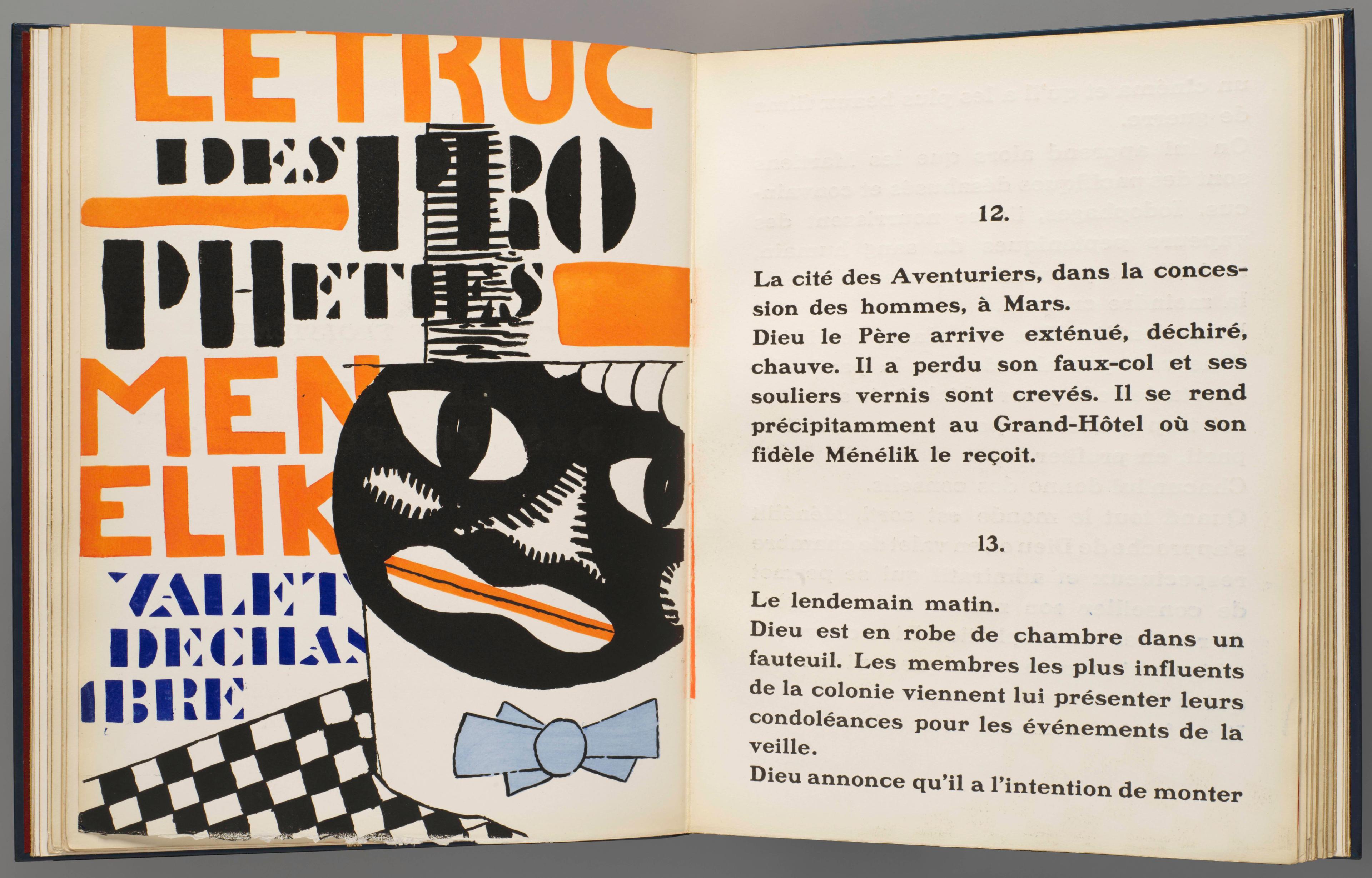
Blaise Cendrars (author) and Fernand Léger (artist). La Fin du monde filmée par l’Ange N.-D., 1919. Illustrated book with twenty-two pochoirs published by Éditions de la Sirène, Paris, and eleven compositions in gouache and pencil, in embossed leather binding, 13 3/8 × 11 1/8 × 1 5/8 in. (34 × 28.3 × 4.1 cm). Collection of the Leonard A. Lauder Cubist Library, Leonard A. Lauder Research Center for Modern Art (PN1997 .F465 1919 LALRC Quarto)
Ménélik’s dazzling costume and black face do not alone dominate Léger’s image. Re-purposing letters given the punch of advertising fonts, in black and orange, he fills more than half the page with words or the fragments of words. Disintegration is again key. Broken apart is the chapter title,“Le Truc des Prophètes” (The Prophecy Trick); the name Ménélik; and the words “valet de chambre.” In the chapter itself, Cendrars has Mélénik deploy the wiles of a valet to influence his master’s decisions. He persuades God the Father that the most effective propaganda to use on the pacifist Martians is to show them the prophesies of the Old Testament Prophets coming to pass. The Prophets disagree too much about whose prophesies should have priority, so finally Ménélik uses a photograph of an Angel perched between the towers of Notre-Dame-de-Paris, holding a trumpet, to persuade God the Father that the propaganda job is one for the Angel. Léger closes the chapter with the encrypted message dispatched to the Angel, the numbers “19-18-43” printed in pale pink on a deeper pink band.
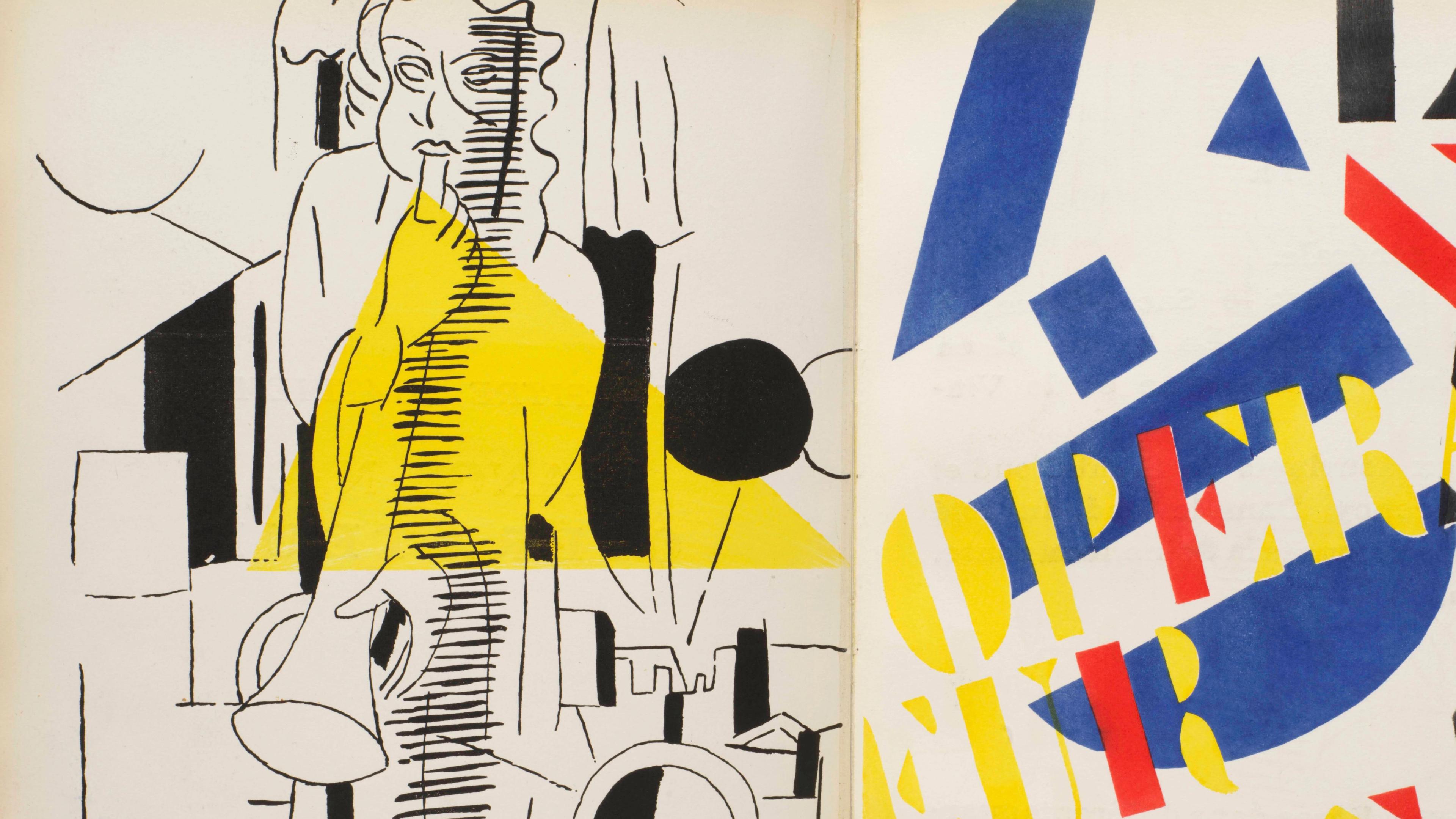
In the double spread that opens chapter 4, the left page presents an easily read story-telling image. There are no words or fragments of words here, and a single, unfragmented image dominates: the Angel with trumpet to lips. Scattered across the right page are stenciled letters in black, blue, red, and yellow—words in fragments— that hit the eye hard against the white of the paper. The words are those of the chapter’s title: “L’Ange N.-D. Opérateur” (The Angel N.-D. Cameraman). This is the first of the three lettering compositions in the book. Because the word “OPERATEUR” coheres enough to be read, this lettering composition can be thought of as complimentary to the image of the “cameraman” Angel. The clamor of its primary colors against white blasts out from the page—Léger’s response to the idea of the world-ending trumpet blast to come. The text that follows is written in the manner of a film script. The end of the world is to be brought about and filmed by the Angel. In anticipation, a record is made of the city whose destruction is to launch the cataclysm: Paris. The film begins with a “Vue Générale” of Paris, taking in first its center, then Boulogne and Vincennes, and then the suburbs. The chapter ends by returning to the Angel N.-D of its frontispiece, but no trumpet blast has yet been sounded.
Cendrars later insisted that he had been drawn to the idea of the apocalypse as a subject since 1907, when he had thought he might become a musician and write a great symphony, “Le Déluge.” Yet there is no doubt that in the context of the First World War, the theme took on new immediacy, with the cathedral square of Notre-Dame de Paris at its heart. In a text dated August 13, 1917, on the writing of his novel Moravagine, he recalled walking in Paris the year before with a young woman, still deeply disturbed as he tried to come to terms with the loss of his writing arm. They stopped in the cathedral square of Notre-Dame, and, looking at the façade of the cathedral, he wondered how the woman would react if the angel between the towers were to blow her trumpet and announce the Last Judgment. Later, in bed with the woman, he told her what he imagined would happen when the trumpet sounded: the cathedral suddenly galloping “like a furious elephant, trumpeting, smashing the city.” This is an image both terrifying and burlesque, centered on Paris and Notre-Dame, but his first attempt to write the end of the world did without the burlesque. Unrelentingly dark in tone, it appeared in a short piece he published a year later, in April 1917, in the periodical La Caravane, as prelude to La Fin du monde, with the title “Le Mystère de l’ange Notre-Dame.” Here the war surfaces explicitly: “Over there, the trenches will close like lips over the combatants,” and everything built by men buries them.
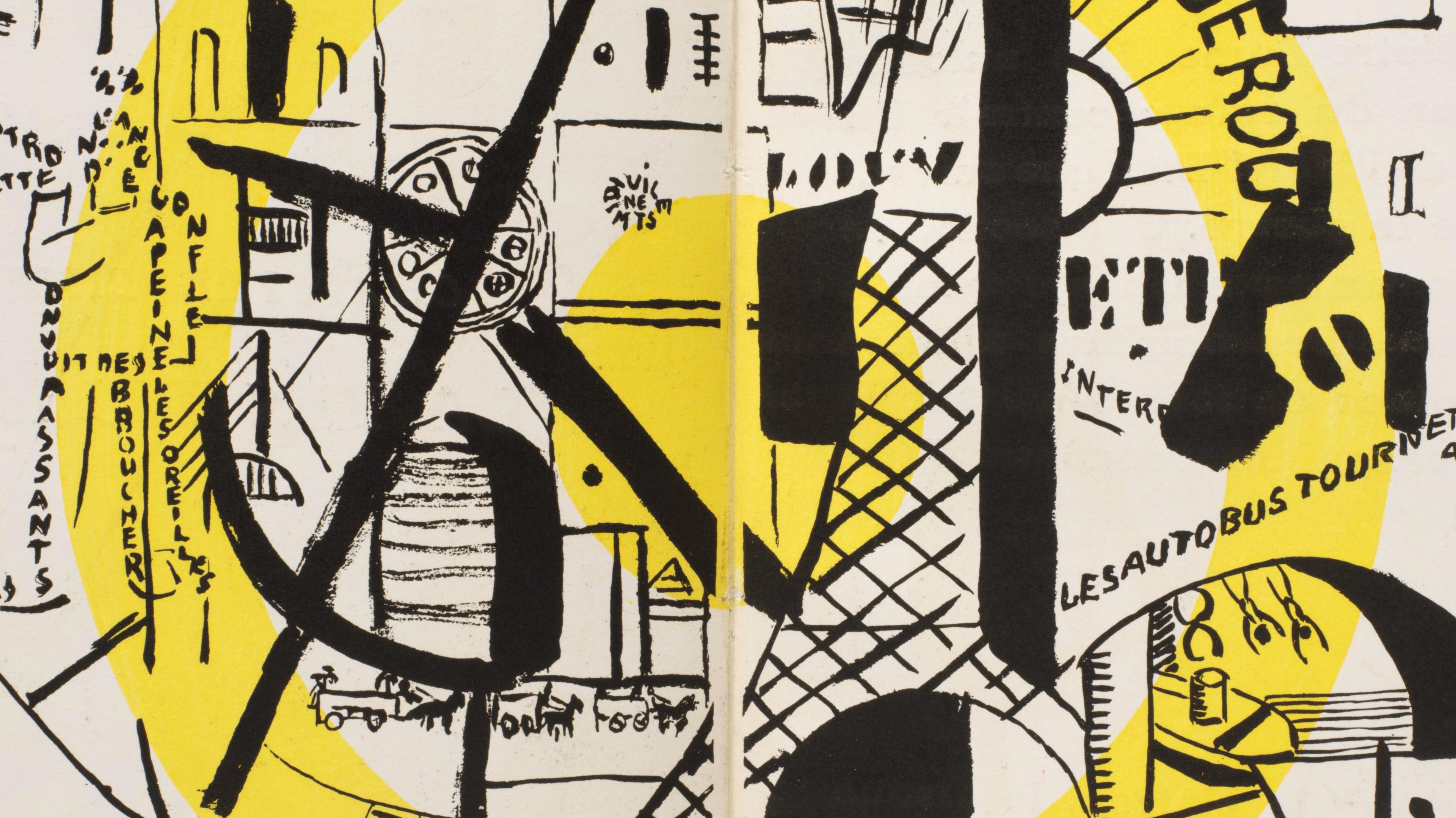
Léger’s opening double spread for chapter 5, “La Fin du monde,” is the storytelling image that illustrates Cendrars’s text most comprehensively. The space of the two pages is burst apart by a fragmentary depiction of Paris that incorporates words—some of which name and describe—and images drawn untidily yet with sureness. Léger depicts the moment just before, or just as, the Angel blows the trumpet. Parisians (predominantly male) are depicted without individuality. They actively go about their lives in a city whose history and whose modernity is represented with playful vivacity, using iconic, instantly recognizable images: the West front of Notre-Dame shown as a symmetrical whole, the Eiffel Tower beheaded, and the Great Wheel (a familiar reminder of the Exposition Universelle of 1901). Moreover, Cendrars’s Angel has become in Leger’s illustration a jaunty figure who is outlined in words lifted from the text and written at speed, and the trumpet has become a megaphone.
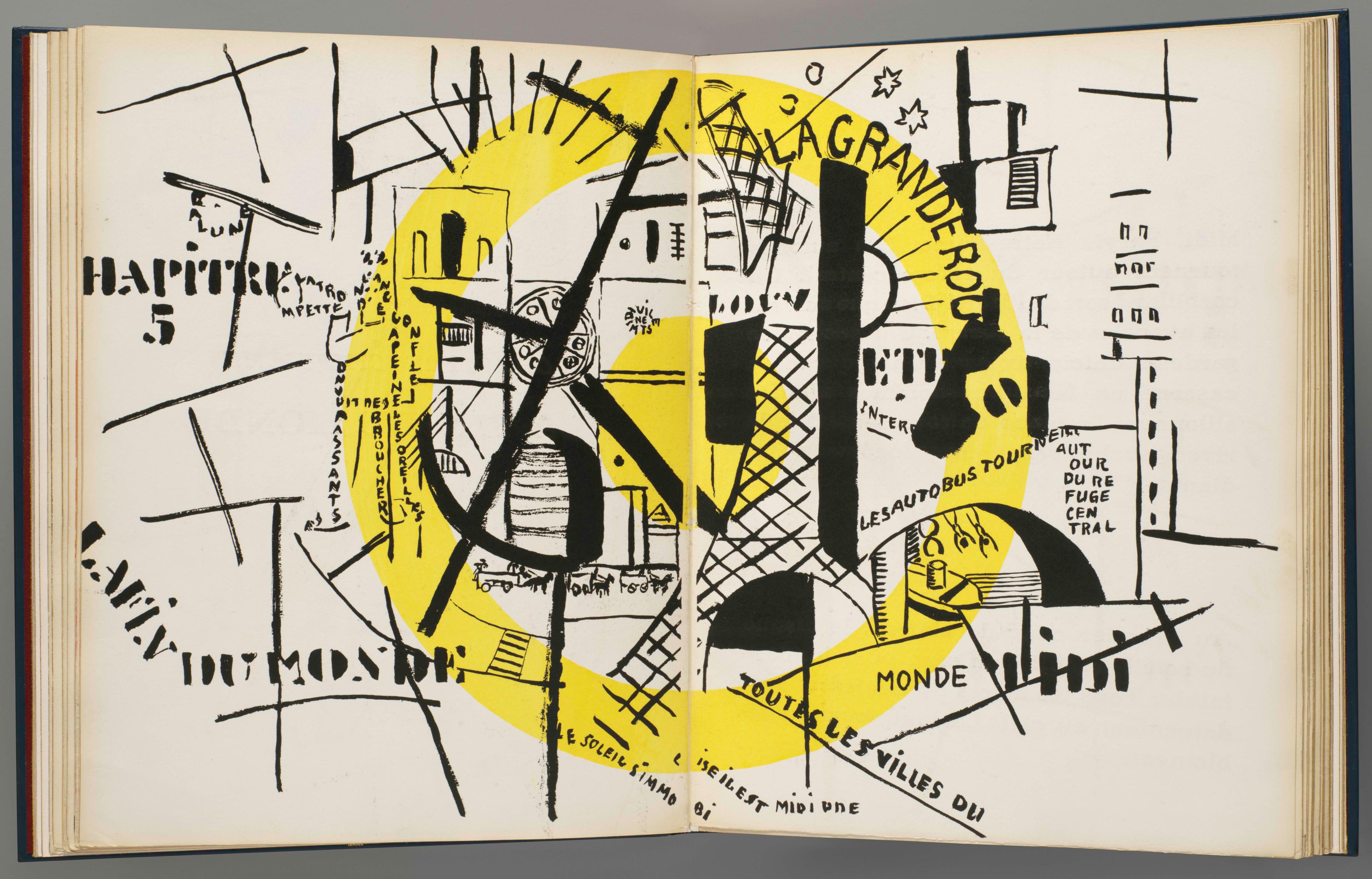
Blaise Cendrars (author) and Fernand Léger (artist). La Fin du monde filmée par l’Ange N.-D., 1919. Illustrated book with twenty-two pochoirs published by Éditions de la Sirène, Paris, and eleven compositions in gouache and pencil, in embossed leather binding, 13 3/8 × 11 1/8 × 1 5/8 in. (34 × 28.3 × 4.1 cm). Collection of the Leonard A. Lauder Cubist Library, Leonard A. Lauder Research Center for Modern Art (PN1997 .F465 1919 LALRC Quarto)
The words that shape the Angel describe the shocking impact of the trumpet blast, and its very beginning is to be seen in the way it can seem as if the Great Wheel has already beheaded the Eiffel Tower. But Cubism as a way of breaking things down into pictorial elements could also, in Léger’s practice, deploy those elements to convey not the destruction of the visible world but the constructive energy needed to re-build after the War, as in La Ville, the painting he would show four months later in the 1920 Salon des Indépendants. That painting’s dislocations, image from image, and the additive mode of composing across a cinematic format invite direct comparison above all with this double spread for chapter 5. Of the words scattered across the image, only “LA GRANDE ROUE” is not taken from Cendrars’s headings and text. In the chapter, Cendrars begins by setting the scene for the trumpet blast by giving us the calm before the storm. Léger shows us the very beginning of the end of the world but cannot resist making an image which can be read as positively as it can negatively. Positive energy is released by the sudden dislocations between pictorial elements and images, by the verve of the drawing, and the éclat of the yellow.
Cendrars ends the chapter with all the cities of the world converging on Notre-Dame’s cathedral square. Everything men have ever built collapses, burying humanity, while airplanes fall from the sky like leaves. Heralding the destruction, the sun stands still. Crossing the two pages at the bottom of Léger’s double-page opening is a one-line paragraph from Cendrar’s text: “The sun stands still. It is one minute past noon.” The black line, resembling the hand of a clock, that crosses out the towers of Notre-Dame, like the giant sun beaming its yellow light behind the Cathedral’s towers, can be read as signaling the destruction to come, but the yellow that Léger adds, spreading across the page, can also signal the energy released by the optimism of the postwar moment.
The reader goes straight from the end of chapter 5 to the title page of chapter 6, whose title, “Cinéma accéléré et cinéma ralenti,” (Cinema, Fast-Forward and Slow-Motion) is printed in black over stenciled words in yellow, supplied by Léger: “MAN SPRICHT DEUTSCH” (German is spoken). The chapter’s twenty three paragraphs make it the longest by far. It is striking that this, the climax of the book—Cendrars's narration of the end not only of humanity but of the globe and the cosmos—is the one in which the text most dominates over Léger’s illustrations. It is also striking that the two frontispieces for chapters 6 and 7, concerning the end of humanity, the world, and the cosmos, followed by its coming back into existence, are the ones for which Léger could conceive no storytelling compositions or even images that could compliment the content of the chapter like the trumpet-blast lettering composition at the beginning of chapter 4.
Léger’s frontispiece for chapter 6 makes the letters of its title rotate, turning one way and another, at the bottom turning upside down, impossible to put back together. Parts of words form suggestively, but whole words refuse to. It is as if Léger is compelled to explode the words that will describe the destruction of everything. The letters become signs in primary red, yellow, and blue, flaring against the white of the page, hitting the eye with force but signifying nothing. In the eleven pages that follow, Cendrars imagines the end of all life, animal and plant, of the mineral world, of the senses, of consciousness: “A dark eye shuts on everything that was.” The pitch black of the 24-point Blanchard type called Morlandcorps fills every page, only gently interrupted on three occasions when it is printed over stenciled images that loosely relate to the text: a yellow star, a growing plant form, and a biomorphic form in pink sometimes described in French as a meduse (jellyfish). The pictorial uplift given the book as a whole by the pugnacious brilliance of Léger’s illustrations is not sustained through these pages. His frontispiece to the chapter readies the reader for a spectacle without sense. Otherwise, Léger does not challenge the momentum toward the end of things put in motion by the black of the type and the rhythm of Cendrars’s film narrated in prose.
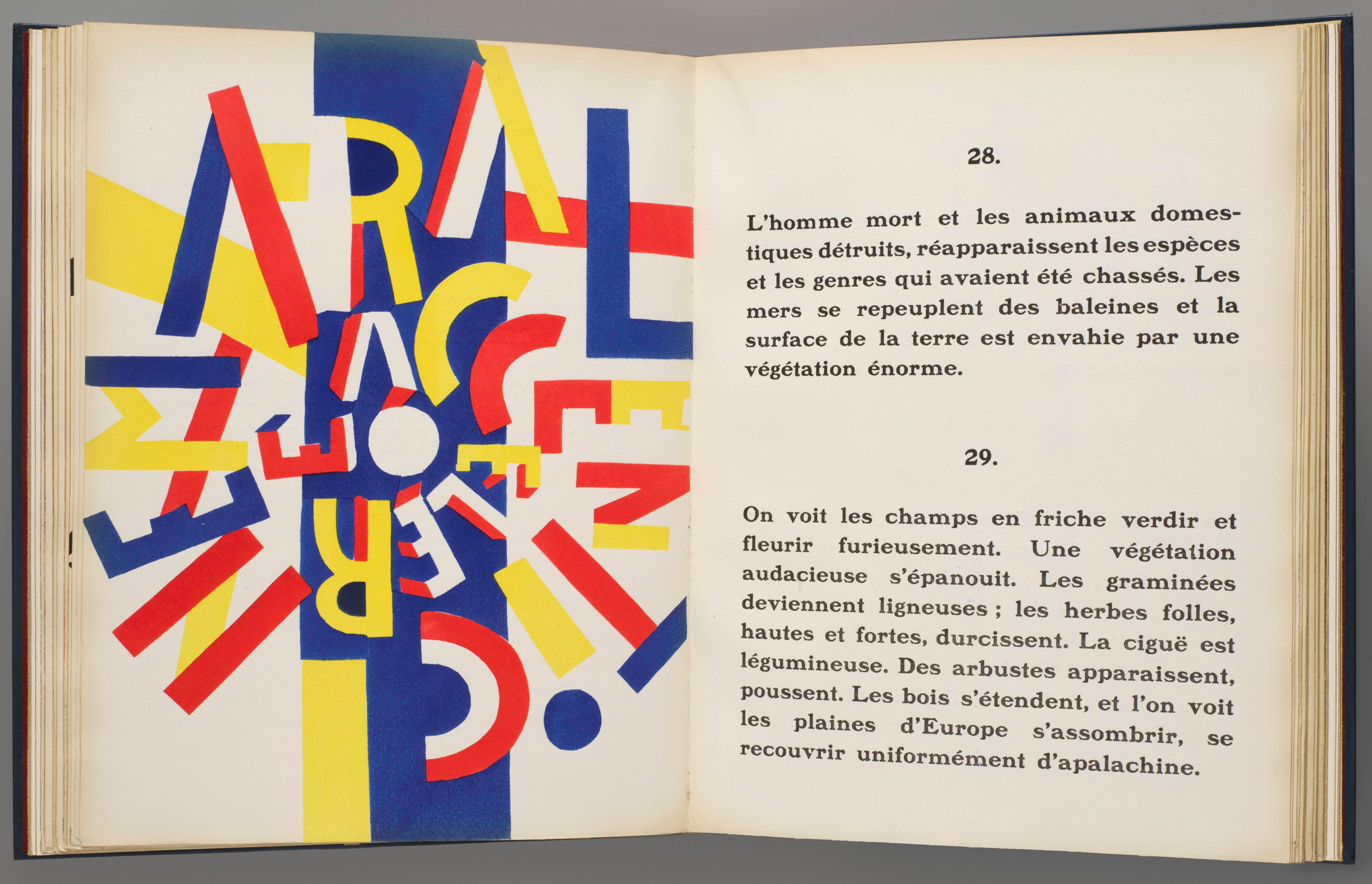
Blaise Cendrars (author) and Fernand Léger (artist). La Fin du monde filmée par l’Ange N.-D., 1919. Illustrated book with twenty-two pochoirs published by Éditions de la Sirène, Paris, and eleven compositions in gouache and pencil, in embossed leather binding, 13 3/8 × 11 1/8 × 1 5/8 in. (34 × 28.3 × 4.1 cm). Collection of the Leonard A. Lauder Cubist Library, Leonard A. Lauder Research Center for Modern Art (PN1997 .F465 1919 LALRC Quarto)
Beneath Léger’s jellyfish the last words of the chapter read: “The final ray of light splits chaotic space, a shark fin.” On the next page, Léger closes the chapter with what may seem a blatant non sequitur: a map of France, a negative space left between bands of mauve and yellow in the shape of France, on which is printed the single word “PARIS” placed in the approximate location of the capital city.
On the opposite, recto, page, the title of chapter 7, “A Rebours” (Rewind), is printed over the words “SI PARLA ITALIANO,” (yes, Italian is spoken) stenciled in pink. Cendrars ends the book with Abin, the technical assistant, setting fire to the projector, and the film running in reverse. Léger’s frontispiece again uses capital letters from the chapter title to create another brilliant composition, here in the three primary colors against white, but although it is still difficult to put the letters together as words, verticals and horizontals are in control, ensuring stability. The last ray of light shines again, and the world comes back into existence. We are taken back to the beginning, with God the Father chomping His cigar. A short sentence brings the book to an abrupt end: “Total bankruptcy.”
The end of the book is a victory. The world does not end—it comes back to life, with God the Father, the ultimate war profiteer, bankrupt. It cannot be without significance that, with the war seemingly going on forever in September 1917, Cendrars imagined the end of the world with such compelling force, nor that he should end his film/novella with the possibility of hope. In October 1919, when the book was published, hope would have become real for both Léger and Cendrars in a hugely enlarged sense. The climax of Abel Gance’s film J’accuse is the return of the dead; it is easy to imagine that Cendrars, as assistant réalisateur, had some role in deciding on that ending. Gance gave him a part as one of those returning from death. Léger’s work in 1918–19 was consistently positive in its message and in its pictorial vigor, and so were the images he supplied for La Fin du monde. His brilliantly colored stenciled lettering compositions used for the final chapters insert moments of uplift.
Léger’s decision to place the map of France and the name Paris immediately after Cendrars’s image of the last ray of light breaking apart chaotic space may not be a non-sequitur; France is put back together again, even if only Paris can be named and otherwise the country is empty. Léger’s decision to stencil on the title pages of the chapters the messages that German and Italian are spoken is patently internationalist: these are the languages of France’s enemy on the Western Front and of its ally from 1915, respectively. Chapter 1 had begun by telling readers that, in God the Father’s office, English is spoken, the language of France’s principal ally on the Western Front.
Notes
Cendrars’s complete works are published in fifteen volumes as Tout autour d’aujourd’hui, abbreviated hereafter as TADA. Blaise Cendrars, Blaise Cendrars vous parle . . ., in TADA, vol.15, ed. Claude Leroy (Paris: Denoël, 2006), 189
Blaise Cendrars, La Fin du monde filmée par l’Ange N.-D., trans. Mark Polizzotti, paragraph 3.
Polizzotti, La Fin du monde, paragraph 1.
Polizzotti, La Fin du monde, paragraph 5.
Polizzotti, La Fin du monde, paragraph 6.
Blaise Cendrars, “Comment j’ai écrit Moravagine,” in Cendrars, TADA, vol. 7, ed. Jean-Carlo Flückiger (Paris: Denoël, 2003), 230–31.
“Comme un éléphant devenu furieux, piétinant, écrasant la ville” (my translation). Ibid.
“Là-bas, les tranchées se fermèrent comme des lèvres sur les combattants” (my translation). Blaise Cendrars, ““Le Mystère de l’ange Notre-Dame,” La Caravane (April 1917) in TADA, vol. 7, 281–82.
How Léger used the fragmentation of things and the dislocation of relationships to do this is introduced in La Fin du monde in Context.
Polizzotti, La Fin du monde, paragraph 25.
Polizzotti, La Fin du monde, paragraph 41.
The font is better known as Blanchard, sold by the Caslon type foundry as “Morland”; it was also used for Cendrars’s J’ai tué (Paris: A la Belle Edition, 1918). See “Blanchard,” Fonts in Use, https://fontsinuse.com/typefaces/46698/blanchard-inland; and Morland: Romain & Italique (Paris: Fonderie Caslon, ca. 1905), https://bibliotheques-specialisees.paris.fr/ark:/73873/pf0000167656.
Polizzotti, La Fin du monde, paragraph 50.
Polizzotti, La Fin du monde, paragraph 55.