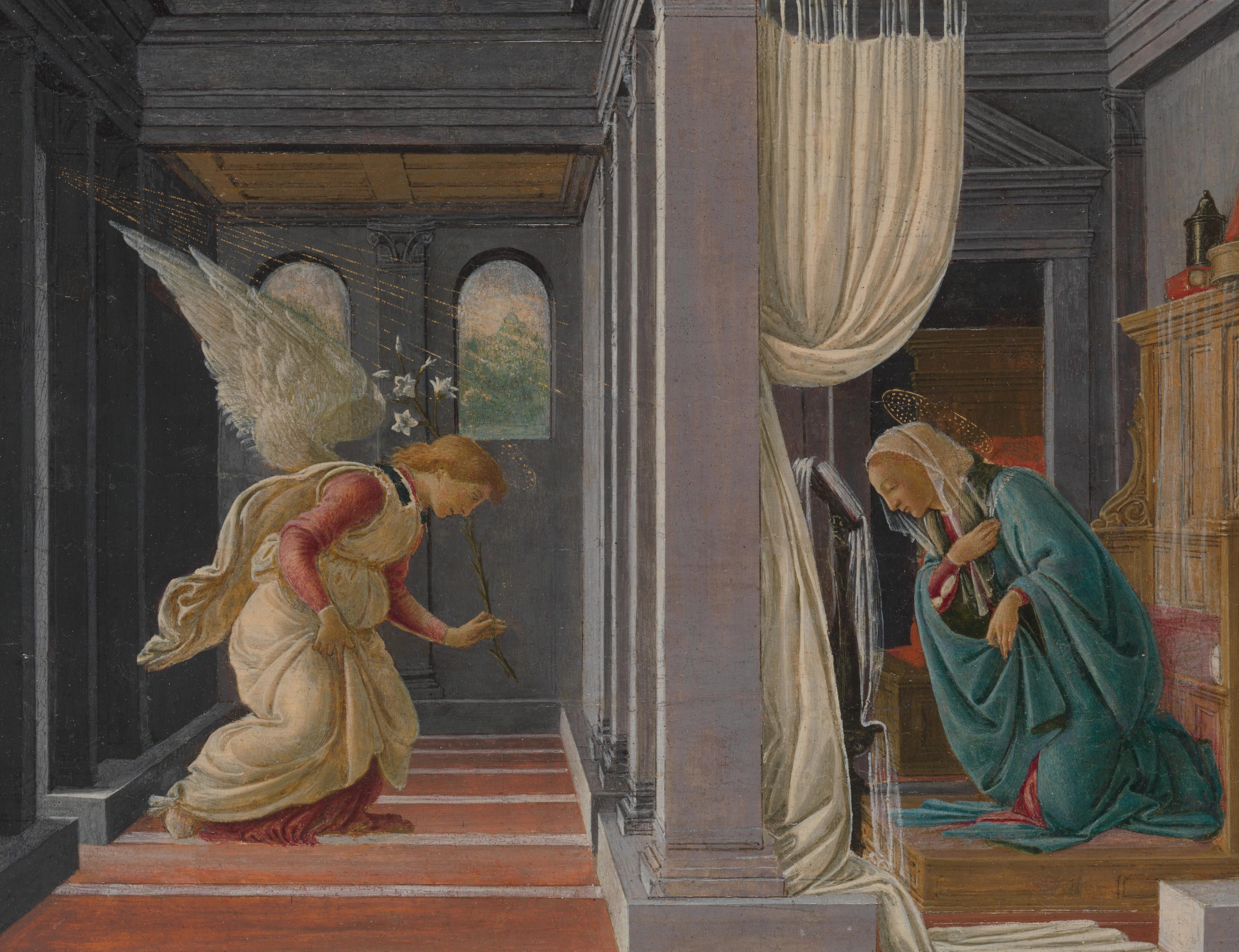
Botticelli (Alessandro di Mariano Filipepi) (Italian, Florence 1444/45–1510 Florence). The Annunciation (detail), ca. 1485–92. Tempera and gold on wood, 7 1/2 x 12 3/8 in. (19.1 x 31.4 cm). The Metropolitan Museum of Art, New York, Robert Lehman Collection, 1975 (1975.1.74)
My name is Mariko Mori. I’m an artist.
I've use different mediums, from drawing to large-scale, site-specific installation in landscape.
When you make an artwork, the artwork decides the scale; the size doesn’t determine the work. So in this case, I think you might lose the tension if this was a huge painting. I feel I'd become more an outside observer.
For this subject of Annunciation, of course the Virgin Mary is honoring the holiness of the angel Gabriel, but the angel Gabriel is also bowing and honoring Virgin Mary, which is very rare I think.
When I saw this painting I found similarity with my own culture. In the tea ceremony tradition the person who’s making tea is a Buddha and the guest is a Buddha, so we bow and we honor each other, we respect each other.
To see angel and human honoring each other, respecting each other, I feel this sensation of being humble, but also of our blessed being or honorable being, because when someone bows to you, that reminds you of your highness, the high quality of your being.
Of course the Virgin Mary is going to receive the son of God, so she’s a blessed woman—as you see her halo—but I believe that every living being in the world has this blessed light.
Although the subject is considered religious, I think this painting goes beyond the religion and becomes universal. I think there is a world invisible to us but that exists. That beam of light is representing something that’s unseen—the holiness—so the artwork can challenge your imagination to see something invisible through the work.
In contemporary society we kind of lost the sense of respectfulness, and I believe that perhaps our ancestors did more of that. But this attitude is the beautiful nature of the human being. There is a lesson here that we have to take from this painting: if you can do this way to other people, if you can do this way to the nature, if you can do this way to everything, then the world can be better.