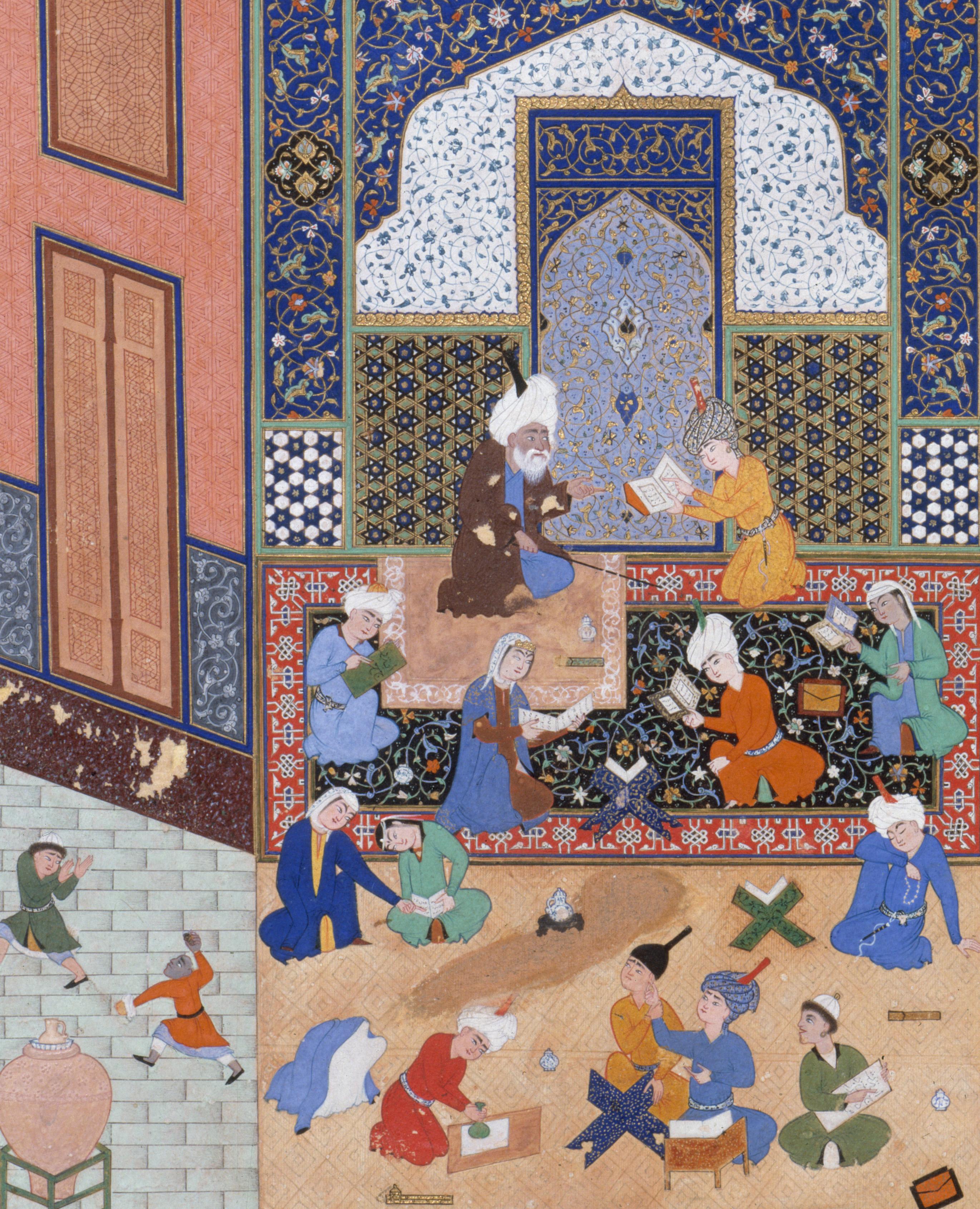
Author: Nizami (present-day Azerbaijan, Ganja 1141–1209 Ganja). Calligrapher: Sultan Muhammad Nur (Iranian, ca. 1472–ca. 1536). Calligrapher: Mahmud Muzahib (Iranian, ca. 1500–1560). Artist: Painting by Shaikh Zada (Iranian, active 1510–1550). "Laila and Majnun in School", Folio 129 from a Khamsa (Quintet) of Nizami of Ganja (detail), dated 931 AH/1524–25 CE. Made in present-day Afghanistan, Herat. Ink, opaque watercolor, and gold on paper, painting: 7 1/2 x 4 1/2 in. (19.1 x 11.4 cm); page: 12 5/8 x 8 3/4 in. (32.1 x 22.2 cm); mat: 19 1/4 x 14 1/4 in. (48.9 x 36.2 cm). The Metropolitan Museum of Art, New York, Gift of Alexander Smith Cochran, 1913 (13.228.7.7)
My name is Shahzia Sikander. I'm an artist.
I have a very deep bond with miniature painting. I studied it for years as a teenager in Lahore, Pakistan. I had an apprenticeship to learn the traditional techniques and crafts.
My interest was to understand the social construct of the so-called "traditional genre." Why is it already determined as a traditional form, or a culturally specific form?
This particular work was part of a book that illustrates a poem of the poet Nizami about Laila and Majnun. The story is about unrequited love. There are many poems and many miniatures on Laila/Majnun's love epic, because the private stories are the ones that connect with us the most: they our capture our attention, they are retold, and they remain in our memory.
Here I see a very powerful notion about provenance. What is the original? How does an artist come up with their own versions of the romance within the challenges of the medium?
For this genre there is intricate stylization: rigor, detail, small scale, stacked-up perspective, complex geometry, color. The style becomes the language, and that language then comes to the next generation of miniature painters. One had to learn the alphabet, the technique, and the skills, and then regurgitate it.
I chose to engage with Indian and Persian miniature painting during a time when it was not popular. I grew up looking at miniature painting as primarily created for tourist consumption. It was a medium burdened with notions of low versus high art, illustration versus fine art, tradition versus the avant-garde. It was really not hip. And that was good! I did not want to be hip; I wanted to learn something. I was trying to see how to cast my own relationship with this genre.
The dense geometric patterns, for me, are like a stalemate, because there is no release, but then when you plunge into it with a magnifying glass it opens up the scale. Looking into the work, not necessarily looking at it, you can see the vastness. It's heroic in scope.
Five hundred years later, the painting seems so fresh and alive. I see it as a map through which history passes.