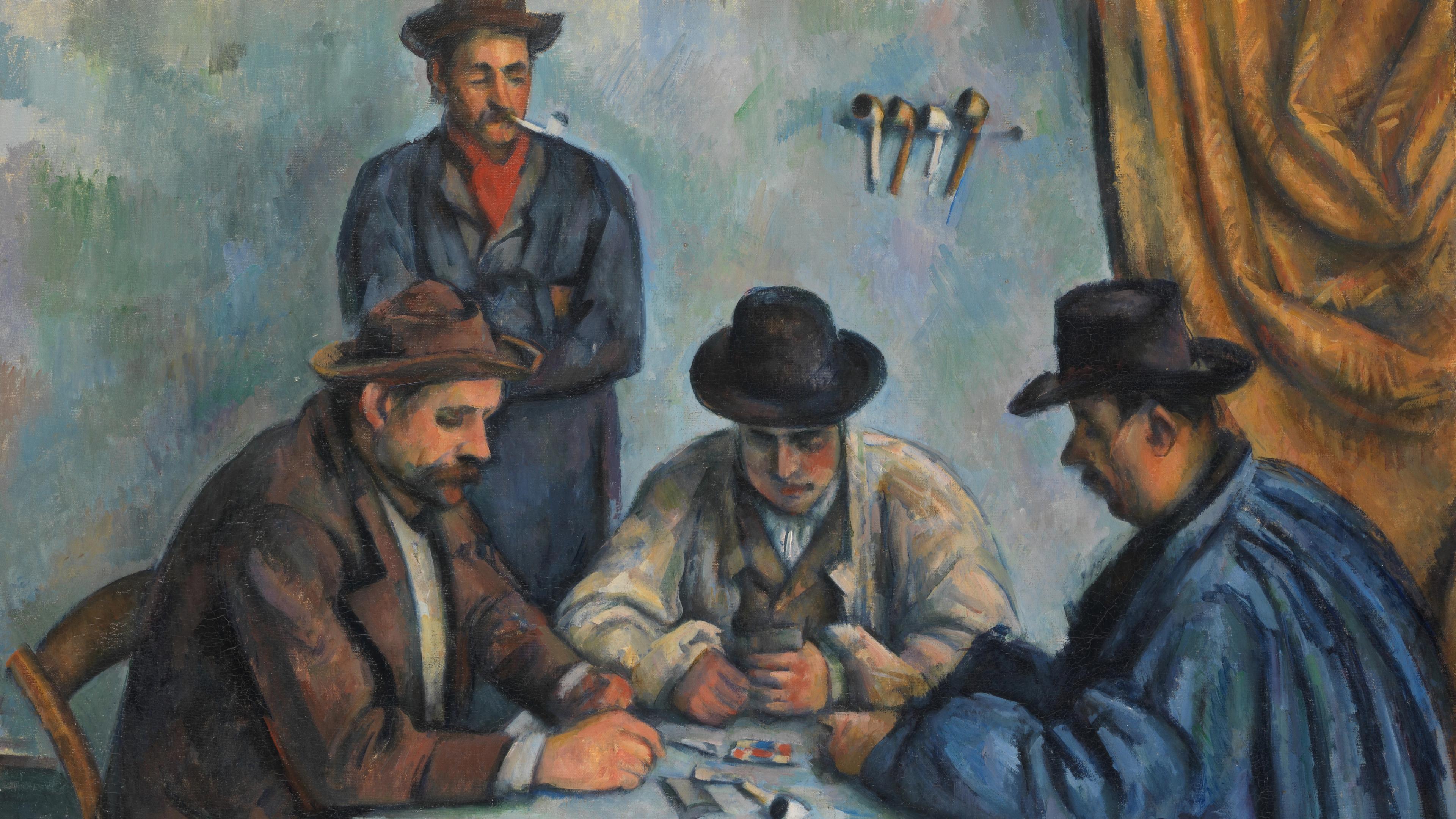
Os jogadores de cartas
Artwork Details
- Título: Os jogadores de cartas
- Artista: Paul Cézanne, francês, 1839–1906
- Data: 1890–1892
- Meio: Óleo sobre tela
- Dimensões: 65,4 x 81,9 cm
- Linha de créditos: Legado de Stephen C. Clark, 1960
- Número de acesso: 61.101.1
- Curatorial Department: European Paintings
Audio
6330. The Card Players
KEITH CHRISTIANSEN: Cézanne’s paintings of card players are among his most powerful works. He arranges the figures to form a composition as hieratic and fixed as an Egyptian relief. But he paints them with a varied brushwork that confers constantly shifting relationships. Conservator Charlotte Hale:
CHARLOTTE HALE: It's typical for Cézanne's way of working and really part of his revolutionary technique that he created this very active brushwork, in all areas of the picture, at the same time retaining tremendous structure.
KEITH CHRISTIANSEN: The sun-dappled wall and prismatic hues of the men’s coats, for example, radiate energy. But the figures, drawn with firm contours, convey steadfast calm. Cézanne was deeply attached to his native region of Provence, in southern France, and used local farmhands as his models.
CHARLOTTE HALE: The men posed individually for multiple sketches, which Cézanne then assembled on his canvas, a process that was clearly not without challenges for him. Technical examination that we undertook recently using x-radiography has revealed that he reworked the contours of the figures, the table, and the chairs many times, revising and refining the relationships between them.
KEITH CHRISTIANSEN: He changed the figure in the blue coat, for example.
CHARLOTTE HALE: In one of the sketches, the man's head is much larger and broader, and he seems to have made the head deliberately smaller on top of this massive body. I think that the massive monumental quality of the figures is part of their timelessness, part of what makes them so riveting.
KEITH CHRISTIANSEN: This is the first in a series of five paintings Cézanne made depicting card players. They are silent, timeless images that convey the dignity of the Provençal people he so admired.
More Artwork
Related Content

Research Resources
The Met provides unparalleled resources for research and welcomes an international community of students and scholars. The Met's Open Access API is where creators and researchers can connect to the The Met collection. Open Access data and public domain images are available for unrestricted commercial and noncommercial use without permission or fee.
To request images under copyright and other restrictions, please use this Image Request form.
Feedback
We continue to research and examine historical and cultural context for objects in The Met collection. If you have comments or questions about this object record, please contact us using the form below. The Museum looks forward to receiving your comments.
Content Notice
The Metropolitan Museum of Art presents over 5,000 years of art from around the world, and our online collection reflects ongoing work conducted over the course of our more than 150-year history. You may encounter objects or images that may be inappropriate for some viewers or information that may be outdated.