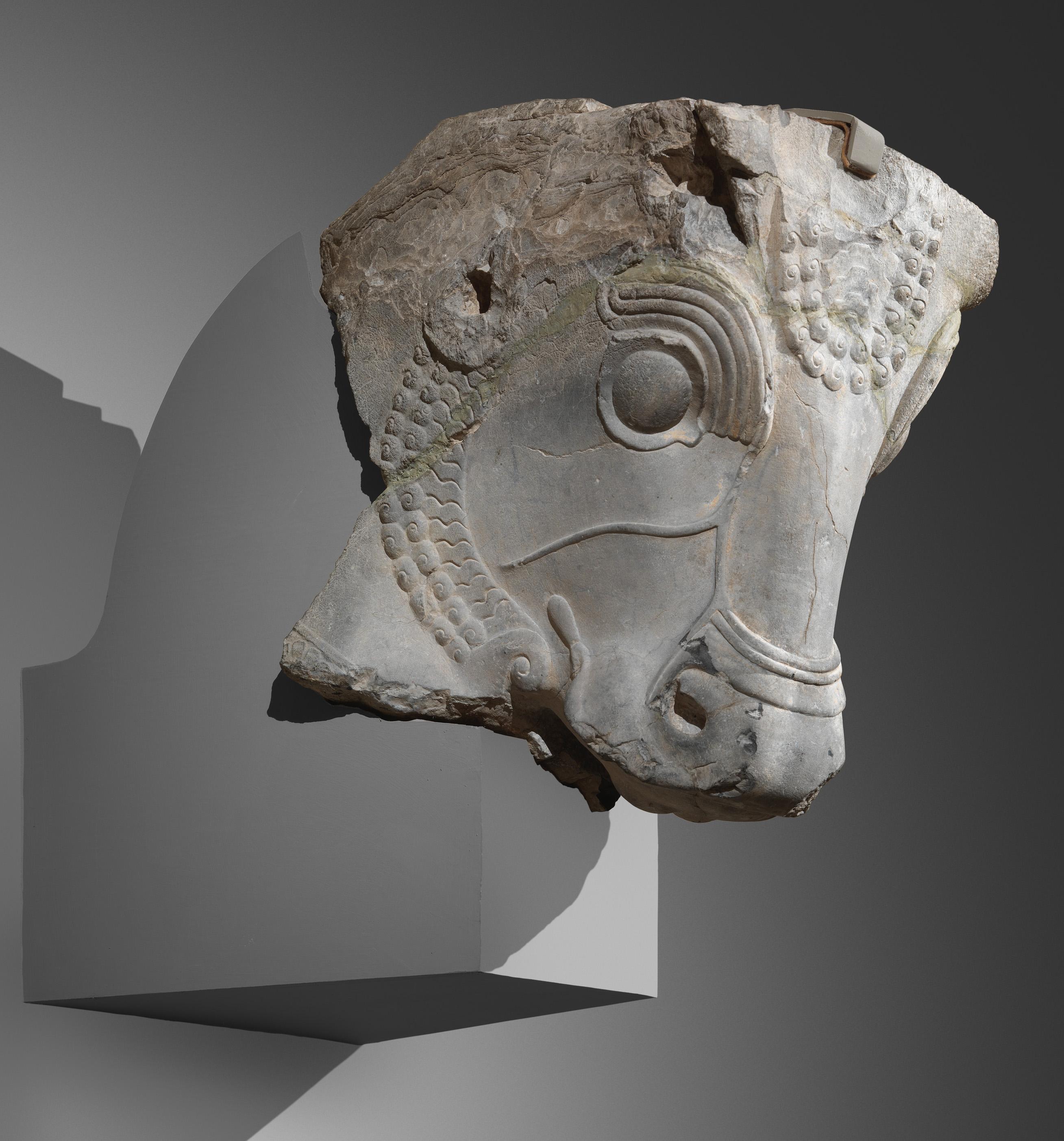
Bull's head from column capital, ca. 5th century BCE. From Iran, Istakhr, near Persepolis. Limestone, 19 1/8 × 11 1/2 × 15 3/4 in. (48.5 × 29 × 40 cm). The Metropolitan Museum of Art, New York, Rogers Fund, 1947 (47.100.83)
My name is Kamrooz Aram and I make paintings and sculptural works.
One of the things that really fascinates me about these galleries is that they're a site for what I've been referring to as "cultural nostalgia"—this idea that Iranians, particularly those in the West, will go to museums like The Met and find their glorious past. It's something that I'm critical of but also guilty of, in some ways.
I think this question of representation is really important to me. We're essentially looking at contemporary objects with a past. I don't think there's such thing as a neutral context. The museum context is as important as the object itself in informing what the object does for us today. So I'm also paying attention to the way that they're displayed, the way they're lit.
I think about this object that was essentially part of architecture and it's now been displayed as a fragment, one floral unit, whereas this was probably part of a pattern that went all the way around the room. You can see repetition already starting to happen and that alone changes everything.
Time is an element in all of these. When we look at these objects we see that passage of time. You see years of weathering that has given it this painterly quality. A painter who kind of applies paint to the canvas and scrapes it away—that quality that I love so much may have not been present. It may have been really bright and gaudy in a way that I would have been less attracted to.
I often ask myself if there were certain conventions back then that we're not aware of. There's this myth that in the ancient East they weren't sophisticated enough to make things realistic. But I tend to think that if somebody is capable of carving eyes that way or carving a pattern that way, it's not out of the question that that person would be capable of making that look like a real bull's head. Perhaps they wanted to interpret the essence of that animal rather than replicate its likeness.
It's fascinating the mythologies that get projected onto these objects. We go into these galleries and we dream of the past. We kind of look at objects for meaning and how we assign meaning to them. I'm not saying that one should forget the original context because that would be somewhat irresponsible in other ways, but at the same time there's something, for me, really compelling about seeing them as contemporary objects. That's essentially how we see them, and that's ok. We don't have to come to terms with their history every time that we look at them.