Rubbing of Stele for Shi Chen
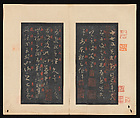
The calligraphy on the stele is an example of Han-dynasty clerical script. Originally developed by scribes and bureaucrats for everyday writing, this script type came to be widely used for stone inscriptions requiring strict, orderly forms of writing. In clerical script, blocky characters fit into an imaginary grid, and strokes tend to be of even thickness. Some horizontal strokes end in sharply defined, angular tips, while curved and downward-flaring strokes display complex shapes. The spacious layout of the text and even spacing of the strokes create a sense of dignity appropriate to the stele's placement within the temple precinct.
Artwork Details
- 清拓《史晨碑》冊 十九世紀拓本
- Title: Rubbing of Stele for Shi Chen
- Artist: Unidentified artist Chinese
- Period: Qing dynasty (1644–1911)
- Date: 19th century rubbing; stele dated 169 CE
- Culture: China
- Medium: Rubbing mounted in an album of thirty-two leaves; ink on paper
- Dimensions: Image: 10 7/8 x 5 5/8 in. (27.6 x 14.3 cm)
Overall with mounting: 13 7/8 x 7 7/16 in. (35.2 x 18.9 cm) - Classification: Rubbing
- Credit Line: Gift of Mr. and Mrs. Wan-go H. C. Weng, 1992
- Object Number: 1992.166.2a–ff
- Curatorial Department: Asian Art
More Artwork
Related Content
Research Resources
The Met provides unparalleled resources for research and welcomes an international community of students and scholars. The Met's Open Access API is where creators and researchers can connect to the The Met collection. Open Access data and public domain images are available for unrestricted commercial and noncommercial use without permission or fee.
To request images under copyright and other restrictions, please use this Image Request form.
Feedback
We continue to research and examine historical and cultural context for objects in The Met collection. If you have comments or questions about this object record, please contact us using the form below. The Museum looks forward to receiving your comments.
Content Notice
The Metropolitan Museum of Art presents over 5,000 years of art from around the world, and our online collection reflects ongoing work conducted over the course of our more than 150-year history. You may encounter objects or images that may be inappropriate for some viewers or information that may be outdated.