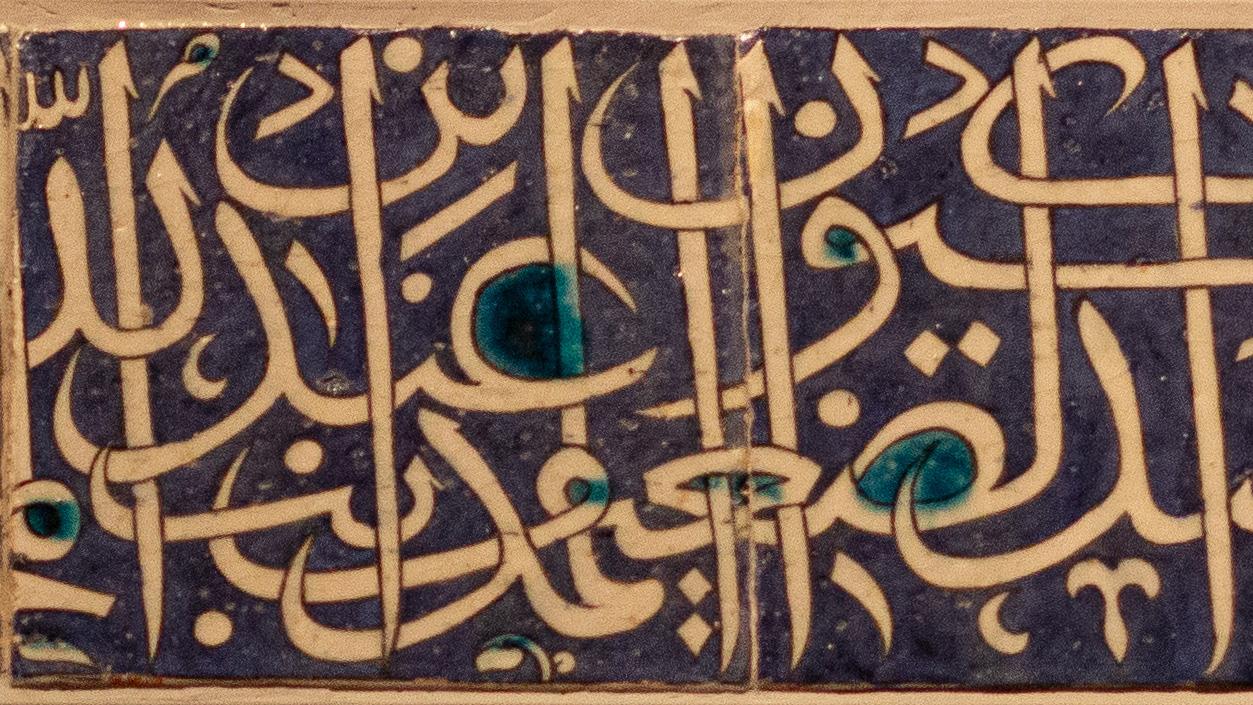
Tile Panel with Calligraphic Inscription (detail), dated 1000 AH/1591–92 CE. Syria. Stonepaste; polychrome painted under transparent glaze, 63 1/4 x 11 1/2 x 1 3/4 in. (160.7 x 29.2 x 4.4 cm); 58 lbs. (26.3 kg). The Metropolitan Museum of Art, New York, Bequest of Agnes Miles Carpenter, 1958 (58.90.1a–g)
My name is Dia Batal and I'm an artist and designer.
The work I do is inspired by Arabic language and text. I used to come to galleries and museums to visit Islamic art and just used to think, "you know, this is all stolen from our part of the world." But in the light of what's been going on, I'm actually pleased that certain pieces are preserved. This mosque may not be there now but we have the privilege of standing in front of the sign to that building.
Even if you don't read it, you'd look at it. It's a beautiful, stunning work of art, but at the same time it does mean something. There's cultural implications and it sits within another context. It's trying to convey this very simple message: "the weak servant Kayun ibn 'Abdallah, the sinful, the one in need of God's mercy, founded this blessed mosque." If you read Arabic you would read it, but you don't read it very quickly. You really have to take time because the composition of the words are not in one line the way they should be read. It's very intertwined.
There's so much focus on form and on negative and positive. The background is darker blue—you know, everything pulls your focus to the actual calligraphy itself. Within the letters he kind of started coloring in this turquoise. And I found that really funny because it's as if he started and then thought "oh, this doesn't look good." So that kind of made me smile. But it's also interesting, you know, that he's trying to convey this very simple message but it's all very well studied, very well worked, really opulent. It's a celebration of the God and who He is.
And it's interesting they probably worked also according to a certain architectural area; it's also confined by that. You know, it's in its own environment where there'd probably be, you know, an elaborate dome—beautiful light coming in, elaborate walls with floral patterns. You'd feel an awe, definitely. I mean, I'm an atheist but I'd still feel an awe just because it has this feeling of being a small being inside a much bigger thing.
When you look at details in such ancient art it kind of takes your mind back. You know, there's a human connection where you kind of think, "what was he thinking? What was he doing?" Sometimes the line kind of shivers. It reminds me that that was an actual person. You kind of forget this when you're in a museum in front of an artwork, but then when you kind of really zoom in there is this human connection.