Search / All Results

1,723 results for carpets

Image for A King’s Carpet: Louis XIV and the Savonnerie
Upcoming Exhibition

A King’s Carpet: Louis XIV and the Savonnerie

September 8, 2026–March 5, 2028
The first U.S. exhibition on the Savonnerie, A King’s Carpet explores The Met’s three carpets from this ambitious royal project.
Image for Carpets from the Islamic World, 1600–1800
Essay

Carpets from the Islamic World, 1600–1800

October 1, 2003

By Marika Sardar

[Carpets] were traded to Europe and the Far East where, too precious to be placed on the ground, they were used to cover furniture or hung on walls. Within the Islamic world, especially fine specimens were collected in royal households.
Image for Met Exhibition to Showcase Monumental Carpets Created for King Louis XIV of France
A King’s Carpet will be the first exhibition in the United States dedicated to the Savonnerie, top European manufacturer of royal carpets of the 17th and 18th centuries
Image for Islamic Textiles and Carpets from the Met's Collection
Florica Zaharia, Conservator in Charge of the Department of Textile Conservation, outlines how the textile conservators treated and prepared tapestries and carpets for the new Islamic galleries.
Image for Taking a Closer Look at the Medallions in *Carpets for Kings*
editorial

Taking a Closer Look at the Medallions in Carpets for Kings

March 22, 2017

By Courtney A. Stewart

Courtney Stewart, senior research assistant in the Department of Islamic Art, takes a closer look at the medallions in the 16th–17th century Persian rugs currently on display in the exhibition Carpets for Kings: Six Masterpieces of Iranian Weaving.
Image for Islamic Carpets in European Paintings
Essay

Islamic Carpets in European Paintings

October 1, 2011

By Walter B. Denny

From biblical times onward, the concept of having an expensive textile underfoot has been associated with wealth, power, and sanctity.
Image for Eternal Springtime: A Persian Garden Carpet from the Burrell Collection
Curator Sheila Canby explores the imagery of eternal springtime in a grand seventeenth-century Persian garden carpet on loan from the Burrell Collection.
Image for Looking at Islamic Carpets with Walter B. Denny
editorial

Looking at Islamic Carpets with Walter B. Denny

December 8, 2015

By Walter B. Denny

Guest blogger Walter B. Denny reflects upon his love of Islamic carpets and his two decades of working with the staff and resources of the Met's Antonio Ratti Textile Center.
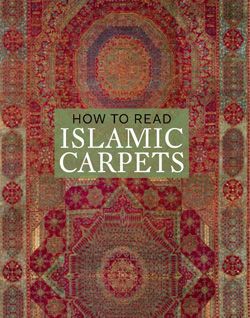
Image for How to Read Islamic Carpets
The engaging and accessible volume offers invaluable insights and novel perspectives on what is perhaps the most iconic of all Islamic art forms: the handwoven carpet. With a history stretching back to the fourteenth century and a geographic reach spanning Europe to Eurasia, Mongolia to the Middle East, Islamic carpets boast a degree of innovation and technical skill to rival the world's most exalted works of art. Beauty and brilliance emerge in equal measure from carpets of all forms be they colossal silk rugs exchanged as gifts by sultans and kings or small and sturdy textiles woven for use in nomadic encampments. Some sixty superlative examples from the Metropolitan Museum's collection—from Persia, India, Turkey, North Africa, and across the Islamic world—are presented here in lavish detail, with concise and approachable texts that position each work in historical and cultural context. Beginning with a discussion of materials and techniques, How to Read Islamic Carpets offers a comprehensive introduction to this captivating art form, and reveals the lasting influence of carpet-weaving traditions in lands far beyond the Islamic world.
Image for Flowers Underfoot: Indian Carpets of the Mughal Era
This publication features Indian carpets created between the sixteenth and the eighteenth centuries. Often overlooked for being too similar to Persian carpets or too reliant on the aesthetic of manuscript illustration, Indian carpets are distinct and meaningful contributions to Indian art and the global carpet-weaving tradition, as the author of this volume argues. More than fifty carpets made of a variety of materials—including cotton, wool, silk, and pashmina—feature in this publication, while illustrations of Indian and European paintings show the role that these carpets played in material culture across continents.
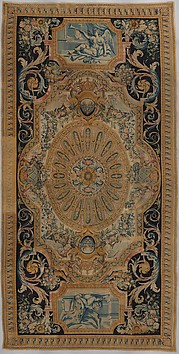
Image for Grande Galerie carpet no. 38 (Fame and Fortitude)

Savonnerie Manufactory (Manufactory, established 1626; Manufacture Royale, established 1663)

Date: ca. 1675
Accession Number: 58.75.129

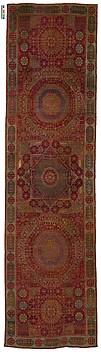
Image for Five Medallion Carpet

Date: ca. 1500
Accession Number: 1970.105

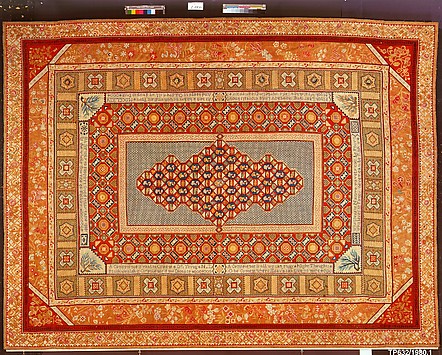
Image for Needlepoint carpet

Date: 1764
Accession Number: 1980.1

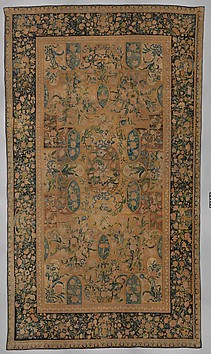
Image for Carpet (tapis)

Savonnerie Manufactory (Manufactory, established 1626; Manufacture Royale, established 1663)

Date: third quarter 17th century
Accession Number: 1976.155.113

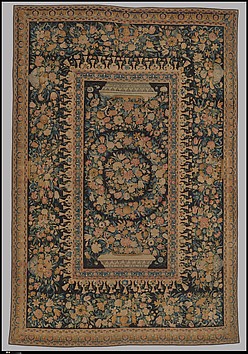
Image for Carpet (tapis)

Savonnerie Manufactory (Manufactory, established 1626; Manufacture Royale, established 1663)

Date: mid-17th century
Accession Number: 1976.155.111

Image for Carpet
Art

Carpet

Savonnerie Manufactory (Manufactory, established 1626; Manufacture Royale, established 1663)

Date: 1729–55
Accession Number: 1976.155.112

Image for 'Lotto' Carpet

Date: 16th century
Accession Number: 08.167.1

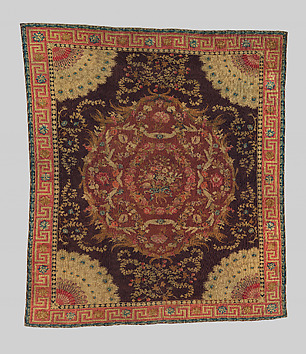
Image for Carpet
Art

Carpet

probably Axminster carpet manufactory (British, 1755–1835)

Date: ca. 1780–90
Accession Number: 57.162a, b

Image for Carpet possibly made for Harewood House

After a design by Robert Adam (British, Kirkcaldy, Scotland 1728–1792 London)

Date: Woven 1791, after a design ca. 1770
Accession Number: 1970.141

Image for Silk Animal Carpet

Date: second half 16th century
Accession Number: 14.40.721