Armet
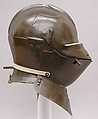
The armet was the typical head piece of the fully armored equestrian knight throughout most of the fifteenth century, and its smooth, compact, rounded form typifies the streamlined appearance of fifteenth-century Italian armor in general. The armet's close-fitting form necessitated its highly practical and ingenious construction, with cheeckpieces hinged to the bowl that opened to admit the head. The vulnerable areas that resulted where plates overlapped, particularly at the front of the chin and along the edge of the visor (which, incidentally, was not fastened closed to the cheekpieces but was merely held down by its own weight), were protected by the addition of the bevor that fit over the lower front half of the helmet. The bevor also protected the front of the neck, which was otherwise covered by the collar of a mail shirt worn underneath the armor and by the mail fringe suspended from the edge of the armet. The ventilation holes in the visor are only on the right side, so that the more exposed left side, which usually bore the brunt of blows, was not weakened.
Throughout its long use, the armet underwent gradual changes in design, and this particular example can be dated toward the end of this development, about 1490. Features which distinguish this armet as a late example include the pronounced comb; the large cusped brow reinforce which covers more than half the skull, its lower edges turned out to cover the hinges of the cheekpieces and its front edge turned out over the eyes; the shape of the visor; and the large inverted semicircular face opening.
The pierced ventilation openings on the right side of the visor are unusual for Italian armets but are found on armets believed to be of Flemish origin and on a group of armets found in English churches, such as those at Beverley Minster, Yorkshire, at Isleham, Cambridgeshire, and Hawstead, Suffolk. Apart from the visors, these armets are so similar to their Italian counterparts that it is impossible to determine if they were made in Italy for export to the north, or if they were made locally in England or Flanders, closely copied from Italian models.
Artwork Details
- Title: Armet
- Date: ca. 1490
- Culture: Italian
- Medium: Steel
- Dimensions: H. 10 5/8 in. (27 cm); W. 8 1/2 in. (21.6 cm); D. 12 7/16 in. (31.6 cm); Wt. 7 lb. 1 oz. (3217 g)
- Classification: Helmets
- Credit Line: Gift of Alan Rutherfurd Stuyvesant, 1949
- Object Number: 49.163.4
- Curatorial Department: Arms and Armor
More Artwork
Related Content
 Free to download
Research Resources
The Met provides unparalleled resources for research and welcomes an international community of students and scholars. The Met's Open Access API is where creators and researchers can connect to the The Met collection. Open Access data and public domain images are available for unrestricted commercial and noncommercial use without permission or fee.
To request images under copyright and other restrictions, please use this Image Request form.
Feedback
We continue to research and examine historical and cultural context for objects in The Met collection. If you have comments or questions about this object record, please contact us using the form below. The Museum looks forward to receiving your comments.
Content Notice
The Metropolitan Museum of Art presents over 5,000 years of art from around the world, and our online collection reflects ongoing work conducted over the course of our more than 150-year history. You may encounter objects or images that may be inappropriate for some viewers or information that may be outdated.