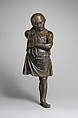
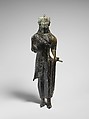
Bronze figure of a boy in Eastern dress
The subject's identity has been much debated and remains a mystery. He may represent Attis, a god of vegetation from Phrygia in central Anatolia. It has also been suggested that the existence of two copies of the same statuette may reflect a double geographical reference—that is, if set up together, the twin figures could be identified as the personifications of Armenia Major and Armenia Minor. However, the images are so similar that more likely they represent the same individual. Most recently, the statuette has been identified as a portrait of Alexander Helios, son of Mark Antony and Cleopatra VII, as prince of Armenia after Mark Antony's conquest in 34 B.C. On the other hand, the mannered style, exotic dress, and moderate scale of this figure likely signal a decorative function for the statuette, possibly as a lamp or incense-burner stand.
Artwork Details
- Title: Bronze figure of a boy in Eastern dress
- Period: Late Hellenistic or Early Imperial
- Date: mid-late 1st century BCE
- Culture: Greek, Ptolemaic or Roman
- Medium: Bronze
- Dimensions: 25 1/8 in., 29.5 lb. (63.8 cm, 13.4 kg)
Width: 11 7/8 × 12 3/4 in. (30.2 × 32.4 cm) - Classification: Bronzes
- Credit Line: Edith Perry Chapman Fund, 1949
- Object Number: 49.11.3
- Curatorial Department: Greek and Roman Art
Audio
1084. Bronze statuette of a boy in Eastern dress
This boy’s costume is indeed very curious. Notice especially his tall, pyramidal hat. He wears loose-fitting leggings beneath a long-sleeved tunic, and another garment belted high above his ample belly. A long cape, fastened with an elaborate pin, drapes down the length of his back. This costume is unusual in Greek and Roman sculpture, and recalls the type of garments worn in far eastern regions of the Roman Empire, especially in Armenia. However, this statuette, which dates to the first century B.C., was most likely made in a Greek workshop, probably in Alexandria, Egypt.
The boy is only about five or six years old. But, he gestures with an air of grandeur, while holding part of a handle or staff. What child could already be so important at such a young age that he was depicted in a regal manner and oriental attire?
The most recent, and most likely, suggestion is that he depicts Alexander Helios, the son of Marc Antony and Cleopatra. Alexander Helios was only five or six years old when his father conquered Armenia in 34 B.C. At this time, Antony declared his young son king of the newly acquired territory. This small bronze statue may have been made to adorn a sanctuary devoted to the cult of the royal house.
More Artwork
Related Content

Research Resources
The Met provides unparalleled resources for research and welcomes an international community of students and scholars. The Met's Open Access API is where creators and researchers can connect to the The Met collection. Open Access data and public domain images are available for unrestricted commercial and noncommercial use without permission or fee.
To request images under copyright and other restrictions, please use this Image Request form.
Feedback
We continue to research and examine historical and cultural context for objects in The Met collection. If you have comments or questions about this object record, please contact us using the form below. The Museum looks forward to receiving your comments.
Content Notice
The Metropolitan Museum of Art presents over 5,000 years of art from around the world, and our online collection reflects ongoing work conducted over the course of our more than 150-year history. You may encounter objects or images that may be inappropriate for some viewers or information that may be outdated.