Palma with textile motif
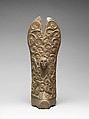
The tall, undulating shape of palmas like this one resembles a palm frond and has given this group of ballgame-related stone sculptures their modern name. There is a deep split at the top, a division emphasized by red pigment and a twisted rope motif that edges the palma and frames the left and right sides on both the front and upper back surfaces. The verticality of the palma form is further enhanced by the relief composition. Knots and connecting threads alternate from top to bottom, their size contracting and expanding to conform to the curved outline of the palma. Only a single knot on the small projecting section at the bottom stands alone. Each knot is depicted as loosely intertwined, rather than pulled tight, displaying its structure and emphasizing the process used to create the hand-woven cloth. A net or textile formed in this way would have additional rows of knots set on a diagonal, creating a web of diamond-shaped openings like those seen here between each knot. Fragments of such textiles constructed using this and similar netting techniques have been found in Mesoamerica and could have come from items of clothing or utilitarian objects such as fishing nets and carrying bags.
Designs on the back of palmas are rare. Some cover the entire rear surface; others, like this one, are limited to the top half. The relief sculpture on the Central Ballcourt of El Tajín depict palmas worn so that they angle away from the chest, making the uppermost area of the back surface visible, if only to the wearer.
Patricia J. Sarro, 2022
Further reading
Ceremonial Sculpture of Veracruz. New York: Long Island University, 1987.
Earley, Caitlin C. "Stone Sculpture and Ritual Impersonation in Classic Veracruz." Metropolitan Museum Journal (2019), pp. 8-25, fig. 5.
Koontz, Rex. Lightning Gods and Feathered Serpents: The Public Sculpture of El Tajín. Austin: University of Texas Press, 2009.
Leyenaar, Ted J.J. Ulama, Jeu de Balle des Olmeques aux Azteques - Ballgame, from the Olmecs to the Aztecs. Lausanne: Musée Olympique, 1997.
Reents-Budet, Dorie (ED.) Painting the Maya Universe: Royal Ceramics of the Classic Period. Durham, N.C.: Duke University Press, 1994.
Schele, Linda and Mary Ellen Miller. "The Ballgame." In The Blood of Kings. New York: George Braziller, 1986, pp. 241-264.
Scott, John F. "Dressed to Kill: Stone Regalia of the Mesoamerican Ballgame." In The Sport of Life and Death, The Mesoamerican Ballgame, E. Michael Whittington, ed, pp. 50-63. New York: Thames and Hudson, 2001.
Shook, Edwin M. and Elayne Marquis. Secrets in Stone: Yokes, Hachas and Palmas from Southern Mesoamerica. Philadelphia: American Philosophical Society, 1996.
Turner, Andrew D., and Payton Phillips Quintanilla. “Collecting and Constructing Classic Veracruz: Earl Stendahl, Guillermo Echaniz, and the Market for Mesoamerican Stone Ballgame Objects.” Journal for Art Market Studies, 2023.
Von Winning, Hasso and Nelly Gutiérrez Solana. La iconographía de la cerámica de Río Blanco, Veracruz. Mexico City: UNAM Instituto de Investigaciones Estéticas, 1996.
Whittington, E. Michael, ed. The Sport of Life and Death: The Mesoamerican Ballgame. New York: Thames and Hudson, 2001.
Artwork Details
- Title: Palma with textile motif
- Artist: Classic Veracruz artist(s)
- Date: 800–1100 CE
- Geography: Mexico, Mesoamerica, Veracruz
- Culture: Veracruz
- Medium: Stone, pigment
- Dimensions: H. 20 1/8 x W. 8 1/8 x D. 5 in. (51.1 x 20.6 x 12.7 cm)
- Classification: Stone-Sculpture
- Credit Line: The Michael C. Rockefeller Memorial Collection, Bequest of Nelson A. Rockefeller, 1979
- Object Number: 1979.206.425
- Curatorial Department: The Michael C. Rockefeller Wing
More Artwork
Related Content
 Free to download
Research Resources
The Met provides unparalleled resources for research and welcomes an international community of students and scholars. The Met's Open Access API is where creators and researchers can connect to the The Met collection. Open Access data and public domain images are available for unrestricted commercial and noncommercial use without permission or fee.
To request images under copyright and other restrictions, please use this Image Request form.
Feedback
We continue to research and examine historical and cultural context for objects in The Met collection. If you have comments or questions about this object record, please contact us using the form below. The Museum looks forward to receiving your comments.
Content Notice
The Metropolitan Museum of Art presents over 5,000 years of art from around the world, and our online collection reflects ongoing work conducted over the course of our more than 150-year history. You may encounter objects or images that may be inappropriate for some viewers or information that may be outdated.