English
DonateMembershipTickets

Handle with two heads of ducks

ca. 9th–8th century BCE
Not on view
This object was found in Fort Shalmaneser, a royal building at Nimrud that was used to store booty and tribute collected by the Assyrians while on military campaign. Many thousands of pieces of carved ivory, probably used as furniture decoration or luxury objects, were excavated from storage rooms in the building. While not as common, carved shell and bone items were also stored at Fort Shalmaneser. This roughly cylindrical object was carved from a piece of bone and decorated with back to back duck’s heads in relief, with bills pointing down and held close to the breast. A circle with drilled dot at the center marks each duck’s eye, and the motif is repeated as a border of circles and dots at the top and bottom. A hole runs through the piece lengthwise, perhaps for inserting a tang that belonged to the implement for which this served as part of a decorated handle.

Artwork Details

Object Information
  • Title: Handle with two heads of ducks
  • Period: Neo-Assyrian
  • Date: ca. 9th–8th century BCE
  • Geography: Mesopotamia, Nimrud (ancient Kalhu)
  • Culture: Assyrian
  • Medium: Bone
  • Dimensions: 2 1/4 x 1 3/4 in. (5.7 x 4.4 cm)
  • Credit Line: Rogers Fund, 1962
  • Object Number: 62.269.9
  • Curatorial Department: Ancient West Asian Art
More Artwork
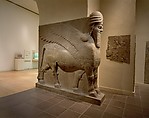
Human-headed winged bull (lamassu), Gypsum alabaster, Assyrian
Assyrian
ca. 883–859 BCE
Cabinet, Jean Brandely  French, Oak veneered with cedar, walnut, ebony and ivory; silvered-bronze mounts, French, Paris
Designer Designed by Jean Brandely
Woodwork by Charles-Guillaume Diehl
Mounts and large central plaque by Emmanuel Frémiet
1867
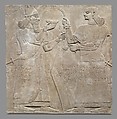
Relief panel, Gypsum alabaster, Assyrian
Assyrian
ca. 883–859 BCE
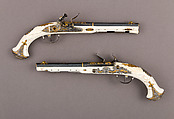
Pair of Flintlock Pistols of Empress Catherine the Great (1729–1796), Johan Adolph Grecke  Russian, Steel, ivory, gold, brass, Russian, Saint Petersburg
Gunsmith Johan Adolph Grecke
1786
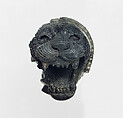
Furniture element carved in the round with the head of a roaring lion, Ivory, Assyrian
Assyrian
ca. 9th–8th century BCE

Research Resources

The Met provides unparalleled resources for research and welcomes an international community of students and scholars. The Met's Open Access API is where creators and researchers can connect to the The Met collection. Open Access data and public domain images are available for unrestricted commercial and noncommercial use without permission or fee.

To request images under copyright and other restrictions, please use this Image Request form.

Feedback

We continue to research and examine historical and cultural context for objects in The Met collection. If you have comments or questions about this object record, please contact us using the form below. The Museum looks forward to receiving your comments.

Send feedback

Content Notice

The Metropolitan Museum of Art presents over 5,000 years of art from around the world, and our online collection reflects ongoing work conducted over the course of our more than 150-year history. You may encounter objects or images that may be inappropriate for some viewers or information that may be outdated.