Search the collection

Filter By

Object Type / Material
Iraq
Department
Date
Show Only:
  • As part of the Met's Open Access policy, you can freely copy, modify and distribute this image, even for commercial purposes.
    APIPublic domain data for this object can also be accessed using the Met's Open Access API
  • Objects with changed or unknown ownership in continental Europe between 1933-1945. Learn more
Showing 2,531 results
Sort by:
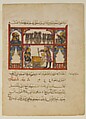
"Preparing Medicine from Honey", from a Dispersed Manuscript of an Arabic Translation of De Materia Medica of Dioscorides, 'Abdullah ibn al-Fadl, Ink, opaque watercolor, and gold on paper
'Abdullah ibn al-Fadl
dated 621 AH/1224 CE
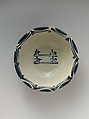
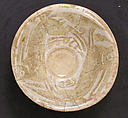
Bowl Emulating Chinese Stoneware, Earthenware; painted in blue on opaque white glaze
9th century
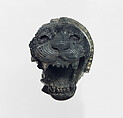
Furniture element carved in the round with the head of a roaring lion, Ivory, Assyrian
Assyrian
ca. 9th–8th century BCE
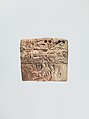
Proto-Cuneiform tablet with seal impressions: administrative account of barley distribution with cylinder seal impression of a male figure, hunting dogs, and boars, Clay, Sumerian
Sumerian
ca. 3100–2900 BCE
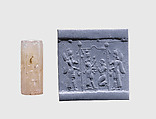
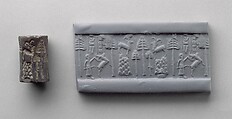
Cylinder seal and modern impression: hunting scene, Chert, Akkadian
Akkadian
ca. 2250–2150 BCE
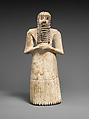
Standing male worshiper, Gypsum alabaster, shell, black limestone, bitumen, Sumerian
Sumerian
ca. 2900–2600 BCE
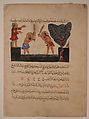
"Men Treading Grapes", Folio from a Materia Medica of Dioscorides, Ink, opaque watercolor, and gold on paper
dated 621 AH/1224 CE
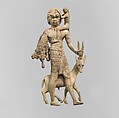
Figure of a man with an oryx, a monkey, and a leopard skin, Ivory, Assyrian
Assyrian
ca. 8th century BCE
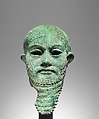
Head of a ruler, Copper alloy
ca. 2300–2000 BCE
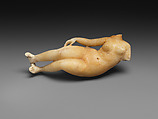
Figure of a reclining woman, Alabaster (gypsum), Parthian
Parthian
ca. 2nd century BCE–2nd century CE
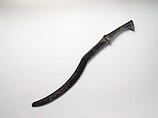
Sickle sword, Bronze, Assyrian
Assyrian
ca. 1307–1275 BCE
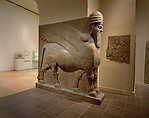
Human-headed winged bull (lamassu), Gypsum alabaster, Assyrian
Assyrian
ca. 883–859 BCE
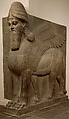
Human-headed winged lion (lamassu), Gypsum alabaster, Assyrian
Assyrian
ca. 883–859 BCE
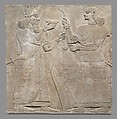
Relief panel, Gypsum alabaster, Assyrian
Assyrian
ca. 883–859 BCE
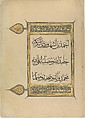
Folio from a Qur'an Manuscript, Ahmad ibn al-Suhrawardi al-Bakri, Ink, opaque watercolor, and gold on paper
Ahmad ibn al-Suhrawardi al-Bakri
Muhammad ibn Aibak ibn 'Abdallah
dated 707 AH/1307–8 CE
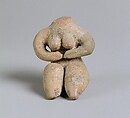
Seated female, Ceramic, paint, Halaf
Halaf
ca. 5600–5000 BCE
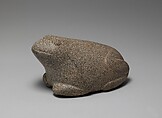
Weight in shape of frog, Diorite or andesite, Babylonian
Babylonian
ca. 2000–1600 BCE
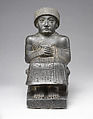
Statue of Gudea, named “Gudea, the man who built the temple, may his life be long”, Diorite, Neo-Sumerian
Neo-Sumerian
ca. 2090 BCE
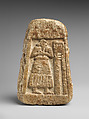
Stele of Ushumgal and Shara-igizi-Abzu, Gypsum alabaster, Sumerian
Sumerian
2900–2700 BCE
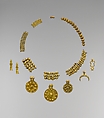
Pendants and beads, Gold, Babylonian
Babylonian
ca. 18th–17th century BCE
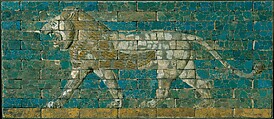
Panel with striding lion, Ceramic, glaze, Babylonian
Babylonian
ca. 604–562 BCE
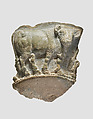
Fragment of a bowl with a frieze of bulls in relief, Steatite with chlorite
ca. 3300–2900 BCE
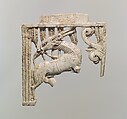
Openwork furniture plaque with a grazing oryx in a forest of fronds, Ivory, Assyrian
Assyrian
ca. 9th–8th century BCE
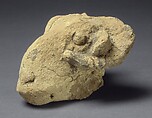
Head of a ram, Ceramic
ca. 3500–3100 BCE
Cylinder seal with cultic scene
, Flawed neutral Chalcedony (Quartz), Assyrian
Assyrian
late 9th–early 8th century BCE
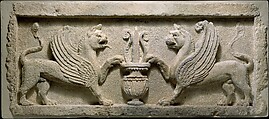
Door lintel with lion-griffins and vase with lotus leaf, Limestone, Parthian
Parthian
ca. 2nd–early 3rd century CE
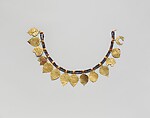
Headdress, Gold, lapis lazuli, carnelian, Sumerian
Sumerian
ca. 2600–2500 BCE
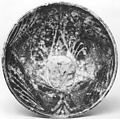
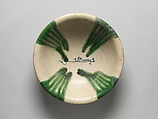
Bowl with Green Splashes, Earthenware; 'splash-painted' on opaque white glaze
9th century
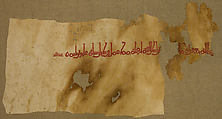
Tiraz Textile Fragment, Linen; plain weave, embroidered in silk
ca. 991–1031
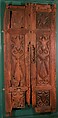
Pair of Doors Carved in the 'Beveled Style', Wood (teak); carved
9th century
Pair of Doors Carved in the 'Beveled Style', Wood (teak); carved
9th century
Pair of Doors, Wood (teak); frames with carved panels
9th century
Pair of Doors, Wood (teak); carved
9th century
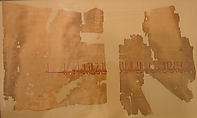
Textile Fragment with Inscription, Cotton, gold, ink; plain weave, painted
10th–11th century
Jar with Four Lug Handles, Earthenware; painted in blue on opaque white glaze
9th century
Fragment of a Lotus-Shaped Bowl with Luster and Green-Mottled Decoration, Earthenware; polychrome luster-painted on opaque white glaze
10th century
Imported Luster Bowl, Earthenware; luster-painted on an opaque white glaze
10th century
Jar Depicting Three Spirited Peacocks, Earthenware; luster-painted on opaque white glaze
second half 10th century
Dish with Interlace Designs, Earthenware; molded and glazed
9th century
Cup with Molded Honeycomb Pattern, Glass, colorless with yellow tinge; dip-molded, blown
7th–10th century or later