Cylinder seal
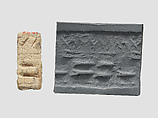
Several styles of seal-carving are known from the Kassite period. The so-called “First Kassite Style” hearkens back to the Old Babylonian presentation scene in which a worshipper appears before a king or deity, but is distinguished from this earlier style by lengthy inscriptions and abbreviated scenes with elongated figures. This milky chalcedony cylinder, carved with a single, bearded male figure wearing a rounded cap and a long fringed dress who stands before an eight-line hymn to the goddess Inanna, is a fine example of the First Kassite Style. The hymn beseeches the goddess to bless Nur-Shamash, in all aspects of civilized life (the “me” in Sumerian), for which she is responsible.
Kassite period artists often drew upon the rich historical traditions of Mesopotamia. In this case, the long-dead Sumerian language and archaic signs were used to write the inscription. The hymn identifies the goddess as “Inanna of Agade”, a form of the goddess associated with the Akkadian kings who reigned ca. 2350-2150 B.C. The deep knowledge of the past exhibited in this and other works of the period demonstrate the interest of the non-Babylonian Kassite rulers in mastering the history and culture of Babylonia, already an ancient land.
Artwork Details
- Title: Cylinder seal
- Period: Kassite
- Date: ca. 16th–12th century BCE
- Geography: Mesopotamia
- Culture: Kassite
- Medium: Milky chalcedony
- Dimensions: 1.35 in. (3.43 cm)
- Credit Line: Gift of The Right Reverend Paul Moore Jr., 1985
- Object Number: 1985.357.29
- Curatorial Department: Ancient West Asian Art
More Artwork
Related Content

 Free to download
Research Resources
The Met provides unparalleled resources for research and welcomes an international community of students and scholars. The Met's Open Access API is where creators and researchers can connect to the The Met collection. Open Access data and public domain images are available for unrestricted commercial and noncommercial use without permission or fee.
To request images under copyright and other restrictions, please use this Image Request form.
Feedback
We continue to research and examine historical and cultural context for objects in The Met collection. If you have comments or questions about this object record, please contact us using the form below. The Museum looks forward to receiving your comments.
Content Notice
The Metropolitan Museum of Art presents over 5,000 years of art from around the world, and our online collection reflects ongoing work conducted over the course of our more than 150-year history. You may encounter objects or images that may be inappropriate for some viewers or information that may be outdated.