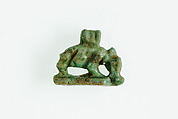
Lion Head Pendant
Lion head amulets exhibit changes in the representation of lions that appeared during the later first millennium B.C. The forehead is smaller, and the face is drawn downward. During the Late Period, there is an emphasis on the mane beneath the cheeks, lacking here. This development might suggest a later date or that it originates from outside Egypt.
While various goddesses take the lioness's form, the lion is rarely associated with specific gods and more commonly appears alongside power and kingship images. Nevertheless, this noble feline is viewed as a magical guardian figure with apotropaic qualities throughout Egyptian history, and its likeness decorates so-called magical knives (birth tasks), furniture, and amulets like this one here.
While various goddesses take the lioness's form, the lion is rarely associated with specific gods and more commonly appears alongside power and kingship images. Nevertheless, this noble feline is viewed as a magical guardian figure with apotropaic qualities throughout Egyptian history, and its likeness decorates so-called magical knives (birth tasks), furniture, and amulets like this one here.
Artwork Details
- Title: Lion Head Pendant
- Period: Late Period or later
- Date: ca. 4th century B.C. or later
- Geography: From Egypt
- Medium: Faience
- Dimensions: H. 7 × W. 4.7 × D. 2.6 cm (2 3/4 × 1 7/8 × 1 in.)
- Credit Line: Bequest of Nanette B. Kelekian, 2020
- Object Number: 2021.41.73
- Curatorial Department: Egyptian Art
More Artwork
A slider containing 5 items.
Press the down key to skip to the last item.
Press the down key to skip to the last item.
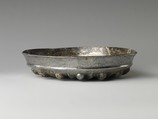
4th century B.C.
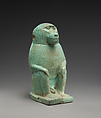
664–525 BCE
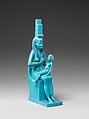
332–30 BCE
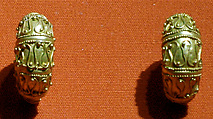
A.D. 1st–2nd century
ca. 1086–664 B.C.
Research Resources
The Met provides unparalleled resources for research and welcomes an international community of students and scholars. The Met's Open Access API is where creators and researchers can connect to the The Met collection. Open Access data and public domain images are available for unrestricted commercial and noncommercial use without permission or fee.
To request images under copyright and other restrictions, please use this Image Request form.
Feedback
We continue to research and examine historical and cultural context for objects in The Met collection. If you have comments or questions about this object record, please contact us using the form below. The Museum looks forward to receiving your comments.