성모자상
Artwork Details
- 제목: 성모자상
- 아티스트: 두초 디부오닌세냐, 이탈리아, 활동기 1278– 1 318년
- 연대: 1300년경
- 재료: 목판에 템페라 및 금;
- 크기: 총 27.9 × 21cm, 색칠된 표면 23.8 × 16.5cm
- 크레디트 라인: 매입, 로저스 기금, 월터와 레오노르 아넨버그 및 아넨버그 재단 기증, 릴라 애치슨 월러스 기증, 애넷 드 라 렌타 기증 해리스 브리스베인 딕, 플레처, 루이 V. 벨, 및 다지 기금 조지프 퓰리처 유증, 복수의 회장위원회 일원 기증, 일레인 L. 로젠버그 및 스티븐슨 가문 개단 기증, 2003년도 자선 기금 여러 기증자로부터의 기증 및 기금, 2004
- 작품 번호: 2004.442
- Curatorial Department: European Paintings
Audio
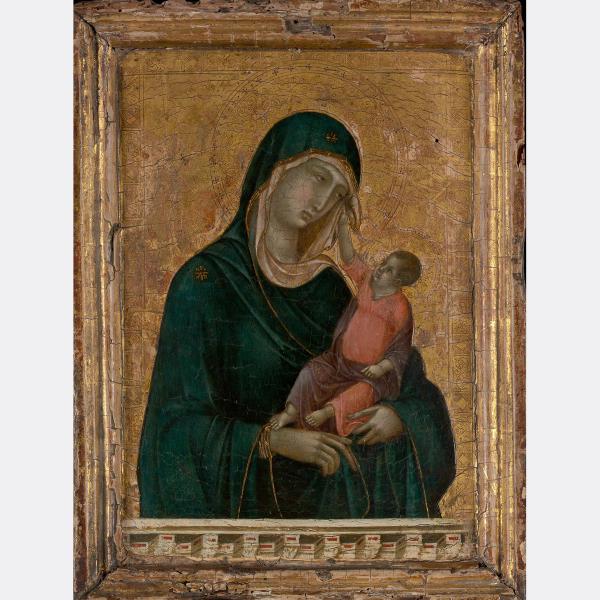
5162. Madonna and Child
Duccio Di Buoninsegna, 1290-1300
STEPHAN WOLOHOJIAN: I always remind people that this painting could be held. It's smaller than a sheet of notebook paper. It was for private devotion.
Hello. I’m Stephan Wolohojian. I’m Curator in Charge of European Paintings.
NARRATOR: This powerful image shows Mary, the mother of Jesus...
STEPHAN WOLOHOJIAN: Who looks out knowing very much what's ahead for her son, who tugs at this refined veil, very much a premonition, perhaps, of the shroud, of the burial cloth that would be his end.
DR. SHANNEN DEE WILLIAMS: I’m always fascinated by depictions of the Madonna and Child.
My name is Dr. Shannen Dee Williams, I am an associate professor of history at the University of Dayton.
STEPHAN WOLOHOJIAN: So, this moment of beginning is already allowing the beholder to think about the end, the very nature of her sorrow and her life, and the wisdom that comes with motherhood.
DR. SHANNEN DEE WILLIAMS: [Mary]speaks to a universal experience.
I identify as a Black Catholic Woman who is also a historian of Black Catholic Women.
NARRATOR: In this painting, Mary’s skin has a green cast. But that doesn’t reflect its original appearance. Over time, the flesh tones have been lost, so that a green underlayer called Terra Verde dominates.
DR. SHANNEN DEE WILLIAMS: I grew up in a predominantly white southern suburban parish. So much of the Catholic iconography that I encountered depicted the holy family as Europeans, which is not historically accurate.
NARRATOR: Exploring these galleries further, you’ll notice that other images of the Virgin present her with features that evoke a European ideal, rather than reflecting her origins in the Holy Land.
DR. SHANNEN DEE WILLIAMS: So for me, one question that I always had to ask myself is, well, if this iconography is showcasing what is divine, what does it mean when that divinity is only rooted in whiteness, in Europeanness? If this Europeanness comes to signify holiness and purity then what does African and later Blackness come to signify?
NARRATOR: Still, according to Dr. Williams, Black Catholics have found ways to see themselves within a visual tradition that has often excluded them.
DR. SHANNEN DEE WILLIAMS: Mary is the mother of the church, but she’s also a suffering mother. Regardless of how she is depicted, and what skin color or whatnot, there are these universal themes that speak to so many people, that speak across cultures.
Listen to more about this artwork
More Artwork
Related Content
Research Resources
The Met provides unparalleled resources for research and welcomes an international community of students and scholars. The Met's Open Access API is where creators and researchers can connect to the The Met collection. Open Access data and public domain images are available for unrestricted commercial and noncommercial use without permission or fee.
To request images under copyright and other restrictions, please use this Image Request form.
Feedback
We continue to research and examine historical and cultural context for objects in The Met collection. If you have comments or questions about this object record, please contact us using the form below. The Museum looks forward to receiving your comments.
Content Notice
The Metropolitan Museum of Art presents over 5,000 years of art from around the world, and our online collection reflects ongoing work conducted over the course of our more than 150-year history. You may encounter objects or images that may be inappropriate for some viewers or information that may be outdated.