Gérôme specialized in a brand of photographic realism which, from the 1840s onward, distinguished him from the increasingly stale Neoclassical style promulgated by the followers of Jean Auguste Dominique Ingres. In 1859, Gérôme began a long and prosperous relationship with the dealer and art publisher Adolphe Goupil, and his success in the newly-established private marketplace liberated him from State commissions and submission to the Salon, although he continued to exhibit there. With Gérôme, the romanticism of earlier artists such as Delacroix and Ingres gives way to the very contemporary objective of recreating the subject depicted rather than evoking it.
Gérôme toured Egypt and Asia Minor from January 1 to April 13, 1868; his companions included Edmond About, who composed a novel about it (
Le Fellah, 1869, dedicated to Gérôme), the journalist Frédéric Masson, the painter Léon Bonnat, and Gérôme's brother-in-law Albert Goupil, an amateur photographer. It is probable that he began work on this canvas in the months following his return to France, and it was completed by March 1869. As the Gérôme scholar Gerald Ackerman has observed, the artist’s Orientalist pictures were not necessarily painted or even conceived abroad, and many of them were executed in his studio using props acquired on his travels.
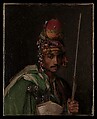
"Bashi-Bazouks were irregular Turkish troops of the Ottoman Empire. They were not paid for their services, but lived from plunder, and were especially feared for their ferocity" (Ackerman 1986, p. 83). Bashi-bazouk is the transliteration of a Turkish term whose literal definition is "broken-head," a reference to the reckless behavior of these soldiers of fortune; but the term may be translated idiomatically as "headless," because this takes into account the fact that the soldiers were not bound by a strict or disciplined hierarchy. The subject held obvious appeal throughout the nineteenth century: an example by Charles Bargue, dated 1875, is also in the Metropolitan Museum (
87.15.102). Similar figures were included in many of Gérôme's paintings, alone and in groups, but none is as arresting an image as this. The expanse of pink silk across the figure's back, shoulders, and arms, combined with the shadow that hides his eyes, disperses and softens the visual impact of the many details of his costume. The figure's aloofness is a byproduct of the illusion that he has not yielded himself entirely to the painter, which endows him with a proud dignity. Photographic reproductions of the Wrightsman painting were circulated by Goupil, Gérôme's dealer, as early as 1869 or 1870 (Tinterow and Miller 2005, p. 390, fig. 1).
Although the distinguished collector Samuel Putnam Avery bought this painting in 1873, it drew considerable attention when a subsequent owner, Henry T. Cox, lent it to the 1884 exhibition organized to raise money for the pedestal for Bartholdi's Statue of Liberty in New York Harbor (Exh. Brooklyn 1884). As noted by a critic for the Brooklyn Daily Eagle (1884): "A strong contrast to the handling of Munkacsy is the finished but powerful handling of Gerome [sic], seen in the Loan exhibition through a good sized canvas hung on the wall opposite the Assembly Room, and showing a half-length portrait of ‘A Bashi-Bazouk.’ The swarthy features of the fellow are shown partially in profile, and the dark color of the skin is brought out against the still darker background. He wears a loose, light silk tunic and a tall, elaborately decorated turban, while above one arm protrude the handles of two or three weapons. There is a great deal of character and dramatic power in the picture, and although not large it is an admirable example of the famous artist."
[2014; adapted from Tinterow and Miller 2005]