Bahram Gur and Azada
Artwork Details
- Title: Bahram Gur and Azada
- Date: 12th–13th century
- Geography: Attributed to Iran
- Medium: Stonepaste; polychrome inglaze and overglaze painted on opaque monochrome glaze (mina'i)
- Dimensions: H. 3 13/16 in. (9.7 cm)
Diam. 8 1/2 in. (21.6 cm) - Classification: Ceramics
- Credit Line: Purchase, Rogers Fund, and Gift of The Schiff Foundation, 1957
- Object Number: 57.36.13
- Curatorial Department: Islamic Art
Audio
6690. Two Ceramic Bowls with Scenes of Bahram Gur and Azada, Part 1
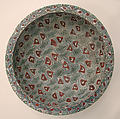
MARYAM EKHTIAR: I'm Maryam Ekhtiar, Senior Research Associate in the Department of Islamic Art. I'm joined here with my colleague who's an objects conservator, Jean-Francois de Lapérouse. We're here today to discuss this wonderful Mina'i bowl, which depicts a favorite story in Persian literature, often in the Shahnameh; the story of Bahram Gur and Azadeh on a hunt. This bowl shows Bahram Gur and Azadeh on a camel as they set out… to hunt gazelle. …He's a Persian king. …And he throws an arrow and pins the ear of the gazelle to its tail. And of course his lover, Azadeh, who's an Armenian princess, she's not happy about what he did because he had actually performed a cruel act. And she reprimanded him. …And he threw her off the camel. So in this scene, you see her… on the camel with him, as well as being… trampled by the camel down below. Jean-Francois, could you say a few words about the technique used here?
JEAN-FRANCOIS DE LAPÉROUSE: Actually this piece is in excellent condition… And that's rather unusual for Mina'i bowls because… it was formed using a ceramic body consisting of about ten parts crushed quartz stone, one part glass, and two parts clay… And this enabled you to create a very thin-walled but strong vessel. Unfortunately, though, it's not quite as strong as the porcelain type wares that they may have been trying to emulate. And a result, many of the Mina'i pieces, all of which were recovered from the ground, were often shattered into many pieces.
NARRATOR: Mina’i is a distinctly Islamic technique; and you’ll find many Mana’i objects in these galleries. To hear how it’s made, press PLAY.
Listen to more about this artwork
More Artwork
Related Content
 Free to download
Research Resources
The Met provides unparalleled resources for research and welcomes an international community of students and scholars. The Met's Open Access API is where creators and researchers can connect to the The Met collection. Open Access data and public domain images are available for unrestricted commercial and noncommercial use without permission or fee.
To request images under copyright and other restrictions, please use this Image Request form.
Feedback
We continue to research and examine historical and cultural context for objects in The Met collection. If you have comments or questions about this object record, please contact us using the form below. The Museum looks forward to receiving your comments.
Content Notice
The Metropolitan Museum of Art presents over 5,000 years of art from around the world, and our online collection reflects ongoing work conducted over the course of our more than 150-year history. You may encounter objects or images that may be inappropriate for some viewers or information that may be outdated.