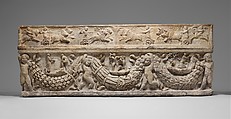
Sarcophagus with Scenes from the Lives of Saint Peter and Christ
Originally, four scenes from Christ’s life decorated the sarcophagus: the Entry into Jerusalem, the Cure of the Man Born Blind, the Multiplication of the Loaves, and the Raising of Lazarus. In the modern restoration, the Cure of the Man Born Blind was omitted, with the man’s feet used instead for the small, frightened child in the Entry into Jerusalem. Roughly carved in low relief on the ends are two Old Testament scenes foretelling mankind’s salvation by Christ: Three Hebrews in the Fiery Furnace and Adam and Eve after the Fall by the Tree of Knowledge.
The sarcophagus was brought to America to decorate the grounds of Burrwood, an estate on Long Island.
Artwork Details
- Title: Sarcophagus with Scenes from the Lives of Saint Peter and Christ
- Date: early 300s, with modern restoration
- Culture: Roman
- Medium: Marble
- Dimensions: 26 1/2 × 83 1/2 × 24 3/8 in. (67.3 × 212.1 × 61.9 cm)
- Classification: Sculpture-Stone
- Credit Line: Gift of Josef and Marsy Mittlemann, 1991
- Object Number: 1991.366
- Curatorial Department: Medieval Art and The Cloisters
Audio
2820. Sarcophagus with Scenes from the Lives of Saint Peter and Christ
NARRATOR: Narrative events from the apocryphal life of Saint Peter are joined on the front of this sarcophagus with stories from the life of Christ.
Look at the different carving styles. The scenes with Saint Peter are boldly carved in deep relief, the style of the early fourth century. The scenes relating to Christ are much flatter and less dramatically carved; they are, in fact, restored from the knees up. One easy way to tell the restored area is to note that Christ appears as a bearded man—an image that did not exist in the fourth century, when he was always shown beardless with curly hair.
On the sides, events from the Old Testament are carved in low relief.
Helen Evans is a curator specializing in Byzantine art at the Metropolitan.
HELEN EVANS: It’s important in looking at these sarcophagi, to think of them in a way as a sermon in stone. And if you look at these two scenes, and look at them in relationship to the shape of the sarcophagus, you will see that the dominant figures, their heads jut forward out from under the lip at the top of the sarcophagus. And you have something that brings you into the space of these two scenes.
And so you have to resurrect in your own mind, or recreate in your own mind, an entire front that would have been as teeming with life, and as dramatically telling you that you can be saved by this man who entered Jerusalem, died for your sins, and that by your presence in Rome where Peter is, you have a particularly good connection to heaven when you arrive there.
More Artwork
Related Content
 Free to download
Research Resources
The Met provides unparalleled resources for research and welcomes an international community of students and scholars. The Met's Open Access API is where creators and researchers can connect to the The Met collection. Open Access data and public domain images are available for unrestricted commercial and noncommercial use without permission or fee.
To request images under copyright and other restrictions, please use this Image Request form.
Feedback
We continue to research and examine historical and cultural context for objects in The Met collection. If you have comments or questions about this object record, please contact us using the form below. The Museum looks forward to receiving your comments.
Content Notice
The Metropolitan Museum of Art presents over 5,000 years of art from around the world, and our online collection reflects ongoing work conducted over the course of our more than 150-year history. You may encounter objects or images that may be inappropriate for some viewers or information that may be outdated.