Cup, Glasses, and Bottle (Le Journal)
Papier collé, a method of adhering diverse paper elements in a composition to upend the tradition of painted representation, was a Cubist technique invented in 1912 by Georges Braque and Pablo Picasso. Initially, Gris only made occasional use of papier collé, but it was he who first exhibited a papier collé composition (The Washstand, 1912, private collection), at the 1912 Section d’Or exhibition at the Galerie la Boétie, Paris, where he received great critical attention for the "curious originality of [his] imagination."
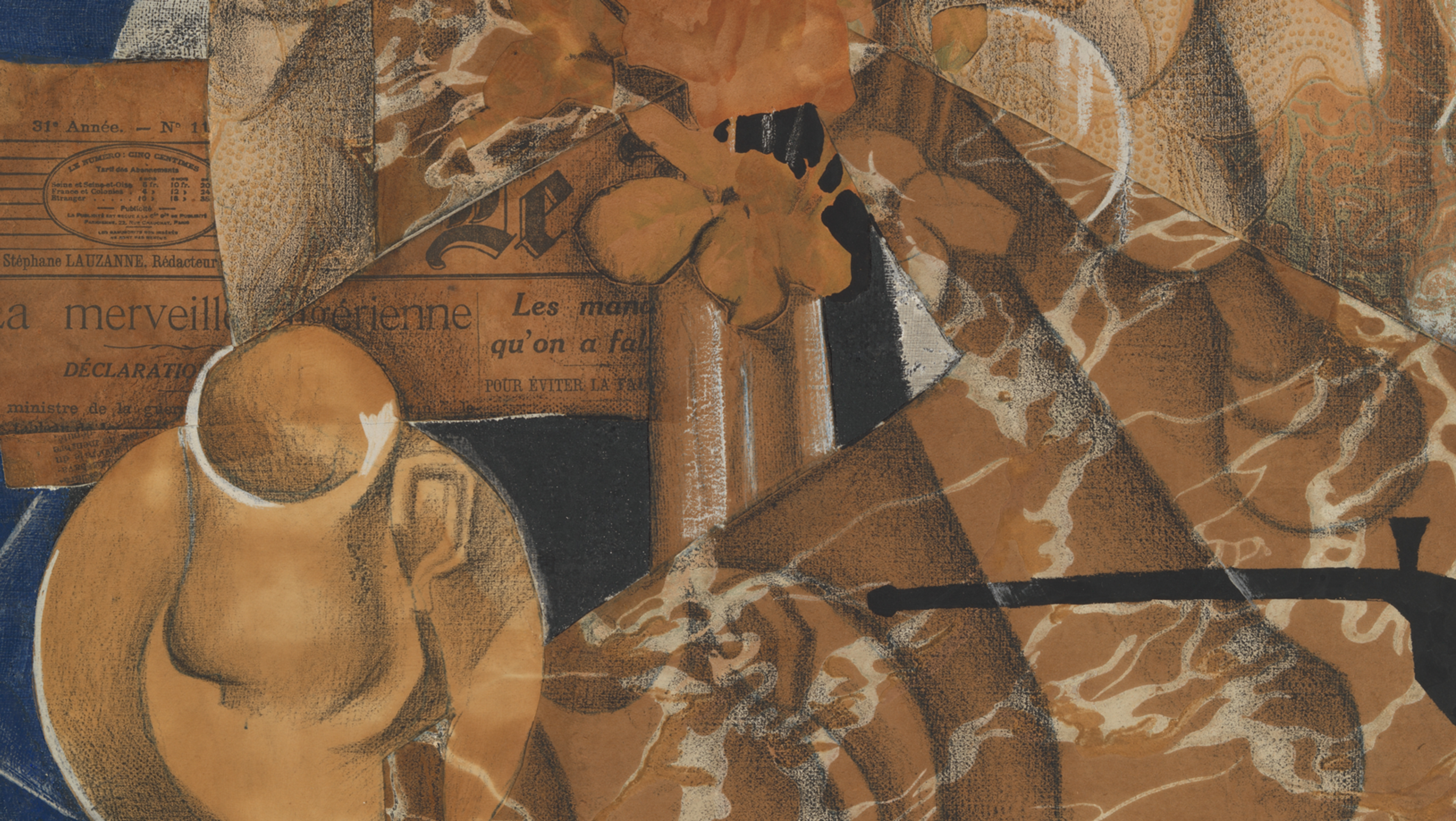
Unlike those of Braque and Picasso, whose papiers collés are typically spare and resistant to reading, Gris’s works are closer to paintings, their entire surfaces covered with paper and paint. He carefully planned his compositions, building them with cut, matched, and layered pieces of paper—some plain, some pages of journals, some wallpapers with imitation surfaces—and then outlined, shaded, and highlighted forms, bringing all the elements into synthetic wholes. Often, such works also draw upon the tradition of trompe l’oeil ("deceive the eye") painting. They question the nature of representation through perceptual and psychological games that complicate truth and fiction. Attentive to the iconic properties of his materials, Gris delighted in such visual puns. His papier collé compositions—with their unique opportunity for pictorial rhyming, optical trickery, and potential misreading—bear witness to his artistic humor.
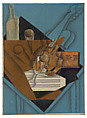
This collage represents a still life set atop a wooden table with a striped napkin, stemmed glasses, a corked bottle, coffee cups with spoons, and a newspaper (Le Journal). To the right of the bottle is a hand-drawn tobacco pouch with a string from which hangs a carefully cut, faux bois (fake wood) toggle, and a tobacco packet. Gris emphasized the newspaper in this composition, allowing its folded form to run almost the entire width of the canvas. Its date (Sunday, May 17, 1914) is visible even though several still-life elements obscure parts of the text. The headlines and snippets of articles relate, however, a variety of events: the state visit of the king and queen of Denmark, impending trial of a woman accused of murder, and demonstration of the inventor Émile Bachelet’s electromagnetically levitated railway. A workaday image set in a workers’ bar or café, the still life bristles with the energy of the modern world.
Artwork Details
- Title: Cup, Glasses, and Bottle (Le Journal)
- Artist: Juan Gris (Spanish, Madrid 1887–1927 Boulogne-sur-Seine)
- Date: Paris, spring–summer 1914
- Medium: Conté crayon, gouache, oil, cut-and-pasted newspaper, white laid paper, printed wallpaper (three types), selectively varnished; adhered overall onto a sheet of newspaper, mounted to primed canvas
- Dimensions: 21 5/8 × 18 1/8 in. (54.9 × 46 cm)
- Classification: Works on Paper
- Credit Line: Leonard A. Lauder Cubist Collection, Gift of Leonard A. Lauder, 2021
- Object Number: 2021.395.4
- Curatorial Department: Modern and Contemporary Art
More Artwork

Related Content
Research Resources
The Met provides unparalleled resources for research and welcomes an international community of students and scholars. The Met's Open Access API is where creators and researchers can connect to the The Met collection. Open Access data and public domain images are available for unrestricted commercial and noncommercial use without permission or fee.
To request images under copyright and other restrictions, please use this Image Request form.
Feedback
We continue to research and examine historical and cultural context for objects in The Met collection. If you have comments or questions about this object record, please contact us using the form below. The Museum looks forward to receiving your comments.
Content Notice
The Metropolitan Museum of Art presents over 5,000 years of art from around the world, and our online collection reflects ongoing work conducted over the course of our more than 150-year history. You may encounter objects or images that may be inappropriate for some viewers or information that may be outdated.