Coffin of Khnumhotep
Artwork Details
- Title: Coffin of Khnumhotep
- Period: Middle Kingdom
- Dynasty: Dynasty 12
- Date: ca. 1981–1802 B.C.
- Geography: From Egypt, Middle Egypt, Khashaba excavations, 1910; Probably from Meir
- Medium: Painted wood (Ficus sycomorus)
- Dimensions: With closed lid: L. 209 cm (82 5/16 in.); W. 54.2 cm (21 5/16 in.); H. 81.3 cm (32 in.)
- Credit Line: Rogers Fund, 1912
- Object Number: 12.182.131a, b
- Curatorial Department: Egyptian Art
Audio
1156. Kids: Coffin of Khnumhotep, Part 1
Gallery 112
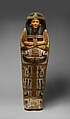
EXPLORER ONE: The mummy looks like a person with gold skin wearing jewelry that's going to bed and somebody really tucked them in really tight.
JO LOH: The ancient Egyptians believed that when they died, they lived on in the afterlife, so they still needed a body, even after death. So the dead person’s body had to be preserved to last forever. It was carefully dried and wrapped in a process called “mummification.” The preserved body—the mummy—was then put inside in a coffin and buried in a tomb. Now look carefully at the outside of the coffin.
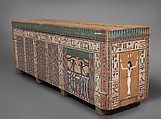
EXPLORER TWO: The eyes on the side of the coffin … I think it's because Egyptians thought they could look out. And the eyes are the eyes of a god of…
ISABEL STUENKEL: The eyes in the side of the coffin are the eyes of the god Horus, and if you think about it, if you look at these coffins, you can see one pair of eyes on each coffin, right?
ALL: Yes.
EXPLORER ONE: And that's the way … they'd make the mummy face.
ISABEL STUENKEL: Exactly. So what does that mean, though? How does the mummy lie in the coffin?
EXPLORER ONE: They lie in sideways.
EXPLORER TWO: Why is this mummy not lying on its side?
ISABEL STUENKEL: Is it lying on its side?
EXPLORER TWO: No.
EXPLORER THREE: Yes, it is.
EXPLORER TWO: It is?
EXPLORER THREE: It is. It’s just, …the mirror looks like it's not.
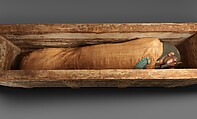
JO LOH: We put a mirror in the coffin so you can see the mummy better. But look inside the coffin. Can you see the ear of the mummy mask? Its face and the whole body is actually turned sideways. The mummy is actually lying on it’s side!
EXPLORER TWO: Oh, yeah, it is.
JO LOH: During the period that these mummies and coffins are from, the eyes on the outside of the coffin matched where the mummy’s eyes would be, inside. But they painted the eyes so that they are looking out side by side.
EXPLORER THREE: And doesn't it always look to the east?
ISABEL STUENKEL: Yes. Do you know why the eyes look towards the east?
EXPLORER THREE: Because that's where the sun rises, and they thought that was rebirth.
ISABEL STUENKEL: Yes. Because the ancient Egyptians looked at the travel of the sun, and it's -- it's rising in the morning, so that was birth, and in the evening...
EXPLORER THREE: ... and sets in the evening, which is death.
ISABEL STUENKEL: Yes, exactly.
EXPLORER ONE: Did they mummify every person and make a coffin for every person?
JO LOH: To find out, press PLAY.
Listen to more about this artwork
More Artwork
Related Content
 Free to download
Research Resources
The Met provides unparalleled resources for research and welcomes an international community of students and scholars. The Met's Open Access API is where creators and researchers can connect to the The Met collection. Open Access data and public domain images are available for unrestricted commercial and noncommercial use without permission or fee.
To request images under copyright and other restrictions, please use this Image Request form.
Feedback
We continue to research and examine historical and cultural context for objects in The Met collection. If you have comments or questions about this object record, please contact us using the form below. The Museum looks forward to receiving your comments.
Content Notice
The Metropolitan Museum of Art presents over 5,000 years of art from around the world, and our online collection reflects ongoing work conducted over the course of our more than 150-year history. You may encounter objects or images that may be inappropriate for some viewers or information that may be outdated.