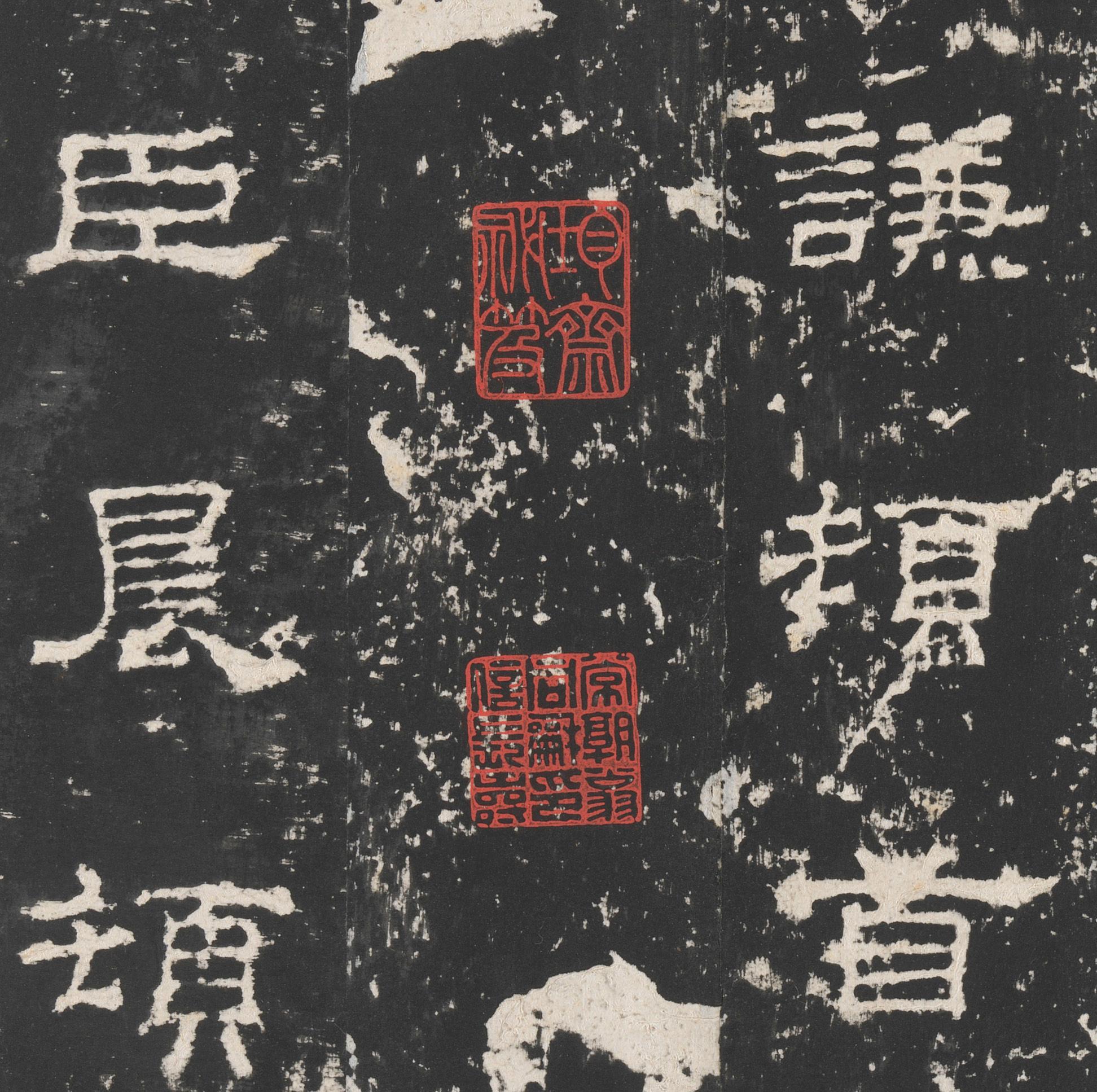
Rubbing of Stele for Shi Chen (detail), 19th century rubbing; stele dated 169 CE. Unidentified artist. Chinese, Qing dynasty (1644–1911). Rubbing mounted in an album of thirty-two leaves; ink on paper, image: 10 7/8 x 5 5/8 in. (27.6 x 14.3 cm), overall with mounting: 13 7/8 x 7 1/8 in. (35.2 x 18.9 cm). The Metropolitan Museum of Art, New York, Gift of Mr. and Mrs. Wan-go H. C. Weng, 1992 (1992.166.2a–ff)
My name is James Nares and I am an artist.
A lot of my connection with calligraphy is intuitive. Some of it is learned. The things I do reference these objects in different ways. I did rubbings of the enormous blocks of granite that are all over the downtown area, which are the same kind of shape as this beautiful object here and are covered with chisel marks. And it was a way of transmitting knowledge or an image. I guess it's early printing, so kind of antithetical to the making of the calligraphy itself, which is a dance with a brush.
I've always been interested in manual events, movements—transmitting a thought from the mind through the arm and into the hand. Calligraphy has always been, to me, a beautiful marriage of design and personality. You don't want it to fall apart completely. It's very admirable when you see a perfect character. There are some scripts that are very bold—some of the older ones. You do sense a kind of methodical mind at work, but where it becomes very loose you feel that you're kind of present at the creation of the thought. You discover the image at the same time that the calligrapher made it. You kind of share the discovery of the mark that he makes, and that connects you very deeply.
I love the concept of the 'flying white' in calligraphy—that the space that has no mark is still charged with the movement of the calligrapher over it. My paintings are all made with one movement of the brush, like a dance. I feel that a beautiful movement can convey a story—there's a beginning, a middle, and an end. If I don't like the brushstroke, my assistant just erases it, and I do it again. I'm not very 'zen' in my practice. I don't meditate for hours and then make one mark, which I think was more in line with the cursive calligraphers' attitude. Because you're doing it on paper anyway, so you can't erase it. I love that nothing is hidden. There's no cover-up. It's very pure in that way, but the room for maneuver within each element is endless.
There's something very individual about the calligrapher's art. You're riding a kind of knife edge between design and circumstance, and I'm searching for the best of both.