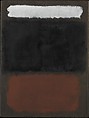
No. 13 (Blanco, rojo, sobre amarillo)
Artwork Details
- Título: No. 13 (Blanco, rojo, sobre amarillo)
- Artista: Mark Rothko, estadounidense, nacido en Rusia, 1903–1970
- Fecha: 1958
- Material: Óleo y acrílico con pigmentos en polvo sobre lienzo
- Dimensiones: 242,3 x 206,7 cm
- Crédito: Donación de The Mark Rothko Foundation Inc., 1985
- Número de inventario: 1985.63.5
- Curatorial Department: Modern and Contemporary Art
Audio
2083. Mark Rothko
Gallery 919
NARRATOR: Mark Rothko is one of the most recognizable figures associated with Abstract Expressionism. He’s the exemplar of what is known as Color Field painting, which is distinguished in part by the large expanses of color applied or stained across a canvas.
Though the compositions might appear relatively straightforward, try holding still in front of a canvas. Many find the experience absorbing, even emotionally moving. Curator Randy Griffey.
RANDY GRIFFEY: One of the distinctive trademarks of Rothko’s work is the degree to which his compositions are flat in their abstractness, but the way they glow and throb. And he typically paints very, very thin layers of color, on top of one another, to produce specific kinds of effects. Often warm colors are beneath cool colors, so you get a sense of a warm color pushing out from below.
The works on view suggest the range of his Color Field painting, from the earlier slightly smaller works where he’s sorting through the colorism of Henri Matisse, whom he worshiped as an earlier modernist, to the classic stacked compositions of quite saturated color, to, one example of a so-called “shadow painting” where a single block of very muted color hovers on a lavender ground.
NARRATOR: That “shadow painting” was inspired by Rothko’s visits to The Met’s own collection to see late paintings by Rembrandt, and those of other Dutch artists. Rothko’s painting, though abstract, reflects the Old Masters’ layering of light and shadow, or chiaroscuro effects.
Rothko’s most recognized compositions, the combinations of vertically stacked colors, are the product of years of work and experimentation.
RANDY GRIFFEY: The format he develops over time, of stacked colors in a methodical way, has been traditionally interpreted as a kind of effort to reconcile the two sides of human nature. One is the Dionysian side, which is the irrational and the impulsive; and the other being the Apollonian, the intellectual and the rational side; the intellect.
I think that's part of the powerful dynamism of his work, that the color in a way is the emotional component. But the structure he develops, which suggests a kind of order and reason, is put into conflict, with the emotive color. It's this combination of emotive color and a rational format in this stacking.
NARRATOR: This exhibition provides a unique opportunity to observe an array of Rothko’s paintings, together. Experiencing the dynamic of the group is different than seeing a single Rothko on a wall.
RANDY GRIFFEY: It's been one of the highlights for me to arrange a room devoted to Rothko around the peak period in Rothko’s own art. Here I think, the effect is increased and enhanced as we put these individual works in dialogue with one another. And the room offers the visitor an invitation to contemplate these works in a way that I think Rothko would have intended.
Listen to more about this artwork
More Artwork
Related Content
Research Resources
The Met provides unparalleled resources for research and welcomes an international community of students and scholars. The Met's Open Access API is where creators and researchers can connect to the The Met collection. Open Access data and public domain images are available for unrestricted commercial and noncommercial use without permission or fee.
To request images under copyright and other restrictions, please use this Image Request form.
Feedback
We continue to research and examine historical and cultural context for objects in The Met collection. If you have comments or questions about this object record, please contact us using the form below. The Museum looks forward to receiving your comments.
Content Notice
The Metropolitan Museum of Art presents over 5,000 years of art from around the world, and our online collection reflects ongoing work conducted over the course of our more than 150-year history. You may encounter objects or images that may be inappropriate for some viewers or information that may be outdated.