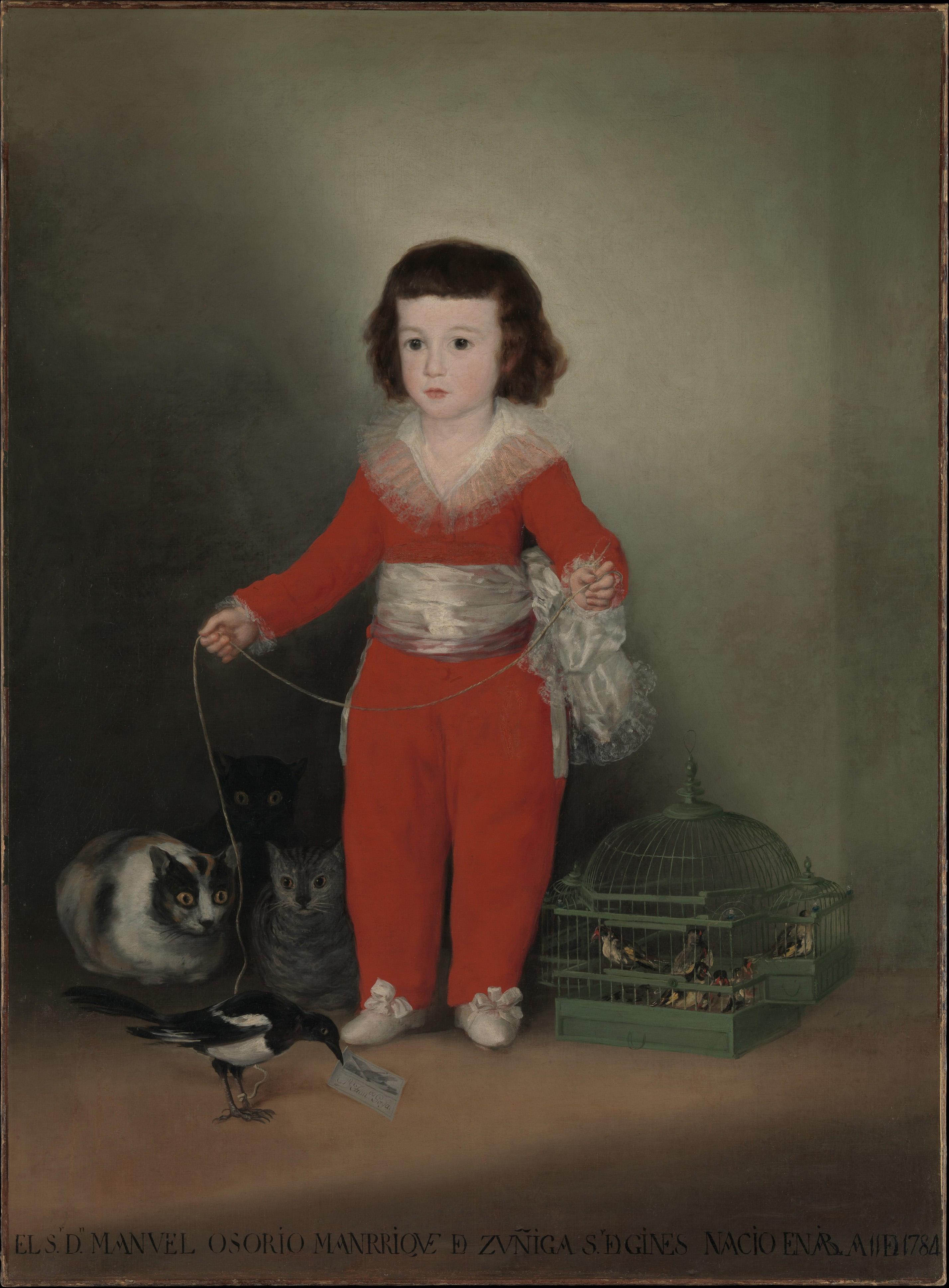
Goya (Francisco de Goya y Lucientes) (Spanish, Fuendetodos 1746–1828 Bordeaux). Manuel Osorio Manrique de Zuñiga (1784–1792), 1787–88. Oil on canvas, 50 x 40 in. (127 x 101.6 cm). The Metropolitan Museum of Art, New York, The Jules Bache Collection, 1949 (49.7.41)
My name is Mary Weatherford and I'm an artist.
Well I was given a book called Famous Paintings when I was born and my very favorite that lived with me in my dreams and my imagination is this one of the little boy in the red suit. I wanted him to come to life and be my friend.
I always felt a little sorry for him because I knew he was rich and that he looked like he didn't have a lot of friends around him, but he had a lot of pets. What child wouldn't want to be friends with a little boy that had three cats and a cage full of finches and a bird on a leash?
I think, part of the childhood imagination which you have to kind of remember when you're an adult that Goya's put sound into this. He's put the soundtrack, "tweet tweet tweet tweet tweet," and then the cats with their mouths watering looking at the little bird. But he's sort of a little bit sad, he's not smiling. And it's easy to make a picture of a happy child: you just turn their mouth up a little bit.
He's also clearly doing what he's told to do. This is his official portrait; it's not like he's captured in a moment of levity, but he has his attributes around him like a saint. His hands are in this beautiful, outstretched manner of a kind of surrender or blessing. He's a holy being that's disguised as a little boy holding a bird.
And then the string is painted so well—I love it—with the light lighting it up in different places. And that color—that red—and his satin belt that's all kind of grays and whites. The background is kind of greenish. His pale, pale skin and his pink cheeks and those deep, those big, brown eyes; they're just like a big, black marble. But then the funniest thing about this painting is his little left hand where the string for the bird starts and it's—the foreshortening is fantastic—it's just like a little flower. And then the cat is just staring, staring, staring: almost dizzy with anticipation.
I had a little baby finch: his name was Christopher. One day I came home and all that was left of Christopher was the little red foot. Like a real thing, like that cat is waiting!
Having a picture—an image—be so important to your very being, and then walking into the museum and seeing it for real right in front of your eyes... There's more in the painting than you ever could have imagined and it comes to life.