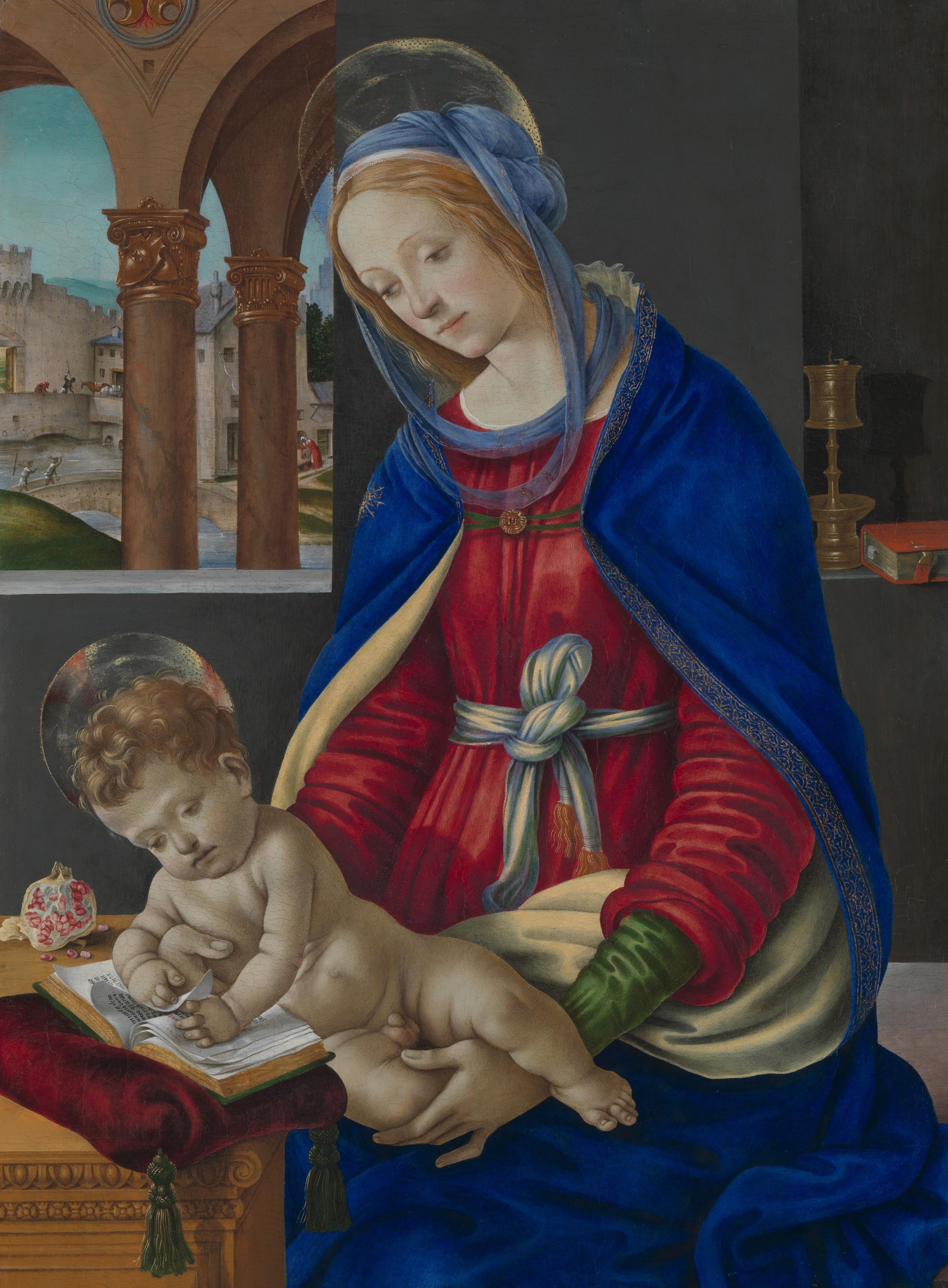
Madonna and Child, ca. 1483–84. Filippino Lippi (Italian, 1457–1504). Tempera, oil, and gold on wood, 32 x 23 1/2 in. (81.3 x 59.7 cm). The Metropolitan Museum of Art, New York, The Jules Bache Collection, 1949 (49.7.10)
My name's Roz Chast. I'm a cartoonist for The New Yorker.
I love this era because it's before everything got so perfect and all of the rules of perspective are in place. They're more fanciful. I like the flatness, I like the sort of made up backgrounds, the attempts at architecture that don't always work out, the attempts at anatomy that don't always work out. I love it!
And sometimes a narrative will occur to me that is funny, especially in this painting. They're washing the newborn baby, but in the foreground there's just these groups of women, some of whom seem to be pregnant, and they're like, "Yeah, I'm about, you know, seven months." And then in the background there's a woman having some sort of beauty treatment, I think. It's kind of like a mud bath—I don't even know. And then this huge architectural thing happening that is not in the subject matter at all.
The fact that they're strangely painted helps me interpret them strangely. Like, this one with the UFO coming down. BING! BING! BING! I just love that sound effect. And he has been knocked off his horse by this beam from the UFO, and then I think what's going to happen next is this pink house is going to come down from space. They're just all astonished, but I think it has something to do with the UFO.
In a lot of these paintings I'm paying attention to the elements that are not religious. In the foreground is all the, you know, religious stuff, but in the background there's just this everyday stuff of somebody bringing wheat to market.
I often think about how rare it was for people to look at images in a world where they weren't, you know, constantly bombarded. I don't even know if they had mirrors and regular people didn't have, like, portraits.
In a lot of these paintings there's a lot more in it than needs to be. That's to me what draws you in, what makes it feel real. Walt Disney said that to make a cartoon look realistic, you have to put more in the scene than somebody can see. It's not just a schematic. I mean, I like to feel, when I'm doing a cartoon, that yes, there's the joke and the people, but I also want to make the person feel that it's real—that, like, if they opened up the drawer they would know what was in the drawer.
What I like about it is knowing how hard it is to draw. I sort of can see, in some these cases, the artist trying to work it out. It's more like a conversation—I think maybe it's because I can hear the voice of the painter. The painter seems more human. It seems less mechanical to me. There's a sort of tension between what they know and what they don't know. It's like, "it's too complicated for me to paint, so I'm going to make up a way of painting it that will work," and that's what I think I like.