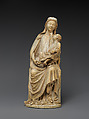
옥좌에 앉은 성모자상
Artwork Details
- 제목: 옥좌에 앉은 성모자상
- 연대: 1300년경
- 지리: 런던 추정
- 문화: 영국
- 재료: 상아
- 크기: 27.3 × 13.5 × 9.6cm
- 크레디트 라인: 클로이스터스 컬렉션, 1979
- 작품 번호: 1979.402
- Curatorial Department: Medieval Art and The Cloisters
Audio
51. Enthroned Virgin and Child
Gallery 14
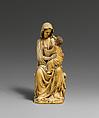
NARRATOR #2 (JANNIE WOLF): This superb ivory statuette of the Virgin and Child was most likely produced in England. It might even have been commissioned by the court of King Edward the First at Westminster. The piece has suffered significant losses, including the Virgin's arms, her throne, and all of the Child, except for vestigial feet. Even so, it retains an elegance and a sense of monumentality despite its actual size. The hole in the Virgin's chest would once have contained an inset jewel or crystal-covered relic, and the statuette would have been enclosed within an ivory or perhaps silver tabernacle. The rich reddish-brown patina may be the result of staining with walnut oil or some other agent. Peter Barnet, Curator in charge of the Department of Medieval Art and the Cloisters. PETER BARNET: This is probably due to either exposure to heat or perhaps even exposure to fire; it’s also possible that an oil such as walnut oil was at one point rubbed into the surface of the ivory to give it a kind of luster or color, in fact even in medieval craftsman’s treatises there is the recommendation that this be done, and it’s possible that that accounts for the color of the ivory we see here although this brown color is quite unusual for medieval ivories.
NARRATOR #2: This Virgin and Child was made for personal devotion, and was intended to give its owners a feeling of personal connection with the Virgin. It was also intended to emphasize the reciprocal tenderness between the Virgin and Child. Look closely at the way the Virgin turns to face the Child climbing over her knee.
More Artwork
Related Content
Research Resources
The Met provides unparalleled resources for research and welcomes an international community of students and scholars. The Met's Open Access API is where creators and researchers can connect to the The Met collection. Open Access data and public domain images are available for unrestricted commercial and noncommercial use without permission or fee.
To request images under copyright and other restrictions, please use this Image Request form.
Feedback
We continue to research and examine historical and cultural context for objects in The Met collection. If you have comments or questions about this object record, please contact us using the form below. The Museum looks forward to receiving your comments.
Content Notice
The Metropolitan Museum of Art presents over 5,000 years of art from around the world, and our online collection reflects ongoing work conducted over the course of our more than 150-year history. You may encounter objects or images that may be inappropriate for some viewers or information that may be outdated.