Stela of the Steward Mentuwoser
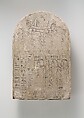
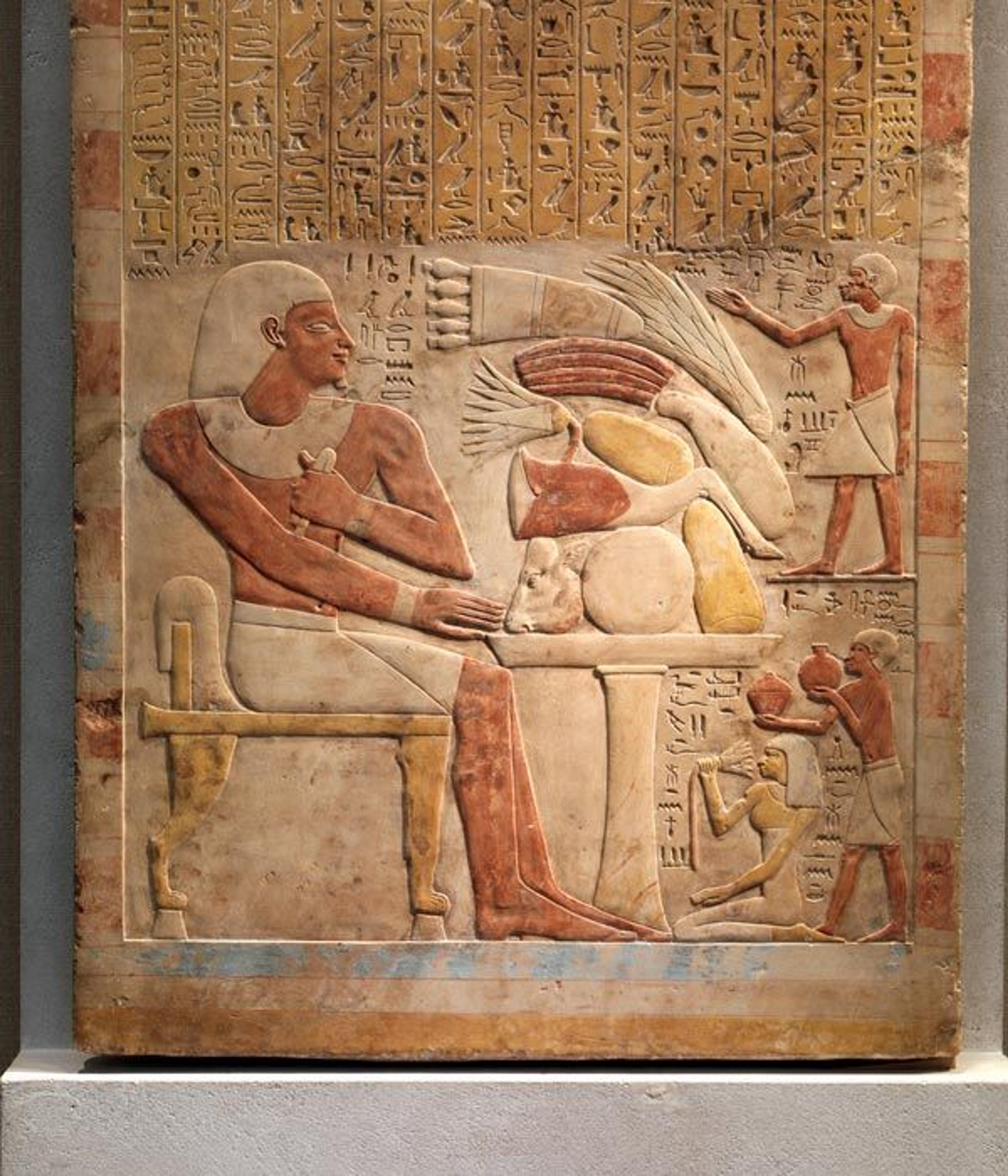
To show clearly each kind of food being offered, the sculptor arranged the images on top of the table vertically. The feast consists of round and conical loaves of bread, ribs and a hindquarter of beef, a squash, onions in a basket, a lotus blossom, and leeks. The low-relief carving is very fine. The background was cut away only about one-eighth of an inch. Within the firm, clear outlines, the sculptor then subtly modeled the muscles of Mentuwoser's arms and legs and the shape of his jaw and cheeks. The chair legs and the calf's head have also been carefully formed. The hieroglyphic inscriptions in sunk relief state that in the seventeenth year of his reign King Senwosret I presented the stela to Mentuwoser in appreciation of his loyal services. Mentuwoser's deeds are described at length. He was steward, granary official, and overseer of all manner of domestic animals, including pigs. He is described as a good man who looked after the poor and buried the dead. Senwosret's throne name, Kheperkare, appears within a cartouche in the middle of the top line.
The stela once stood at Abydos, the sacred pilgrimage center of the god of the underworld Osiris. Mentuwoser's image and the prayers on the stela were meant to bring him both rebirth and sustenance at the annual festivals honoring Osiris. At such festivals family members and other pilgrims would visit the commemorative chapels in which the stelae were set up, and at its end this stea's text addresses explicitly three groups of people: 1. any scribe who shall read the stela; 2. any person who shall hear the stela read aloud; 3. all people who shall approach it. It is thus suggested that, according to ancient Egyptian understanding, the written word—and its imagery—reached many more people than only just the fully literate.
Link to a blog about food in Ancient Egypt
Food and Feasts in Middle Kingdom Egypt
Artwork Details
- Title: Stela of the Steward Mentuwoser
- Period: Middle Kingdom
- Dynasty: Dynasty 12
- Reign: reign of Senwosret I, year 17
- Date: ca. 1944 B.C.
- Geography: From Egypt; Probably from Northern Upper Egypt, Abydos
- Medium: Limestone, paint
- Dimensions: H. 103 cm (40 9/16 in.); W. 50.5 cm (19 7/8 in.); Th. 8.3 cm (3 1/4 in.)
- Credit Line: Gift of Edward S. Harkness, 1912
- Object Number: 12.184
- Curatorial Department: Egyptian Art
Audio
3325. Stela of the Steward Mentuwoser
DIANA PATCH: This limestone stela is one of the finest from Middle Kingdom Egypt. It was carved by order of King Senwosret I for the steward Mentuweser. It was probably set up at Abydos, one of Egypt's holiest sites and the burial ground for the kings of the earliest dynasties. Nearby, or so the Egyptians believed, was the tomb of Osiris—the legendary god-king who died by his brother's hand but was resurrected by his wife, Isis to become the ruler of the netherworld. The legend was so compelling that Abydos became an important destination for pilgrims.
The sixteen vertical columns of text above the figure of Mentuweser summarize his career and draw particular attention to his honesty and generosity. The inscription makes a distinction between people who actually read the text and those who listen to it while someone else reads it. It reminds us that a lot of people in ancient Egypt were illiterate.
The stela was carved in Senwosret’s seventeenth year, about 1955 B.C. You see that date written at the right end of the uppermost line of text. Though we mark time in relation to distant events, such as the birth of Christ, the Egyptians reckoned years according to the ruling Pharaoh.
DOROTHEA ARNOLD: From a purely artistic point of view it is remarkable how well balanced this relief is. The inscription occupies considerably more than half of the space. And the figurative panel, by being the lower, is clearly subordinate to the text, although the figures draw the attention of the viewer because of their fine modeling, and their varied gestures and their even spacing. Note how closely the figures fill their allotted space. This man and his family and attendants feel totally comfortable with their role and existence. They live in an ordered, and to them, meaningful system.
More Artwork
Related Content
Research Resources
The Met provides unparalleled resources for research and welcomes an international community of students and scholars. The Met's Open Access API is where creators and researchers can connect to the The Met collection. Open Access data and public domain images are available for unrestricted commercial and noncommercial use without permission or fee.
To request images under copyright and other restrictions, please use this Image Request form.
Feedback
We continue to research and examine historical and cultural context for objects in The Met collection. If you have comments or questions about this object record, please contact us using the form below. The Museum looks forward to receiving your comments.
Content Notice
The Metropolitan Museum of Art presents over 5,000 years of art from around the world, and our online collection reflects ongoing work conducted over the course of our more than 150-year history. You may encounter objects or images that may be inappropriate for some viewers or information that may be outdated.