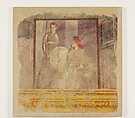
弹基萨拉的妇女坐像壁画
Artwork Details
- 标题: 弹基萨拉的妇女坐像壁画
- 年代: 共和晚期
- 创作日期: 约公元前50–40年
- 文化: 古罗马
- 材料: 湿壁画
- 尺寸: 731⁄2 x 731⁄2 英寸(186.7 x 186.7厘米)
- 来源信息: 罗杰斯基金,1903年
- 藏品编号: 03.14.5
- Curatorial Department: Greek and Roman Art
Audio
1252. Wall painting from Room H of the Villa of P. Fannius Synistor at Boscoreale
[MUSIC PLAYS]
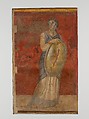
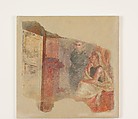
These three large frescoes, as well as a column and two small paintings on the wall to your right, come from the main reception hall of the villa at Boscoreale. Owing to their fine craftsmanship and intriguing subject matter, they are among the most important frescoes to have survived from antiquity.
Pigments were mixed with water and brushed onto fresh, damp plaster walls. Take a minute and see how the artist used strokes of paint to give volume to these fully three-dimensional figures. This is very clear on the shield held by a woman at the far right. The technique is quite impressionistic, mixing different strokes of paint so that your eye actually blends them.
Now stand back a bit so that you can see all three frescoes. Most likely they are copies of paintings that decorated a Hellenistic palace, and that celebrated a dynastic marriage.
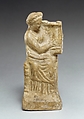
Farthest to your left is a seated woman playing a gilded kithara, a large stringed instrument. She must be an important person at the court for she wears a gold diadem and sits on a throne-like chair. The child leaning over her shoulder might also be a member of the ruling family.
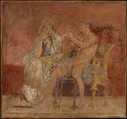
In the central panel is the wedded couple. The ruler is shown in heroic nudity, whereas his wife is heavily draped and veiled. She appears very somber and reflective, much like brides were often represented in antiquity.
The woman holding the shield at the far right is a prophetess, predicting the birth of a male heir and future king. She gazes upward in a trance-like state. Look closely at the small figure on her shield, its thought to be a vision. Notice that he wears a white band around his head. Headbands like this were the royal insignia of Hellenistic rulers.
On the wall to your right, a photograph shows a reconstruction of the reception hall where these magnificent frescoes once stood.
More Artwork
Related Content

Research Resources
The Met provides unparalleled resources for research and welcomes an international community of students and scholars. The Met's Open Access API is where creators and researchers can connect to the The Met collection. Open Access data and public domain images are available for unrestricted commercial and noncommercial use without permission or fee.
To request images under copyright and other restrictions, please use this Image Request form.
Feedback
We continue to research and examine historical and cultural context for objects in The Met collection. If you have comments or questions about this object record, please contact us using the form below. The Museum looks forward to receiving your comments.
Content Notice
The Metropolitan Museum of Art presents over 5,000 years of art from around the world, and our online collection reflects ongoing work conducted over the course of our more than 150-year history. You may encounter objects or images that may be inappropriate for some viewers or information that may be outdated.