This July, the United States celebrates the 250th anniversary of the Declaration of Independence, ratified in Philadelphia in the summer of 1776. It was a seminal moment when delegates of thirteen states to the Continental Congress responded to British oppression and pledged their lives, fortunes, and honor to defy the authority of King George III and establish a new nation. Objects on view in Revolution! offer insights into how artists on both sides of the Atlantic responded to the political and military drama that unfolded before and after the Declaration, using reportage, satire, and propaganda to shape public opinion.
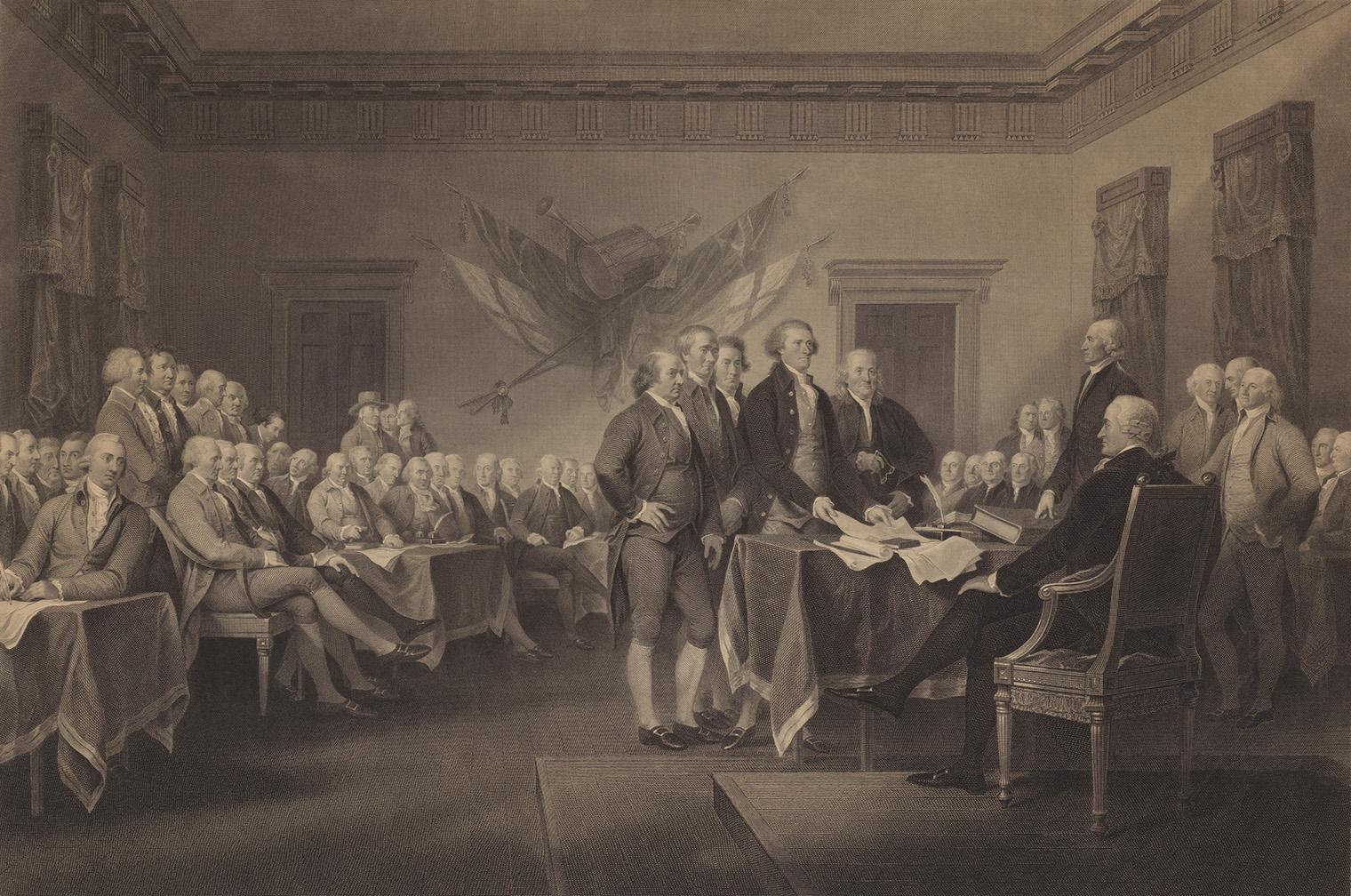
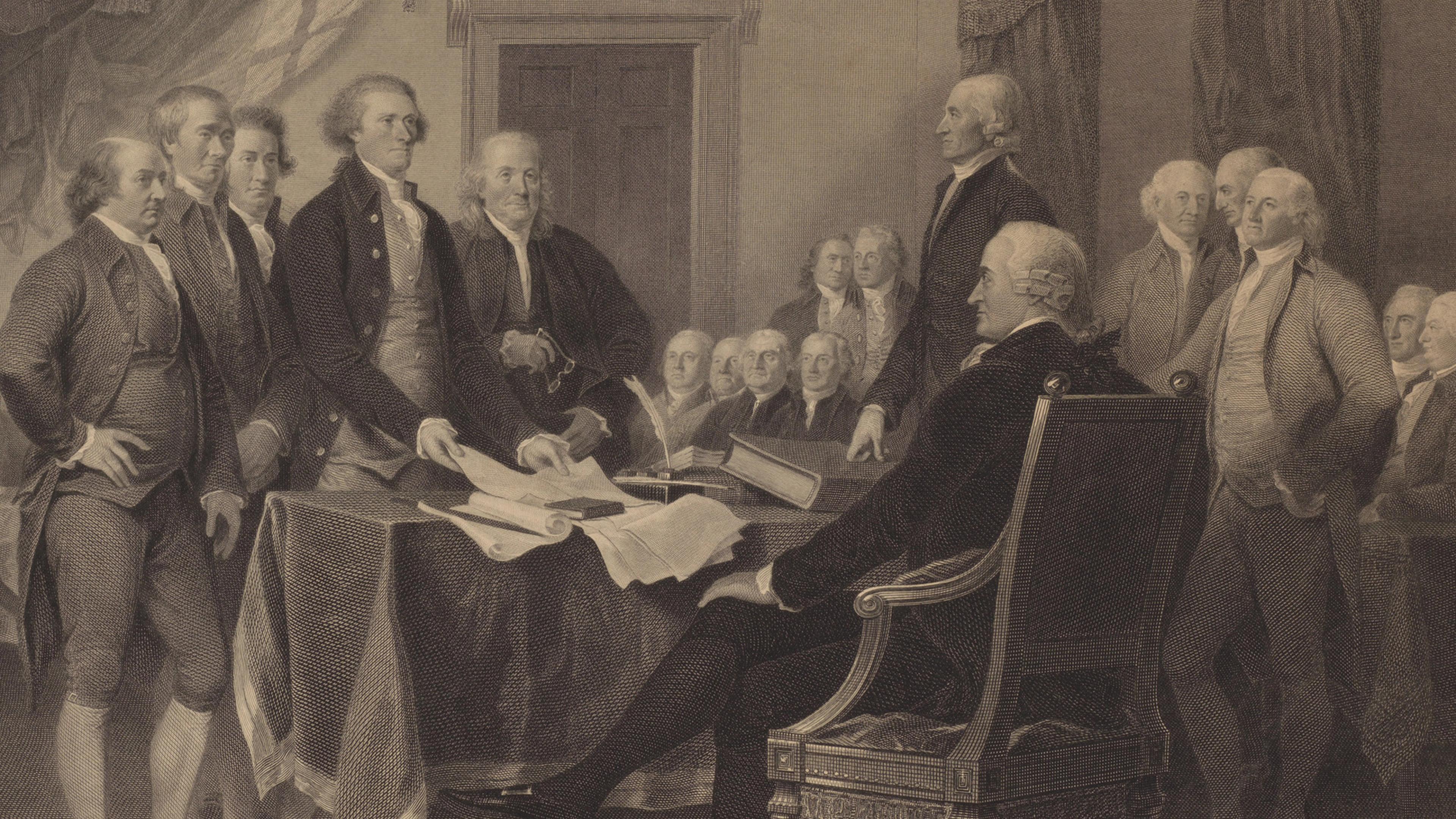
Asher Brown Durand (1796–1886), after John Trumbull (1756–1843). Declaration of Independence, 1820–23. Etching and engraving, fifth state of six, 20 1/16 × 30 3/16 in. (51 × 76.7 cm). The Metropolitan Museum of Art, New York, NY, Gift of Morrison H. Heckscher, 2022 (2022.29)
Asher Brown Durand’s engraving reproduces John Trumbull’s iconic painting, which he began a decade after the signing of the Declaration of Independence. Thomas Jefferson and his drafting committee stand at the center to present their text to Congress’s president, John Hancock, on June 28, 1776. The Declaration was formally adopted on July 4, then signed on August 2. During the Revolution, Trumbull served as aide-de-camp (personal assistant) to George Washington, then studied painting in London. In 1786, he met Jefferson in Paris to plan this celebratory reconstruction, which represents forty-two of the fifty-six original signatories, plus six additional patriots. The artist’s decision to base all the portraits on life studies delayed the painting’s completion until 1820. Durand, as one of the nation’s first native-born skilled engravers, then created this print based on Trumbull’s painting to help make the image ubiquitous.
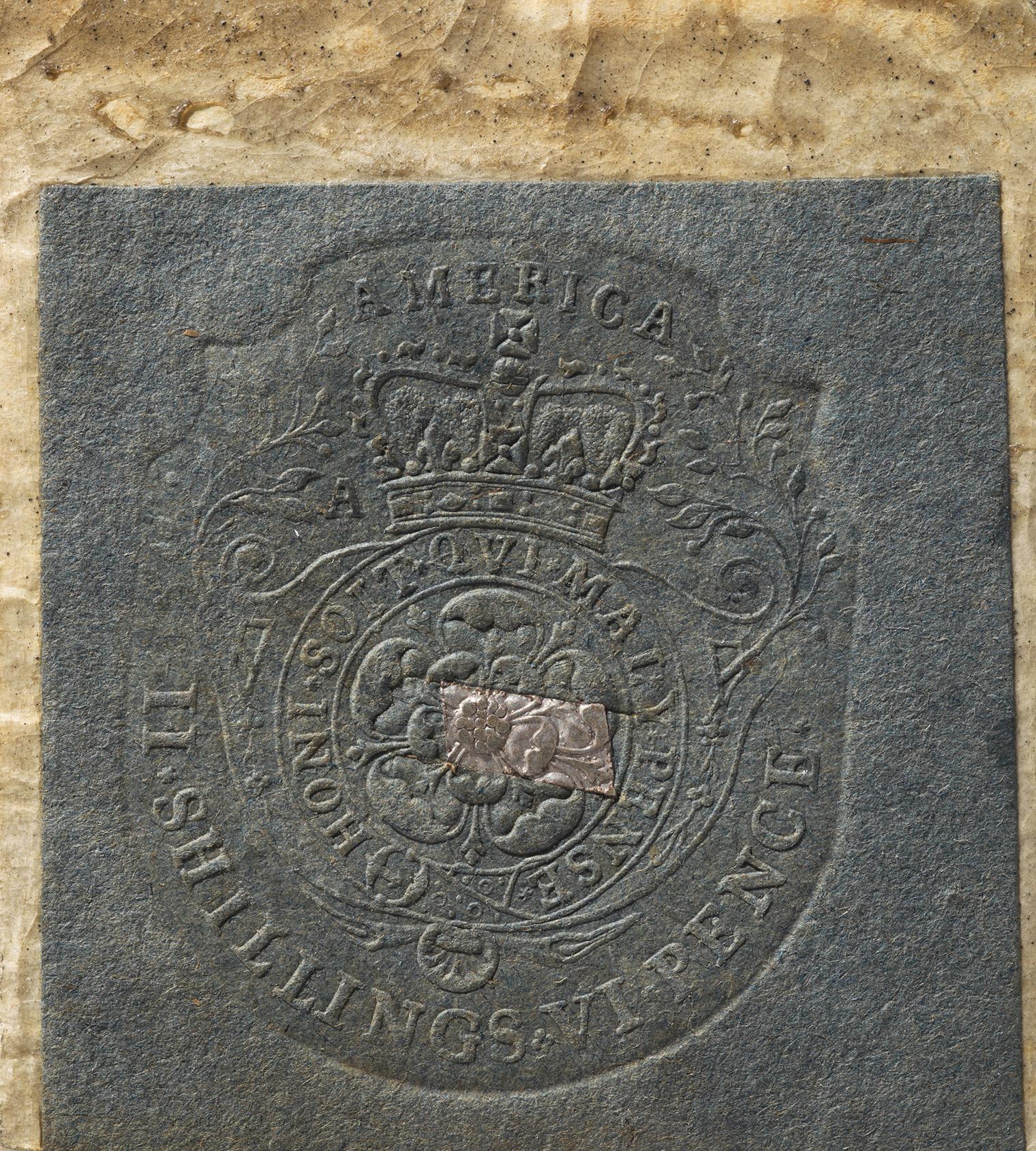
Two shillings and six pence revenue stamp, 1765–66. British, 18th century. Embossed gray-blue paper with metal staple on vellum, 1 5/8 × 1 5/8 in. (4.2 × 4.2 cm). The Metropolitan Museum of Art, New York, NY, Bequest of Charles Allen Munn, 1924 (24.90.1365)
The path to Revolution began with American colonial animus sparked by a new tax imposed by Parliament after the French and Indian War (known in Europe as the Seven Years’ War, 1756–63). The Stamp Act of March 1765 aimed to reduce the national debt by requiring colonists to pay small fees on paper goods such as newspapers and playing cards, and larger fees to ratify legal documents. The proceeds were intended to maintain British troops in the colonies. Resentful at their lack of say over these measures, Americans began to protest and avoid payment. This embossed blue paper stamp communicates royal authority through a crown set above a central Tudor rose. It was made to attach to a vellum document using the central metal staple but never used because the Stamp Act proved so short lived.
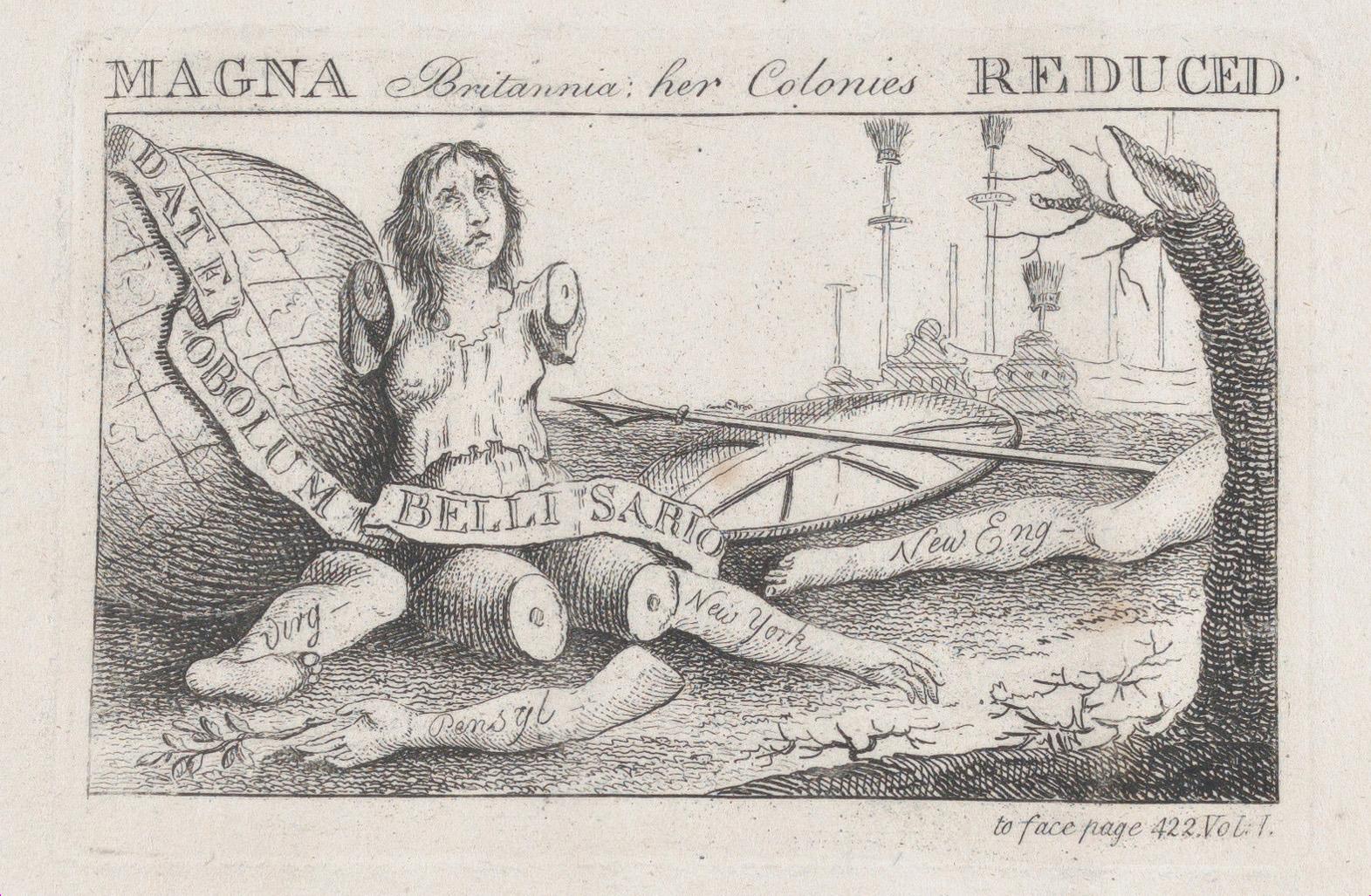
Benjamin Franklin (1706–1790). Magna Britannia: Her Colonies Reduced, 1833, after 1766 original. Etching and engraving, 2 15/16 × 4 1/2 in. (7.5 × 11.5 cm). The Metropolitan Museum of Art, New York, NY, Gift of William H. Huntington, 1883 (83.2.759)
The vociferous and sometimes violent American protests mounted in response to the Stamp Act prompted Benjamin Franklin—then in London as Pennsylvania’s colonial agent—to lobby for repeal. He testified before Parliament and designed this small allegorical image to be printed on cards for distribution to legislators. Presciently, the image predicts the fate of Britain’s empire if government policy persisted. Britannia, the national personification of Britain, appears as a weeping statue whose limbs (the colonies) have been severed, leaving trading vessels idle. While Parliament did, on this occasion, respond by repealing the Stamp Act in April 1766, George III’s ministers did not alter course; instead, they simply imposed alternative tariffs on paint, lead, glass, and tea imported by the colonies—goods that Americans could not make themselves. A growing military presence sent to enforce compliance, coupled with reductions to colonial legislative power, fanned further dissent.
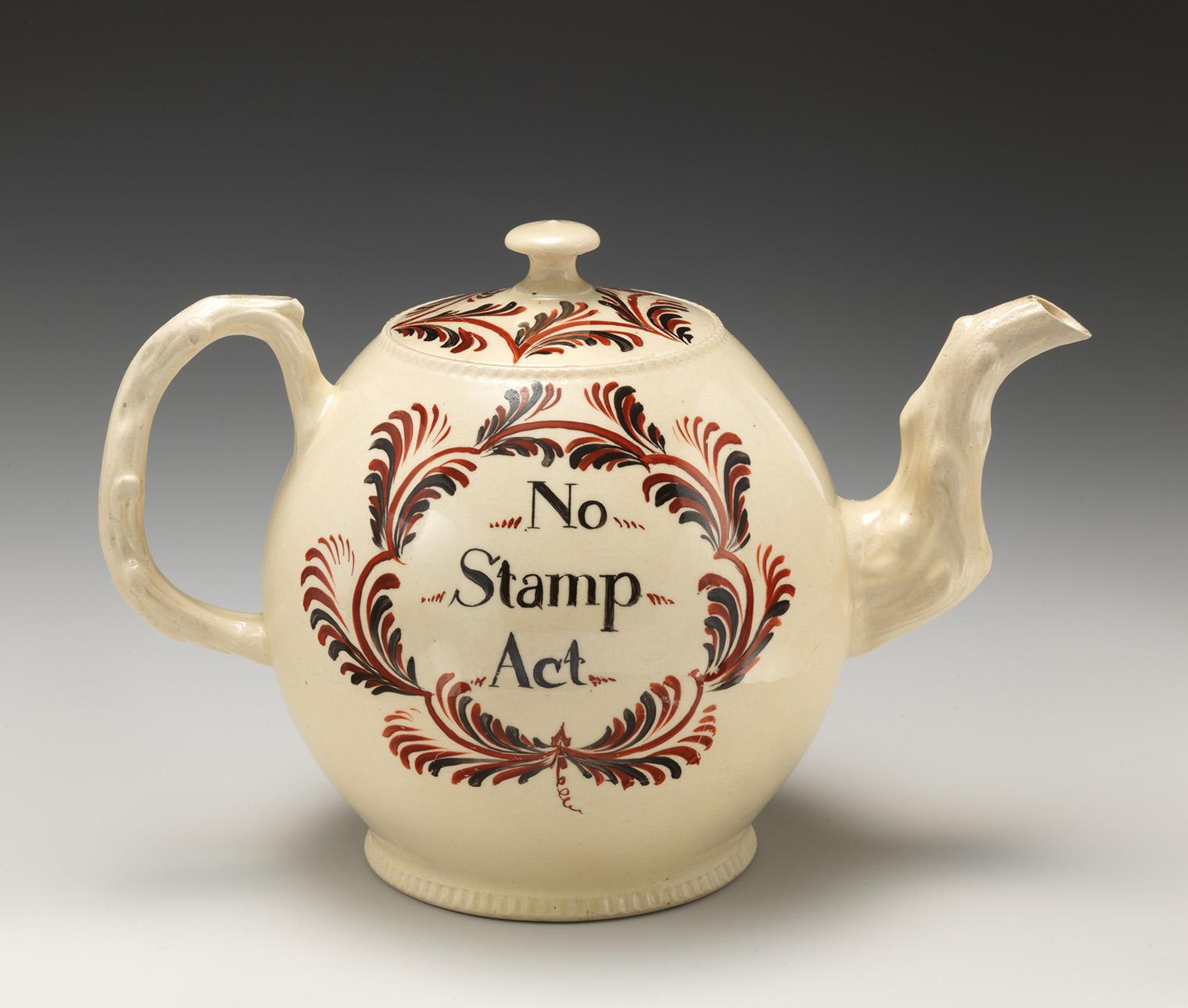
Teapot, 1766–75. British, American market. Earthenware, H. 5 3/4 in. (14.6 cm). The Metropolitan Museum of Art, New York, NY, Rogers Fund, 1927 (27.232a, b)
Made in England to sell across the Atlantic, this teapot demonstrates how events leading up to the Revolution gave colonial protestors a rallying cry. One side of the vessel is lettered “No Stamp Act” and the other “American Liberty Restored”—an indication that the decorations were applied after the act was repealed. One can imagine this pot displayed on a patriot sideboard, or in a Son of Liberty’s shop window, to affirm the owner’s sympathies, and the imagery demonstrates that many British manufacturers, merchants, and Whig politicians shared the colonists’ antipathy towards Tory policies that disrupted transatlantic trade.
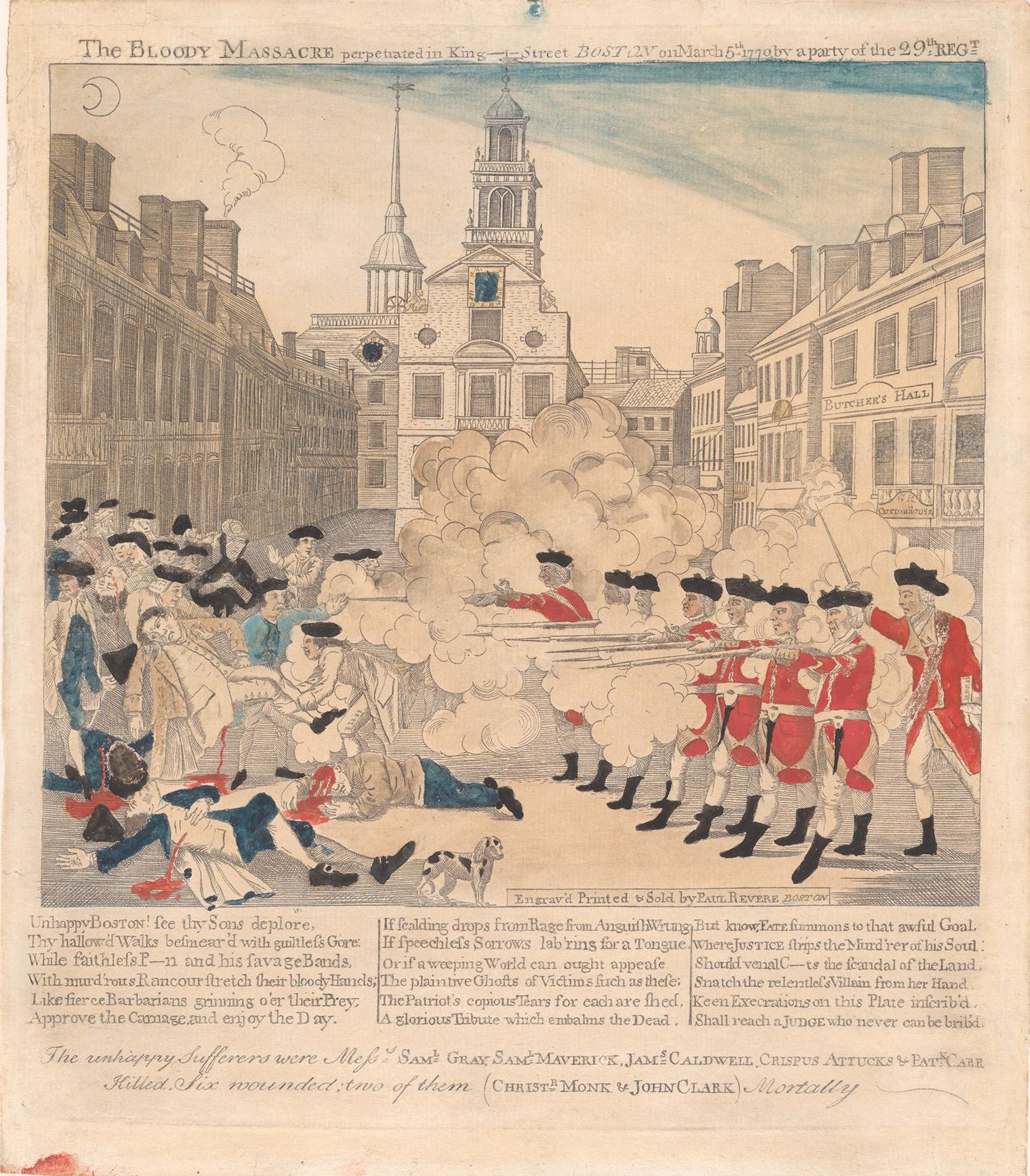
Paul Revere Jr. (1734–1818), after Henry Pelham (1749–1806). The Boston Massacre, or, The Bloody Massacre perpetrated in King Street, Boston on March 5, 1770 by a party of the 29th Regiment, 1770. Hand-colored engraving and etching, 10 1/4 × 9 1/8 in. (26 × 23.2 cm). The Metropolitan Museum of Art, Gift of Mrs. Russell Sage, 1910 (10.125.103)
This American-made print significantly impacted colonial opinion. The Boston silversmith and engraver Paul Revere Jr. offered it for sale a mere fifteen days after the deadly confrontation on King Street between British troops and angry locals. With two thousand British soldiers billeted in the city, tensions grew until, on the night of March 5, 1770, Americans began to throw stones and ice balls at a lone guard outside the Custom House. Once British enforcements arrived, a standoff ensued, and the soldiers eventually fired—although who shouted the command is unknown.
Among the five fallen Bostonians was Crispus Attucks, a sailor and dockworker of Native (Wampanoag) and African American ancestry, shown here in the foreground. Revere’s masterful visual propaganda presents a handful of unarmed Bostonians fired upon at close range by callous British soldiers. Contemporary accounts suggest that about fifty locals participated, threatening and taunting the guards, and that events unfolded in a disorganized way. The artist’s incendiary title and image of calculated aggression were quickly copied, widely circulated, and helped push the colonies toward revolution.
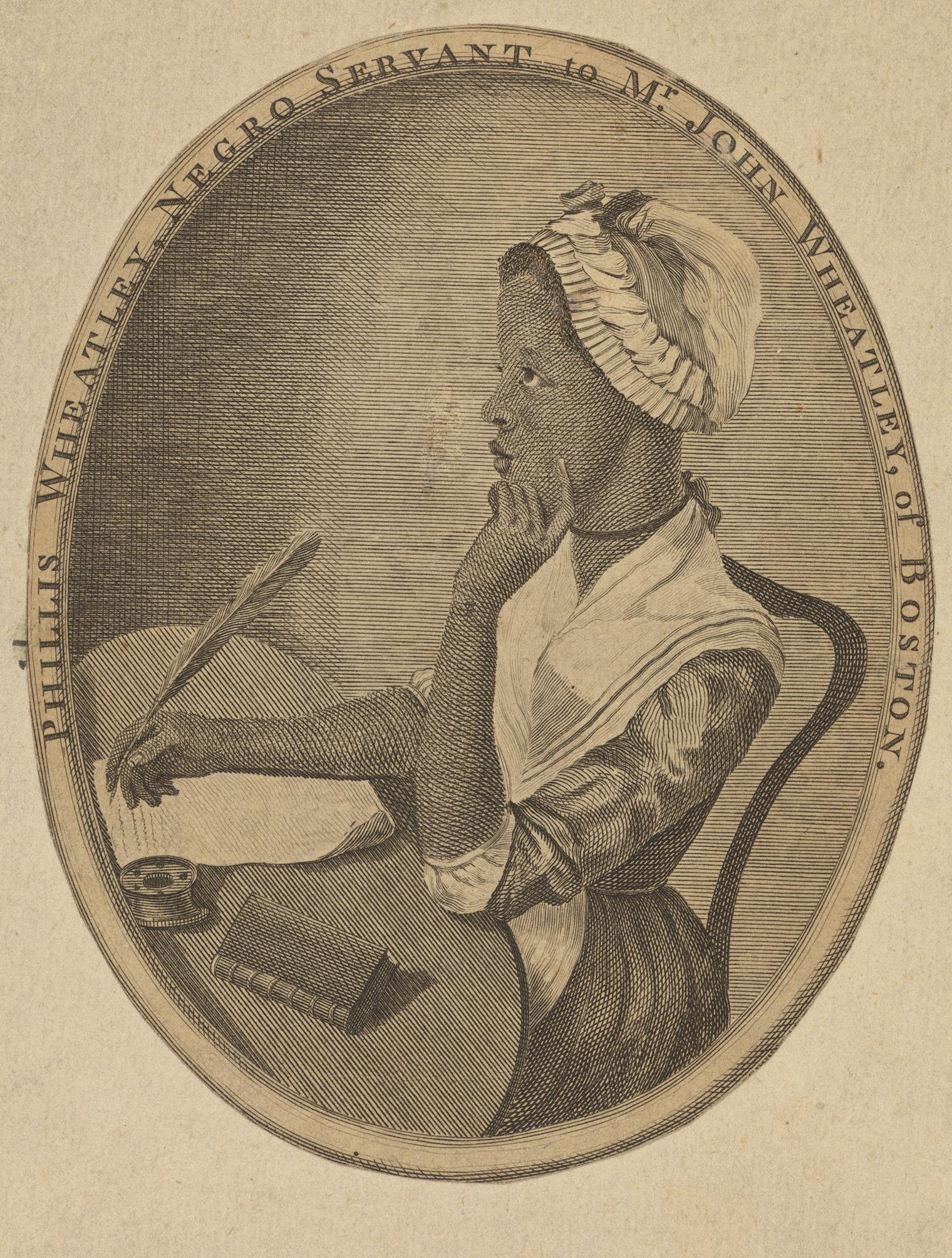
Attributed to Scipio Moorhead (active 1760–75). Phillis Wheatley, 1773. Engraving, 5 in. × 3 7/8 in. (12.7 × 9.8 cm). The Metropolitan Museum of Art, New York, NY, The Elisha Whittelsey Collection, The Elisha Whittelsey Fund, 1949 (49.40.24)
In 1770, the young Black poet Phillis Wheatley lived one block from the Custom House on King Street. While her poems do not mention the Boston Massacre, one does respond to the Stamp Act: it praises George III for supporting the act’s repeal, then appeals for general emancipation. Enslaved as a child by a Boston merchant family, her mistress, Susanna, encouraged Phillis’s writing. Susanna sought support from a British patron, Selena Hastings, Countess of Huntington, who helped bring a collection of Phillis’s work titled Poems on Various Subjects, Religious and Moral (1773) to press. It became the first published book by an African American author.
The countess suggested that this frontispiece portrait be added to enhance the volume, and it may have been designed by Scipio Moorhead, a Black enslaved Bostonian artist whom the author admired. Wheatley is presented as literate and thoughtful, while her modest attire and the border text remind us of her enslaved status. The author traveled to London from May through July 1773 to promote her work and was received as a celebrity. Before the second printing of her volume went on sale in Boston in the spring of 1774, pressure from British abolitionists helped secure her freedom.
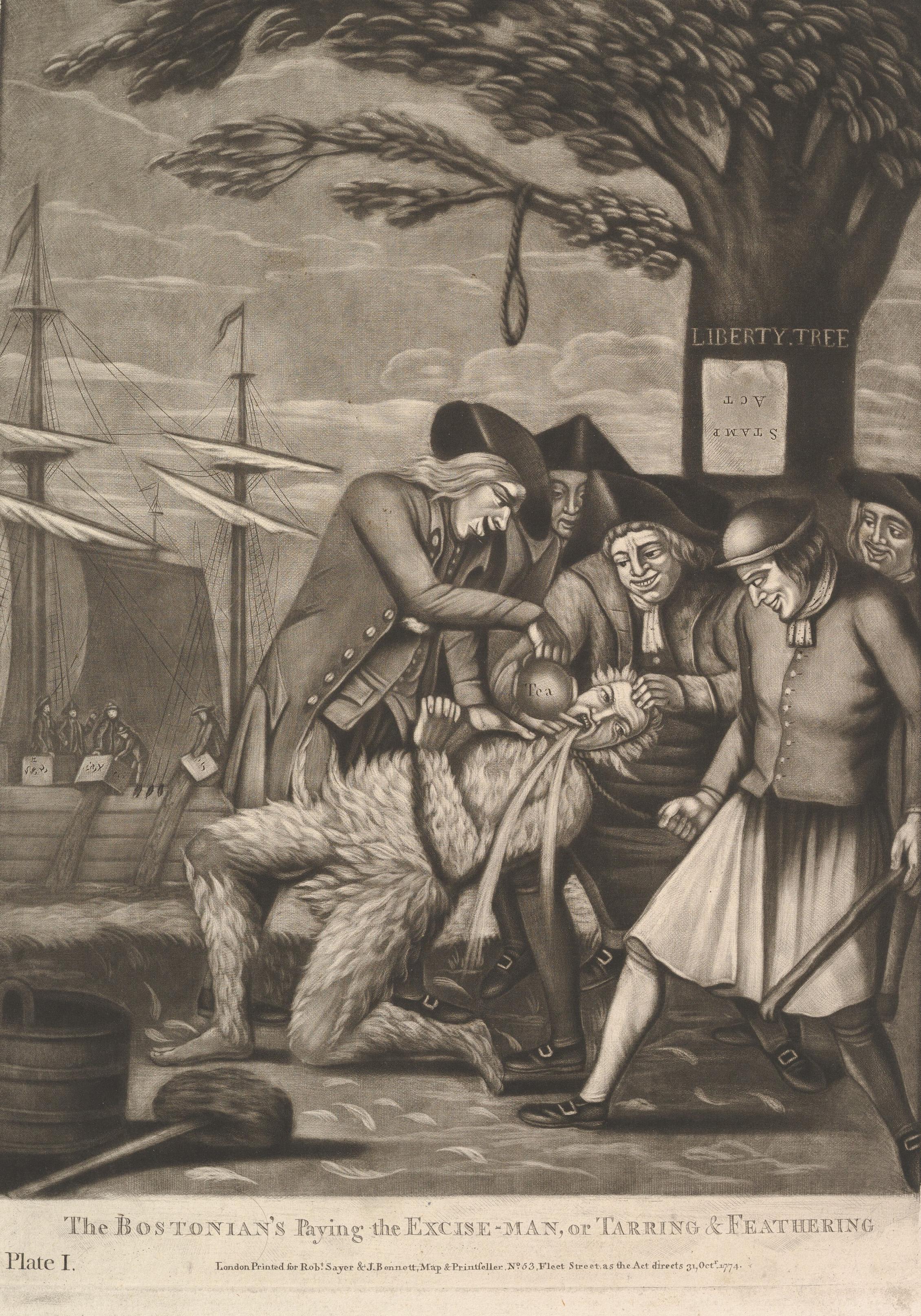
Attributed to Philip Dawe (ca. 1745–1809?). The Bostonians Paying the Excise-Man, or Tarring & Feathering, 1774. Mezzotint and etching, published London by Robert Sayer and John Bennett, 14 in. × 10 1/8 in. (35.6 × 25.7 cm). The Metropolitan Museum of Art, New York, NY, Bequest of Charles Allen Munn, 1924 (24.90.32)
Incidents of colonial protest reported in London newspapers prompted the adept British satirist Philip Dawe to respond with a series of mezzotints between 1774–75. The first centers on Boston after the Tea Act of 1773 and includes an early representation of the Boston Tea Party on the composition’s left in the background, where local Sons of Liberty dumped tons of East India Company cargo into the harbor in December 1773. On the right in the foreground is the January 1774 attack on a loyalist customs agent, John Malcolm, whose violent harassment of locals eventually provoked harsh retaliation. Here, he appears tarred and feathered—an American form of punishment that fascinated Britons—forced to guzzle tea and threatened with hanging. Behind, an upended copy of the Stamp Act has been nailed to the Liberty Tree, a site near Boston Common where patriots met, which the artist placed here by the waterfront.
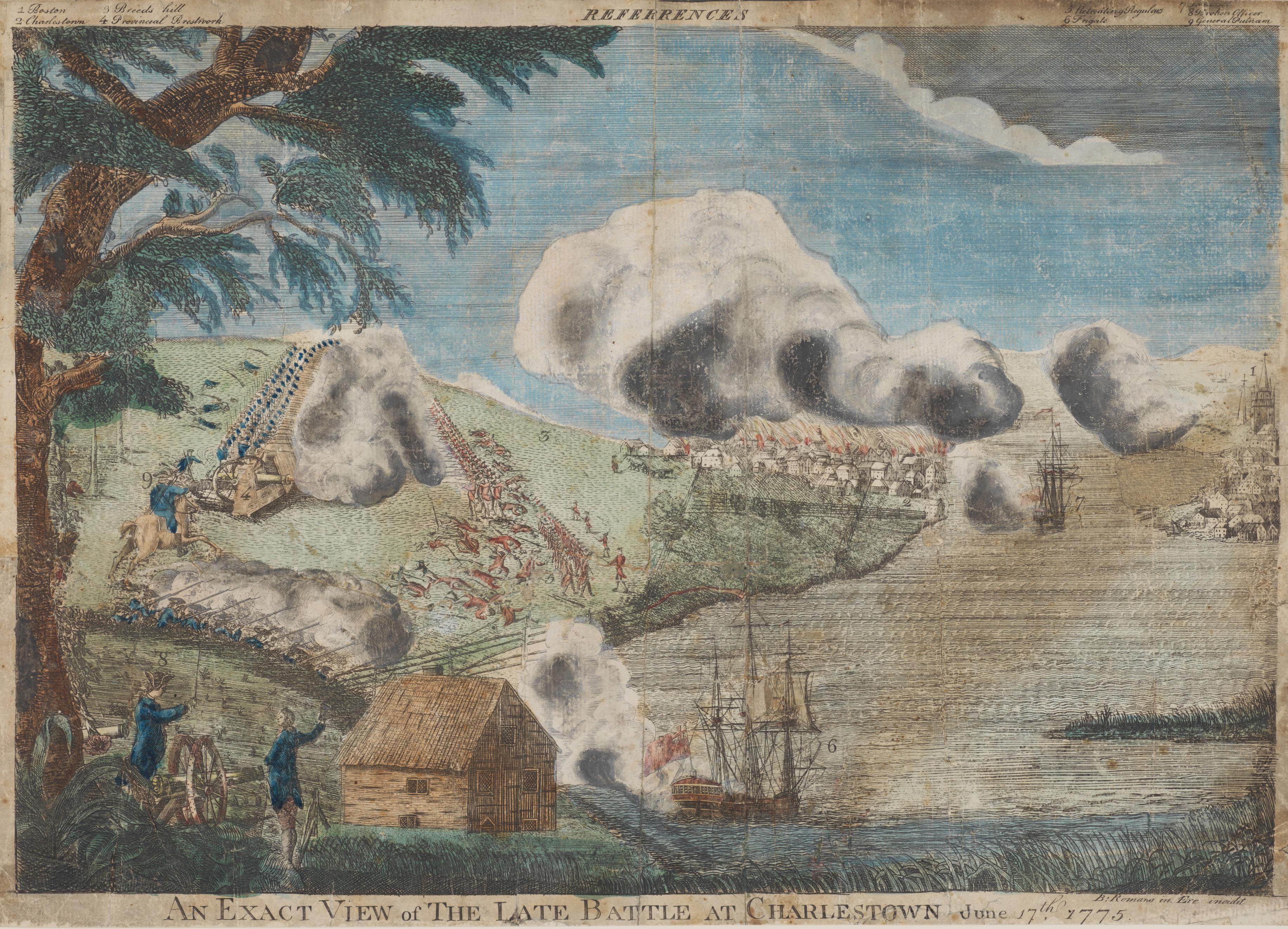
Bernard Romans (1720–1784), An Exact View of the Late Battle at Charlestown, June 17, 1775, ca. 1775. Hand-colored engraving, 11 7/8 × 16 5/8 in. (30.1 × 42.2 cm). The Metropolitan Museum of Art, New York, NY, Bequest of Charles Allen Munn, 1924 (24.90.46)
As one of the few American prints made during the war, this work describes the Battle of Bunker Hill, fought north of Boston Harbor above Charlestown. The Dutch-born Bernard Romans had trained in England as a cartographer and printmaker, then worked in the colonies before joining the patriot cause. As an eyewitness to this conflict, he later produced a panoramic composition that details two armies fiercely engaged. 1,500 American soldiers (shown in blue) held the high ground until their ammunition and powder ran out. Their tenacity and bravery astounded the 2,400 British troops (shown in red), who assumed that their superior numbers and training would lead to an easy victory. The many fallen redcoats shown here underscore the heavy British losses.
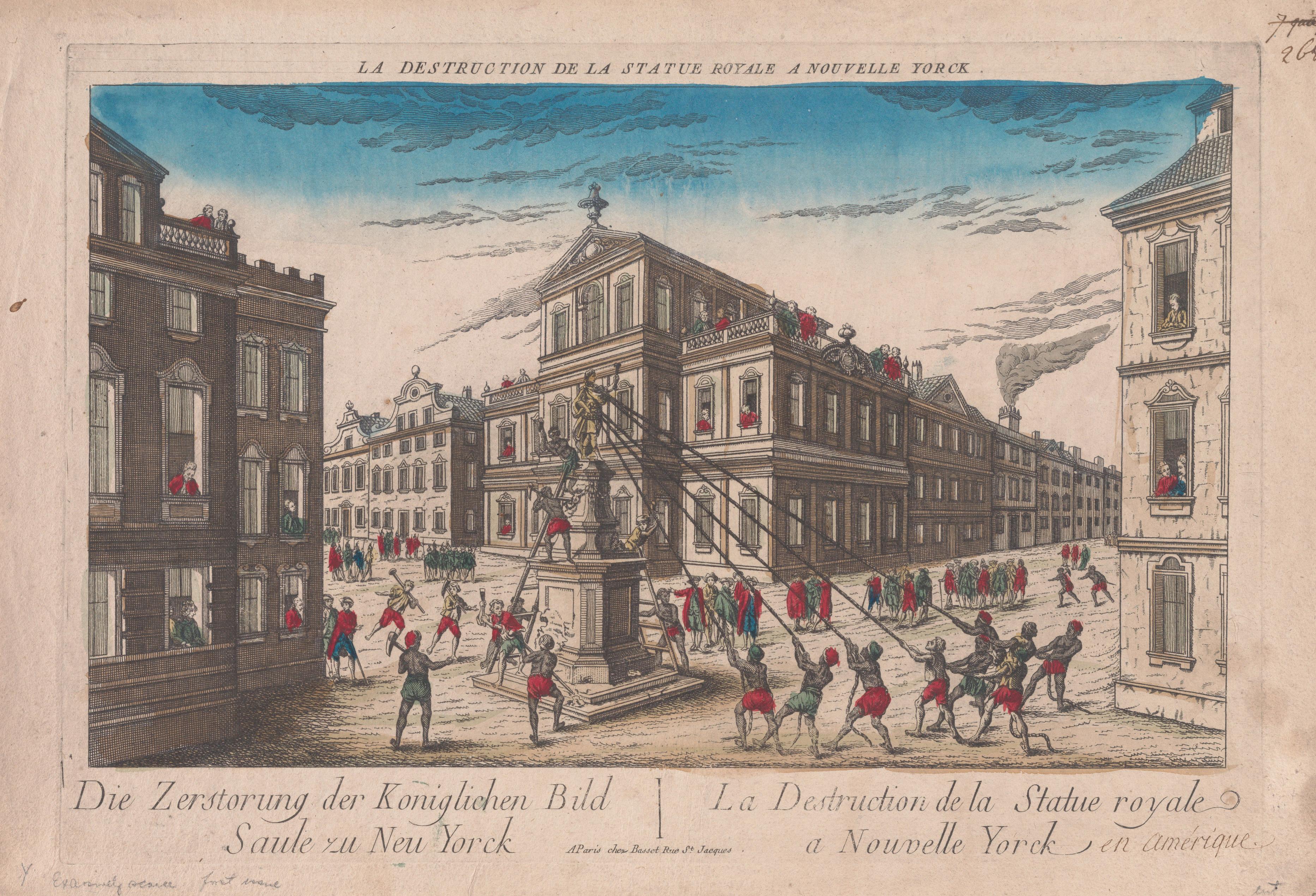
Anonymous French, 18th century, after Franz Xavier Habermann (German, 1721–1796), The Destruction of the Royal Statue at New York on July 9, 1776, ca. 1776. Hand-colored etching and engraving, 9 in. × 15 3/16 in. (22.8 × 38.5 cm). The Metropolitan Museum of Art, New York, NY, The Edward W. C. Arnold Collection of New York Prints, Maps and Pictures, Gift of Edward W. C. Arnold, 1954 (54.90.1418)
Vues d’optiques, or perspective views, issued in Augsburg and Paris, helped Europeans to imagine events unfolding across the Atlantic. This example shows a statue of George III that was erected at Bowling Green in Lower Manhattan in 1770. When the Declaration was read out to George Washington’s troops on July 9, 1776, patriots and soldiers moved down Broadway to topple that symbol of royal authority, with enslaved Black men shown here performing most of the labor. The statue was later melted down to make bullets. Inhabitants of princely European states would have been shocked by this image and probably overlooked inaccuracies such as the architecture, which resembles a contemporary German city more than Anglo-Dutch New York, or the fact that the statue actually depicted the king on horseback.
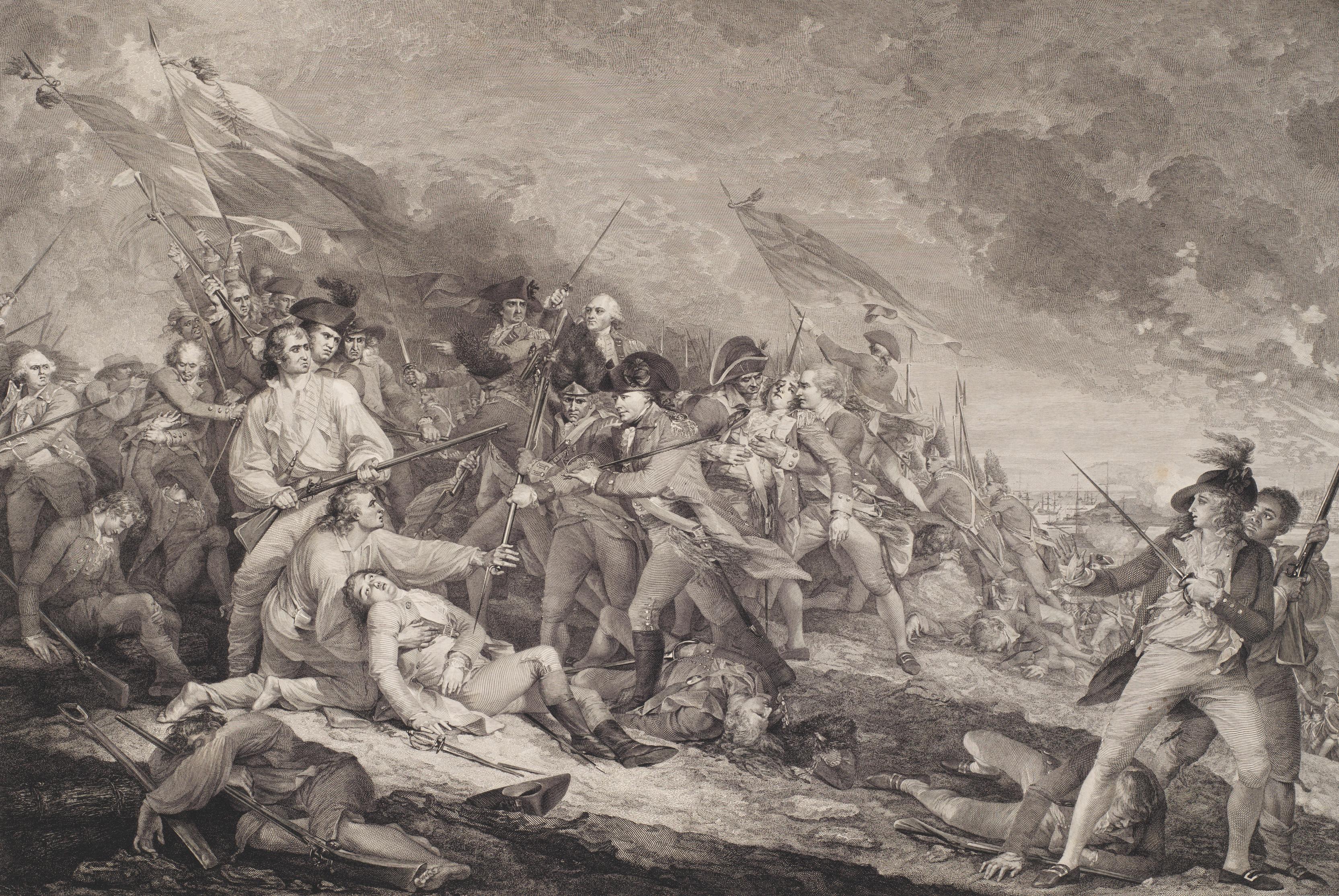
Johann Gotthard Müller (1747–1830), after John Trumbull (1756–1843). The Battle of Bunker’s Hill (June 17, 1775), 1788–98. Engraving, second state of seven, 19 13/16 × 29 5/8 in. (50.3 × 75.2 cm). The Metropolitan Museum of Art, New York, NY, Bequest of Charles Allen Munn, 1924 (24.90.1315)
Once Britain and the United States made peace in 1783, artists chose key moments in the Revolutionary War to produce celebratory images. John Trumbull, then studying painting in London, produced battle scenes to highlight American heroism and military sacrifice, including The Battle of Bunker Hill (1786). Trumbull’s painting differs radically from Bernard Romans conception; the composition focuses on the tragic death of the young patriot doctor General Joseph Warren, who joined foot soldiers in the front line and was fatally wounded as the British breached the hill. In an approach shaped by the ideals of history painting, the artist depicted a British general demonstrating compassion towards the fallen Warren. Since engravings at this scale could not yet be made in the United States, the skilled London-based engraver Johann Gotthard Müller created this print based on the artist’s painting.
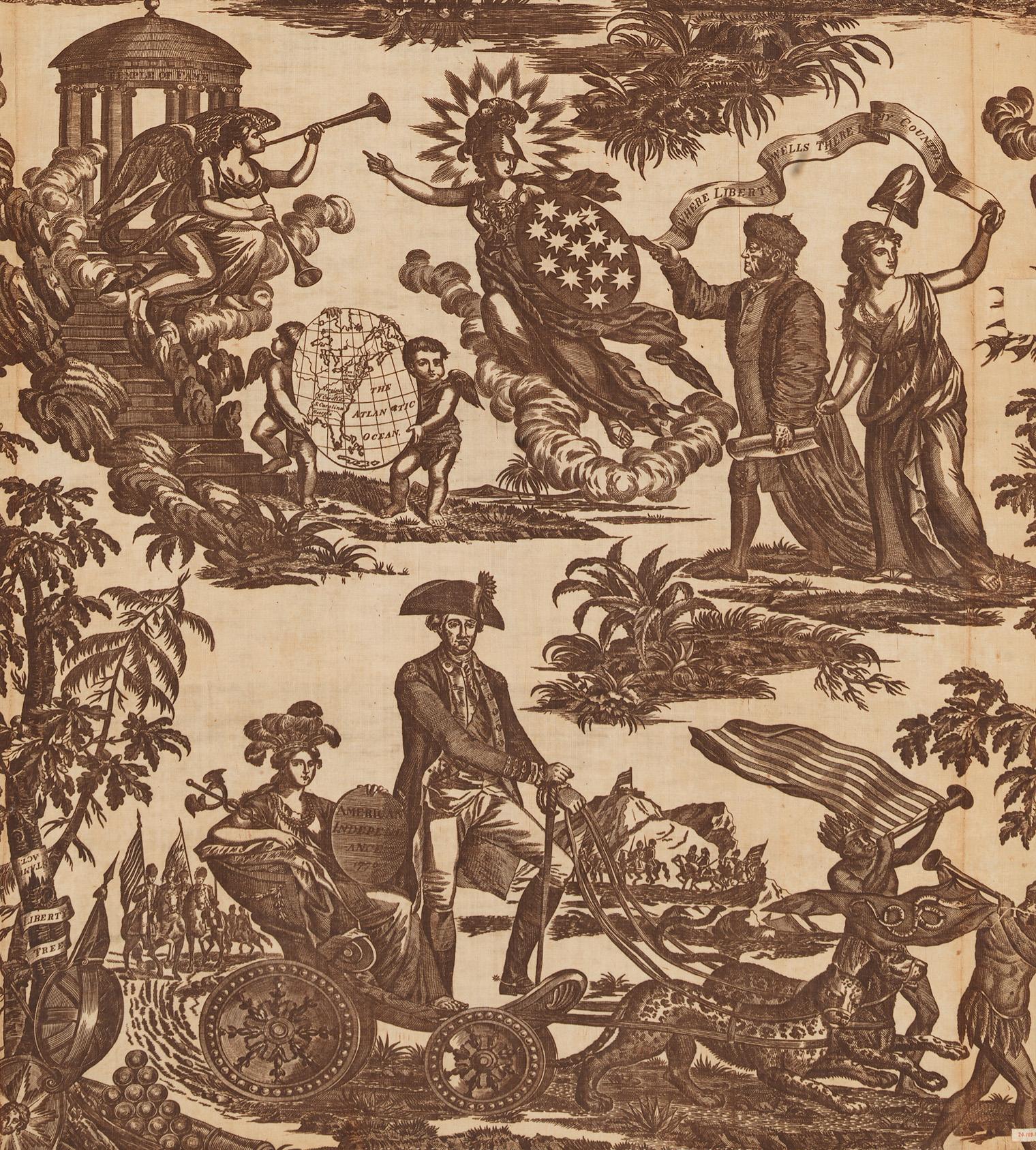
Apotheosis of Franklin (detail), ca. 1790. Cotton and linen, L. 85 1/2 x w. 31 inches (as now mounted) (217.2 x 78.7 cm) Framed: H. 75 1/2 x W. 31 inches (191.8 x 78.7 cm). The Metropolitan Museum of Art, New York, NY, Bequest of Charles Allen Munn, 1924 (24.109.104)
The peace between nations allowed British textile manufacturers to resume production for the American market, and this example honors Benjamin Franklin’s death in 1790. Dressed in his signature fur cap, the founding father is guided to a temple of fame by embodiments of Liberty and America. Below, George Washington drives Liberty in a chariot—to recognize his achievements and honor his recent voluntary resignation from the presidency, which sealed his reputation on both sides of the Atlantic. Citizens of the new United States used this fabric to fashion bed curtains and upholster furniture. The imagery demonstrates how, after the crisis of war, artists and printmakers conceived idealized images that still shape our conception of the Revolutionary era.
This essay is published in conjunction with the exhibition Revolution!, on view through September 7, 2026.


