Necklace beads
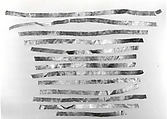
When excavated at Ur, beads were rarely discovered in an undisturbed state, since they had been originally strung together using organic material that has long since disintegrated. Thus, it is not certain in which order the beads were originally strung. These strands consist of biconical shaped beads. They are strung in groups of three gold sheets and six lapis lazuli beads, ending with one of gold and three of lapis. Their repetition gives a sense of rich contrasting color within the highly uniform Sumerian artistic system. It is possible that the different materials held particular meanings, since later texts describe their amuletic and magical properties. They certainly evoked distant lands because none of them are native to southern Mesopotamia and indicate the importance of long-distance connections in the acquisition of precious materials. The lapis lazuli would have originated in the Badakhshan region of Afghanistan and the gold reached Mesopotamia from a number of possible directions since there were ancient sources in Iran, Anatolia, and even as far away as Egypt.
Artwork Details
- Title: Necklace beads
- Period: Early Dynastic IIIa
- Date: ca. 2600–2500 BCE
- Geography: Mesopotamia, Ur (modern Tell al-Muqayyar)
- Culture: Sumerian
- Medium: Gold, lapis lazuli
- Dimensions: L. 54 cm
- Credit Line: Dodge Fund, 1933
- Object Number: 33.35.48
- Curatorial Department: Ancient West Asian Art
More Artwork
Related Content

Research Resources
The Met provides unparalleled resources for research and welcomes an international community of students and scholars. The Met's Open Access API is where creators and researchers can connect to the The Met collection. Open Access data and public domain images are available for unrestricted commercial and noncommercial use without permission or fee.
To request images under copyright and other restrictions, please use this Image Request form.
Feedback
We continue to research and examine historical and cultural context for objects in The Met collection. If you have comments or questions about this object record, please contact us using the form below. The Museum looks forward to receiving your comments.
Content Notice
The Metropolitan Museum of Art presents over 5,000 years of art from around the world, and our online collection reflects ongoing work conducted over the course of our more than 150-year history. You may encounter objects or images that may be inappropriate for some viewers or information that may be outdated.