Mary Shelley (1797–1851)
Here, the Italian neoclassicist Camillo Pistrucci uses the imposing genre of the white marble portrait bust to present Shelley in the grand manner of a virtuoso. Balancing the rhythmic forms of the face and drapery with the dazzling details of her sweeping Victorian hairstyle, Pistrucci achieves a precision and finesse that betrays the influence of his father, Benedetto, the unrivaled cameo carver. The artist carved the bust in Rome in the year of Shelley’s Italian sojourn.
Artwork Details
- Title: Mary Shelley (1797–1851)
- Artist: Camillo Pistrucci (Italian, 1811–1854)
- Date: 1843
- Culture: Italian
- Medium: Marble
- Dimensions: wt. confirmed: 25 3/8 in., 107 lb. (64.5 cm, 48.5 kg)
- Classification: Sculpture-Marble
- Credit Line: Purchase, Wrightsman Fellows Gifts, 2019
- Object Number: 2019.341
- Curatorial Department: European Sculpture and Decorative Arts
Audio
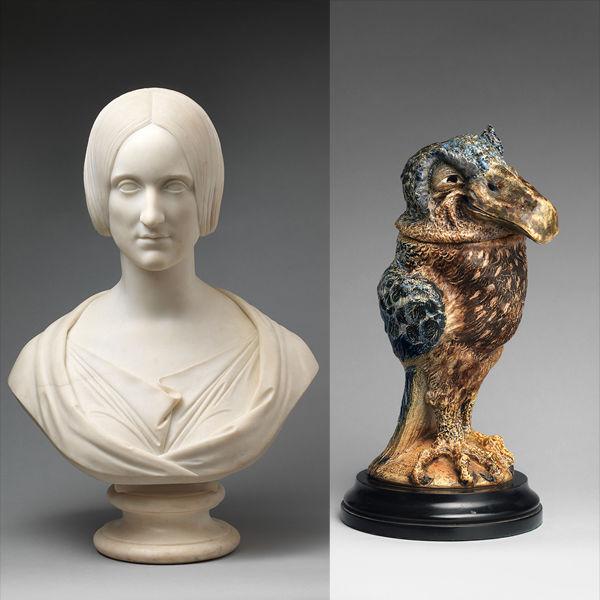
420. The Bust of Mary Shelley and the Martin Brothers Bird Jar
Gallery 516
NARRATOR: Your tour of these galleries began a portrait by an Italian’ craftsman; it was of a bishop who defended the Catholic Church. Similarly, this marble bust is also by an émigré Italian artist–a portrait of the author Mary Shelley.
WOLF BURCHARD: British art cannot be seen in isolation. What's so striking about this bust is that it's really acts as a bookend in combination with the Torrigiano bust of John Fisher.
NARRATOR: Mary Shelley was the author of the gothic novel, Frankenstein, about an "ungodly" creature born of modern technology. The story encapsulated a common, uneasy feeling: what was the modern world coming to? Today, new design and technology continue to give us pause: When the unthinkable becomes possible, what happens next?
If you peek around the corner to the threshold of this gallery, you’ll find a case along the right-hand wall: the final object on this audio tour. Inside, is a "grotesque" creature staring back at you: a jar in the shape of a bird. It blends the “gothic” with an Arts and Crafts ethos. It’s not a medieval gargoyle: it's a totally functional cookie jar. Ceramicist Kate Malone:
KATE MALONE: The character is just gorgeous. Is it funny, is it silly? No. Is he what, is, is he scary? I don't know. It's sort of on the edge, and the Martin Brothers were brilliant at that. So the wonderful Martin Brothers bird jar is obviously in two pieces, 'cause it's got a lid and a body. The core piece would have been modeled with soft clay and then cut out, probably hollowed, and then things like the eyes, and the beak, and the feathers pinched with their fingers, and smoothed with sponges, and their thumbs. There's joy in the making.
There's a sort of fine line between ugly, funny, satirical, I mean, the Martin Brothers bird looks as though he's, he's looking at the viewer and criticizing them.
WOLF BURCHARD: What I think this object illustrates is that decorative arts are primarily made for joy and entertainment. In these galleries, we've been looking at a variety of objects through a very serious lens, which of course is extremely important. But this bird's cheeky smile suggests that for all the complex—and at times traumatic—political and economic subjects that inform the works exhibited in these galleries, decorative arts are frequently designed simply to delight and entertain. And apart from being historically fascinating, beautiful, or sometimes practical, these objects can also be fun, quirky, and even a little eccentric.
More Artwork
![La Basilica di San Marco in Venezia illustrata nella storia e nell'arte da scrittori veneziani : [volume 3], Camillo Boito](https://images.metmuseum.org/CRDImages/li/web-additional/b1240450_002.jpg)
Related Content
 Free to download
Research Resources
The Met provides unparalleled resources for research and welcomes an international community of students and scholars. The Met's Open Access API is where creators and researchers can connect to the The Met collection. Open Access data and public domain images are available for unrestricted commercial and noncommercial use without permission or fee.
To request images under copyright and other restrictions, please use this Image Request form.
Feedback
We continue to research and examine historical and cultural context for objects in The Met collection. If you have comments or questions about this object record, please contact us using the form below. The Museum looks forward to receiving your comments.
Content Notice
The Metropolitan Museum of Art presents over 5,000 years of art from around the world, and our online collection reflects ongoing work conducted over the course of our more than 150-year history. You may encounter objects or images that may be inappropriate for some viewers or information that may be outdated.