Drop-front secretary (Secrétaire en armoire)
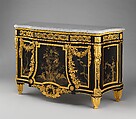
The history of these famous pieces of furniture is remarkably well documented. Marie-Antoinette frequently changed the decor of her private rooms, and in 1787 she had the commode and secretary sent from Versailles to her new summer palace at Saint-Cloud. Both pieces left the royal collections when they were given in lieu of payment for his services during the Revolution to Abraham Alcan, a contractor of supplies for the army of the Rhine and Moselle. During the nineteenth century, the queen's secretary and commode were part of several notable British collections. George Watson Taylor (1770 - 1841) kept them at his country house, Erlestoke Park, in Wiltshire, and later they belonged to the dukes of Hamilton. At the famous Hamilton Palace sale of 1882 the royal pieces were acquired for Mrs. William Kissam Vanderbilt (1853 - 1933 ), one of the reigning society hostesses of New York City, for her mansion on Fifth Avenue. Her daughter Consuelo Vanderbilt Balsan (1877 - 1964) remembered Marie-Antoinette's lacquer secretaire and commode standing in the white drawing room, which was hung with a set of Boucher tapestries. [2]
Footnotes
1. Mercy-Argenteau 1770 . 80 .1874, vol. 1, p. 75.
2. Balsan 1952, p. 11.
Artwork Details
- Title: Drop-front secretary (Secrétaire en armoire)
- Maker: Jean Henri Riesener (French, Gladbeck, North Rhine-Westphalia 1734–1806 Paris)
- Date: 1783
- Culture: French, Paris
- Medium: Oak veneered with ebony and 17th-century Japanese lacquer; interiors veneered with tulipwood, amaranth, holly, and ebonized holly; gilt-bronze mounts; marble top; velvet (not original)
- Dimensions: Overall: 57 × 43 × 16 in. (144.8 × 109.2 × 40.6 cm);
Length (key): 3 5/8 in. (9.2 cm) - Classification: Woodwork-Furniture
- Credit Line: Bequest of William K. Vanderbilt, 1920
- Object Number: 20.155.11
- Curatorial Department: European Sculpture and Decorative Arts
More Artwork
Related Content
Research Resources
The Met provides unparalleled resources for research and welcomes an international community of students and scholars. The Met's Open Access API is where creators and researchers can connect to the The Met collection. Open Access data and public domain images are available for unrestricted commercial and noncommercial use without permission or fee.
To request images under copyright and other restrictions, please use this Image Request form.
Feedback
We continue to research and examine historical and cultural context for objects in The Met collection. If you have comments or questions about this object record, please contact us using the form below. The Museum looks forward to receiving your comments.
Content Notice
The Metropolitan Museum of Art presents over 5,000 years of art from around the world, and our online collection reflects ongoing work conducted over the course of our more than 150-year history. You may encounter objects or images that may be inappropriate for some viewers or information that may be outdated.