皇太后のペンダント・マスク
Artwork Details
- 題: 皇太后のペンダント・マスク
- 月日: 16世紀
- 地理: ナイジェリア、ベニン王国
- 文化: エド族
- 手法: 象牙、鉄、銅(?)
- 寸法: 23.8 x 12.7 x 8.3 cm
- 提供者: マイケル C. ロックフェラー記念コレクション、ネルソン A. ロックフェラー寄贈、1972年
- 受け入れ番号: 1978.412.323
- Curatorial Department: The Michael C. Rockefeller Wing
Audio
114. The Director's Tour, First Floor: Queen Mother Pendant Mask: Iyoba
Gallery 103
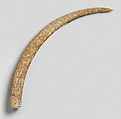
This finely carved ivory mask comes from the kingdom of Benin, in present-day Nigeria. It is the idealized female face of a specific individual. We’ve seen other portraits of women today, in the Lehman Wing, and this representation has some parallels and many differences.
We’re looking at a portrait of Idia, the mother of King Esigie, who commissioned it in the early 1500s. King Esigie faced many challenges in his reign, and Idia was his most trusted advisor. He honored her by establishing the title of Queen Mother, empowered her equally with other senior male chiefs, and immortalized her through a series of remarkable portraits like this one. This image captures her virtues rather than just recording her appearance; the composure of the face, in particular, seems to reflect her wisdom and strength. Look, too, at the detail of her tiara-like arrangements of locks of hair; alternately rendered as miniature Portuguese merchants and stylized mudfish. As a creature that exists on both land and water, the mudfish is a metaphor for kingship’s dual nature: human and divine.
But this object was more than a depiction of an idealized person. It was a protective amulet worn as a pendant—part of the king’s ceremonial dress during state rituals.
In the cases nearby are works of African art: sculpture, metalwork, masks, and ritual objects in a variety of materials from cultures that span the continent. As you look around, pay attention to the functions of these objects as well as their aesthetic qualities. You’ll find that many offer a glimpse into a culture’s way of life, and a community’s most deeply held principles and beliefs.
Keep in mind that great art is often produced in conjunction with the end of life. And our next stop takes us back in time to classical antiquity and to another part of the world entirely. Refer to your map for directions.
Listen to more about this artwork
More Artwork
Related Content
Research Resources
The Met provides unparalleled resources for research and welcomes an international community of students and scholars. The Met's Open Access API is where creators and researchers can connect to the The Met collection. Open Access data and public domain images are available for unrestricted commercial and noncommercial use without permission or fee.
To request images under copyright and other restrictions, please use this Image Request form.
Feedback
We continue to research and examine historical and cultural context for objects in The Met collection. If you have comments or questions about this object record, please contact us using the form below. The Museum looks forward to receiving your comments.
Content Notice
The Metropolitan Museum of Art presents over 5,000 years of art from around the world, and our online collection reflects ongoing work conducted over the course of our more than 150-year history. You may encounter objects or images that may be inappropriate for some viewers or information that may be outdated.